

5.6 Monatomic Solids
247
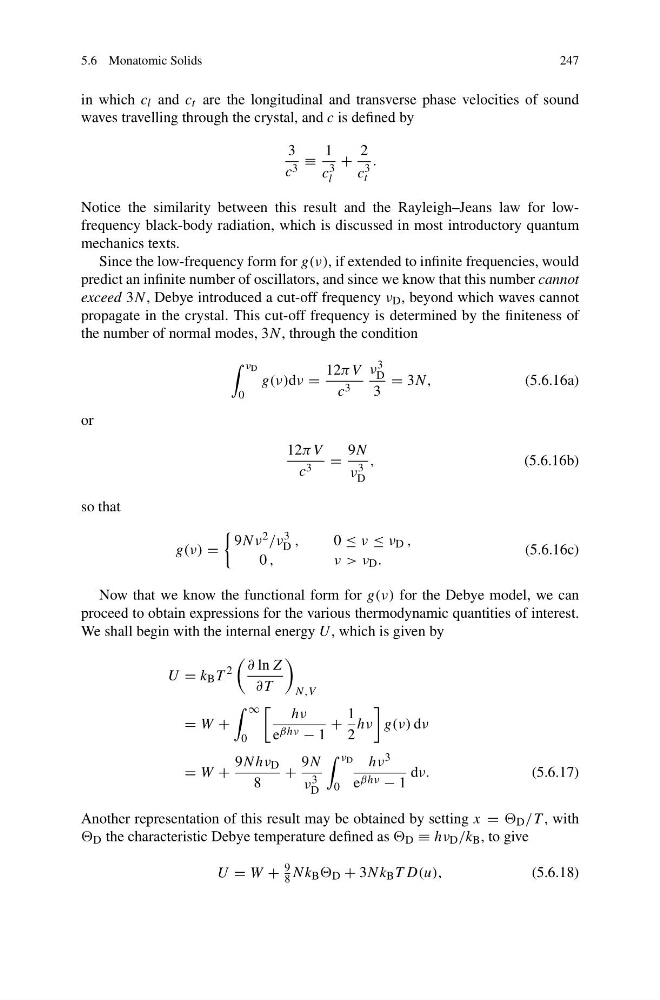
in which c l and c t are the longitudinal and transverse phase velocities of sound
waves travelling through the crystal, and c is defined by
3
c 3 ≡
1
c 3
l
+
2
c 3
t
.
Notice the similarity between this result and the Rayleigh–Jeans law for lowfrequency black-body radiation, which is discussed in most introductory quantum
mechanics texts.
Since the low-frequency form for g(ν), if extended to infinite frequencies, would
predict an infinite number of oscillators, and since we know that this number cannot
exceed 3N , Debye introduced a cut-off frequency ν D , beyond which waves cannot
propagate in the crystal. This cut-off frequency is determined by the finiteness of
the number of normal modes, 3N, through the condition
ν D
0
g(ν)dν =
12πV
c 3
ν 3
D
3
= 3N,
(5.6.16a)
or
12πV
c 3 =
9N
ν 3
D
,
(5.6.16b)
so that
g(ν) =
9Nν 2 /ν 3
D ,
0 ≤ ν ≤ ν D ,
0 ,
ν>ν D .
(5.6.16c)
Now that we know the functional form for g(ν) for the Debye model, we can
proceed to obtain expressions for the various thermodynamic quantities of interest.
We shall begin with the internal energy U , which is given by
U = k B T
2
∂ ln Z
∂T
N,V
= W +
∞
0
hν
e βhν − 1
+
1
2
hν
g(ν) dν
= W +
9Nhν D
8
+
9N
ν 3
D
ν D
0
hν 3
e βhν − 1
dν.
(5.6.17)
Another representation of this result may be obtained by setting x = D /T , with
D the characteristic Debye temperature defined as D ≡ hν D /k B , to give
U = W +
9
8 Nk B D + 3Nk B T D(u),
(5.6.18)
247
in which c l and c t are the longitudinal and transverse phase velocities of sound
waves travelling through the crystal, and c is defined by
3
c 3 ≡
1
c 3
l
+
2
c 3
t
.
Notice the similarity between this result and the Rayleigh–Jeans law for lowfrequency black-body radiation, which is discussed in most introductory quantum
mechanics texts.
Since the low-frequency form for g(ν), if extended to infinite frequencies, would
predict an infinite number of oscillators, and since we know that this number cannot
exceed 3N , Debye introduced a cut-off frequency ν D , beyond which waves cannot
propagate in the crystal. This cut-off frequency is determined by the finiteness of
the number of normal modes, 3N, through the condition
ν D
0
g(ν)dν =
12πV
c 3
ν 3
D
3
= 3N,
(5.6.16a)
or
12πV
c 3 =
9N
ν 3
D
,
(5.6.16b)
so that
g(ν) =
9Nν 2 /ν 3
D ,
0 ≤ ν ≤ ν D ,
0 ,
ν>ν D .
(5.6.16c)
Now that we know the functional form for g(ν) for the Debye model, we can
proceed to obtain expressions for the various thermodynamic quantities of interest.
We shall begin with the internal energy U , which is given by
U = k B T
2
∂ ln Z
∂T
N,V
= W +
∞
0
hν
e βhν − 1
+
1
2
hν
g(ν) dν
= W +
9Nhν D
8
+
9N
ν 3
D
ν D
0
hν 3
e βhν − 1
dν.
(5.6.17)
Another representation of this result may be obtained by setting x = D /T , with
D the characteristic Debye temperature defined as D ≡ hν D /k B , to give
U = W +
9
8 Nk B D + 3Nk B T D(u),
(5.6.18)