

246
5 Atomic Systems
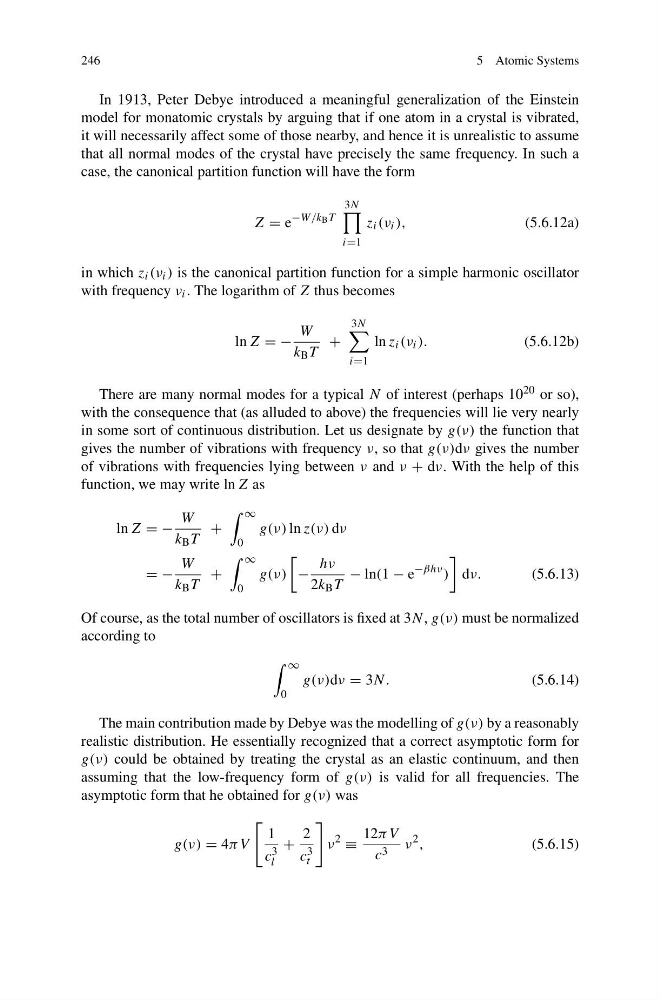
In 1913, Peter Debye introduced a meaningful generalization of the Einstein
model for monatomic crystals by arguing that if one atom in a crystal is vibrated,
it will necessarily affect some of those nearby, and hence it is unrealistic to assume
that all normal modes of the crystal have precisely the same frequency. In such a
case, the canonical partition function will have the form
Z = e
−W/k B T
3N
i=1
z i (ν i ),
(5.6.12a)
in which z i (ν i ) is the canonical partition function for a simple harmonic oscillator
with frequency ν i . The logarithm of Z thus becomes
ln Z = −
W
k B T
+
3N
i=1
ln z i (ν i ).
(5.6.12b)
There are many normal modes for a typical N of interest (perhaps 10 20 or so),
with the consequence that (as alluded to above) the frequencies will lie very nearly
in some sort of continuous distribution. Let us designate by g(ν) the function that
gives the number of vibrations with frequency ν, so that g(ν)dν gives the number
of vibrations with frequencies lying between ν and ν + dν. With the help of this
function, we may write ln Z as
ln Z = −
W
k B T
+
∞
0
g(ν) ln z(ν) dν
= −
W
k B T
+
∞
0
g(ν)
−
hν
2k B T
− ln(1 − e
−βhν )
dν.
(5.6.13)
Of course, as the total number of oscillators is fixed at 3N, g(ν) must be normalized
according to
∞
0
g(ν)dν = 3N.
(5.6.14)
The main contribution made by Debye was the modelling of g(ν) by a reasonably
realistic distribution. He essentially recognized that a correct asymptotic form for
g(ν) could be obtained by treating the crystal as an elastic continuum, and then
assuming that the low-frequency form of g(ν) is valid for all frequencies. The
asymptotic form that he obtained for g(ν) was
g(ν) = 4πV
1
c 3
l
+
2
c 3
t
ν
2
≡
12πV
c 3 ν
2 ,
(5.6.15)
5 Atomic Systems
In 1913, Peter Debye introduced a meaningful generalization of the Einstein
model for monatomic crystals by arguing that if one atom in a crystal is vibrated,
it will necessarily affect some of those nearby, and hence it is unrealistic to assume
that all normal modes of the crystal have precisely the same frequency. In such a
case, the canonical partition function will have the form
Z = e
−W/k B T
3N
i=1
z i (ν i ),
(5.6.12a)
in which z i (ν i ) is the canonical partition function for a simple harmonic oscillator
with frequency ν i . The logarithm of Z thus becomes
ln Z = −
W
k B T
+
3N
i=1
ln z i (ν i ).
(5.6.12b)
There are many normal modes for a typical N of interest (perhaps 10 20 or so),
with the consequence that (as alluded to above) the frequencies will lie very nearly
in some sort of continuous distribution. Let us designate by g(ν) the function that
gives the number of vibrations with frequency ν, so that g(ν)dν gives the number
of vibrations with frequencies lying between ν and ν + dν. With the help of this
function, we may write ln Z as
ln Z = −
W
k B T
+
∞
0
g(ν) ln z(ν) dν
= −
W
k B T
+
∞
0
g(ν)
−
hν
2k B T
− ln(1 − e
−βhν )
dν.
(5.6.13)
Of course, as the total number of oscillators is fixed at 3N, g(ν) must be normalized
according to
∞
0
g(ν)dν = 3N.
(5.6.14)
The main contribution made by Debye was the modelling of g(ν) by a reasonably
realistic distribution. He essentially recognized that a correct asymptotic form for
g(ν) could be obtained by treating the crystal as an elastic continuum, and then
assuming that the low-frequency form of g(ν) is valid for all frequencies. The
asymptotic form that he obtained for g(ν) was
g(ν) = 4πV
1
c 3
l
+
2
c 3
t
ν
2
≡
12πV
c 3 ν
2 ,
(5.6.15)