

5.6 Monatomic Solids
245
for the thermodynamic pressure, but we cannot readily obtain an expression for
P , or for the equation of state for the monatomic crystal in this direct fashion,
because both W and ν E are functions of the particle density N/V , and we would
therefore need to know explicitly how these quantities depend upon the volume V .
This difficulty in obtaining an appropriate expression for P means that it will be
equally difficult in principle to obtain proper expressions for the thermodynamic
state functions G = A + P V and H = U + P V . However, as the vapour pressure
for crystals is normally extremely small, so that P V A, U , for example, we can
approximate G by A, and H by U . These approximations are normally very good for
crystals. The chemical potential (for a pure substance!) is related to G by G = Nμ,
so that for the Einstein model the chemical potential μ is well approximated by
μ
A
N
=
W
N
+
3
2 k B E + 3k B E ln(1 − e
− E /T ).
(5.6.11)
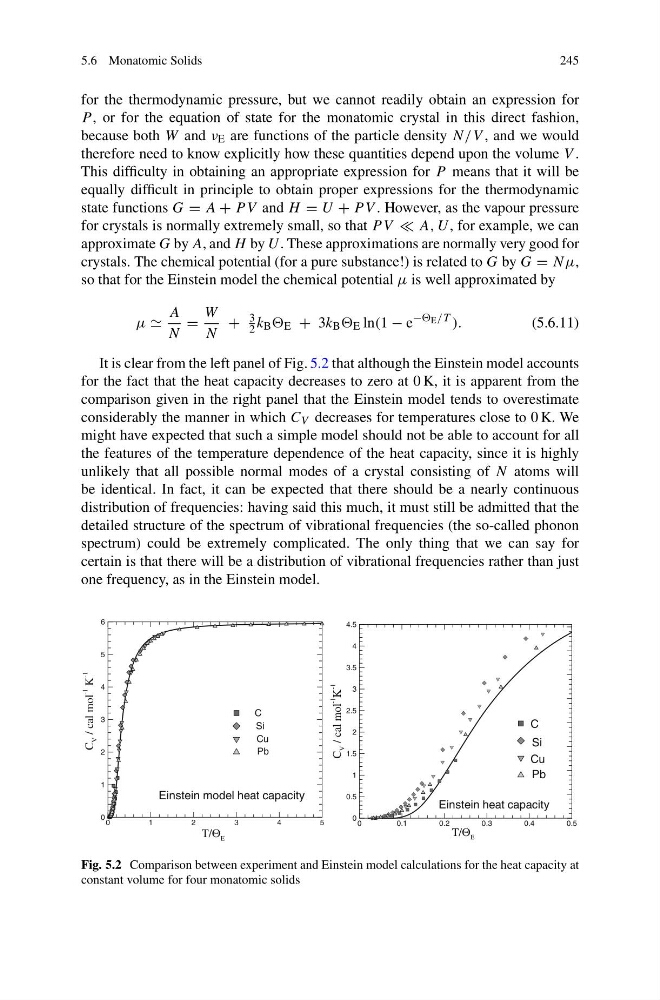
It is clear from the left panel of Fig. 5.2 that although the Einstein model accounts
for the fact that the heat capacity decreases to zero at 0 K, it is apparent from the
comparison given in the right panel that the Einstein model tends to overestimate
considerably the manner in which C V decreases for temperatures close to 0 K. We
might have expected that such a simple model should not be able to account for all
the features of the temperature dependence of the heat capacity, since it is highly
unlikely that all possible normal modes of a crystal consisting of N atoms will
be identical. In fact, it can be expected that there should be a nearly continuous
distribution of frequencies: having said this much, it must still be admitted that the
detailed structure of the spectrum of vibrational frequencies (the so-called phonon
spectrum) could be extremely complicated. The only thing that we can say for
certain is that there will be a distribution of vibrational frequencies rather than just
one frequency, as in the Einstein model.
0
1
2
3
4
5
0
1
2
3
4
5
6
T/Θ E
C
V / cal mol
-1
K
-1
Einstein model heat capacity
C
Si
Cu
Pb
0
0.1
0.2
0.3
0.4
0.5
0
0.5
1
1.5
2
2.5
3
3.5
4
4.5
T/Θ E
C
V
/ cal mol
-1
K
-1
C
Si
Cu
Pb
Einstein heat capacity
Fig. 5.2 Comparison between experiment and Einstein model calculations for the heat capacity at
constant volume for four monatomic solids
245
for the thermodynamic pressure, but we cannot readily obtain an expression for
P , or for the equation of state for the monatomic crystal in this direct fashion,
because both W and ν E are functions of the particle density N/V , and we would
therefore need to know explicitly how these quantities depend upon the volume V .
This difficulty in obtaining an appropriate expression for P means that it will be
equally difficult in principle to obtain proper expressions for the thermodynamic
state functions G = A + P V and H = U + P V . However, as the vapour pressure
for crystals is normally extremely small, so that P V A, U , for example, we can
approximate G by A, and H by U . These approximations are normally very good for
crystals. The chemical potential (for a pure substance!) is related to G by G = Nμ,
so that for the Einstein model the chemical potential μ is well approximated by
μ
A
N
=
W
N
+
3
2 k B E + 3k B E ln(1 − e
− E /T ).
(5.6.11)
It is clear from the left panel of Fig. 5.2 that although the Einstein model accounts
for the fact that the heat capacity decreases to zero at 0 K, it is apparent from the
comparison given in the right panel that the Einstein model tends to overestimate
considerably the manner in which C V decreases for temperatures close to 0 K. We
might have expected that such a simple model should not be able to account for all
the features of the temperature dependence of the heat capacity, since it is highly
unlikely that all possible normal modes of a crystal consisting of N atoms will
be identical. In fact, it can be expected that there should be a nearly continuous
distribution of frequencies: having said this much, it must still be admitted that the
detailed structure of the spectrum of vibrational frequencies (the so-called phonon
spectrum) could be extremely complicated. The only thing that we can say for
certain is that there will be a distribution of vibrational frequencies rather than just
one frequency, as in the Einstein model.
0
1
2
3
4
5
0
1
2
3
4
5
6
T/Θ E
C
V / cal mol
-1
K
-1
Einstein model heat capacity
C
Si
Cu
Pb
0
0.1
0.2
0.3
0.4
0.5
0
0.5
1
1.5
2
2.5
3
3.5
4
4.5
T/Θ E
C
V
/ cal mol
-1
K
-1
C
Si
Cu
Pb
Einstein heat capacity
Fig. 5.2 Comparison between experiment and Einstein model calculations for the heat capacity at
constant volume for four monatomic solids