

244
5 Atomic Systems
U = W +
3
2 Nk B E + 3Nk B E
e − E /T
1 − e − E /T
(5.6.7)
for the internal energy U , from which the heat capacity, C V , at constant volume is
given as
C V = 3Nk B
E
T
2
e − E /T
(1 − e − E /T ) 2 ,
(5.6.8a)
or, equivalently, as
C V = 3Nk B
E /2T
sinh{ E /2T }
2
.
(5.6.8b)
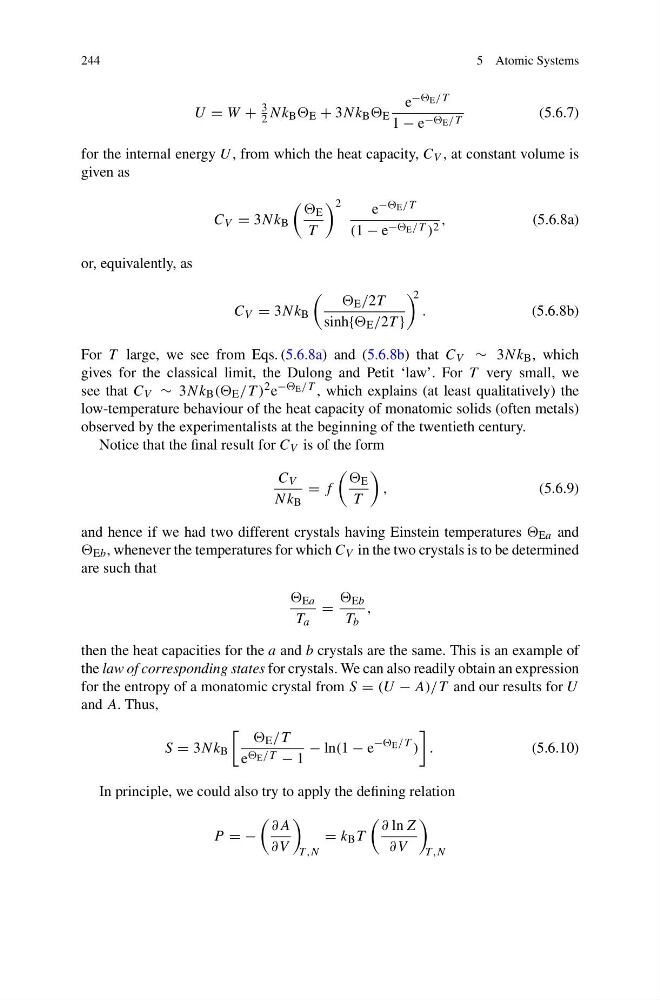
For T large, we see from Eqs. (5.6.8a) and (5.6.8b) that C V ∼ 3Nk B , which
gives for the classical limit, the Dulong and Petit ‘law’. For T very small, we
see that C V ∼ 3Nk B (( E /T ) 2 e − E /T , which explains (at least qualitatively) the
low-temperature behaviour of the heat capacity of monatomic solids (often metals)
observed by the experimentalists at the beginning of the twentieth century.
Notice that the final result for C V is of the form
C V
Nk B
= f
E
T
,
(5.6.9)
and hence if we had two different crystals having Einstein temperatures Ea and
Eb , whenever the temperatures for which C V in the two crystals is to be determined
are such that
Ea
T a
=
Eb
T b
,
then the heat capacities for the a and b crystals are the same. This is an example of
the law of corresponding states for crystals. We can also readily obtain an expression
for the entropy of a monatomic crystal from S = (U − A)/T and our results for U
and A. Thus,
S = 3Nk B
E /T
e E /T − 1
− ln(1 − e
− E /T )
.
(5.6.10)
In principle, we could also try to apply the defining relation
P = −
∂A
∂V
T ,N
= k B T
∂ ln Z
∂V
T ,N
5 Atomic Systems
U = W +
3
2 Nk B E + 3Nk B E
e − E /T
1 − e − E /T
(5.6.7)
for the internal energy U , from which the heat capacity, C V , at constant volume is
given as
C V = 3Nk B
E
T
2
e − E /T
(1 − e − E /T ) 2 ,
(5.6.8a)
or, equivalently, as
C V = 3Nk B
E /2T
sinh{ E /2T }
2
.
(5.6.8b)
For T large, we see from Eqs. (5.6.8a) and (5.6.8b) that C V ∼ 3Nk B , which
gives for the classical limit, the Dulong and Petit ‘law’. For T very small, we
see that C V ∼ 3Nk B (( E /T ) 2 e − E /T , which explains (at least qualitatively) the
low-temperature behaviour of the heat capacity of monatomic solids (often metals)
observed by the experimentalists at the beginning of the twentieth century.
Notice that the final result for C V is of the form
C V
Nk B
= f
E
T
,
(5.6.9)
and hence if we had two different crystals having Einstein temperatures Ea and
Eb , whenever the temperatures for which C V in the two crystals is to be determined
are such that
Ea
T a
=
Eb
T b
,
then the heat capacities for the a and b crystals are the same. This is an example of
the law of corresponding states for crystals. We can also readily obtain an expression
for the entropy of a monatomic crystal from S = (U − A)/T and our results for U
and A. Thus,
S = 3Nk B
E /T
e E /T − 1
− ln(1 − e
− E /T )
.
(5.6.10)
In principle, we could also try to apply the defining relation
P = −
∂A
∂V
T ,N
= k B T
∂ ln Z
∂V
T ,N