

5.6 Monatomic Solids
243
ν osc =
1
2π
f
m
= ν osc
V
N
,
(5.6.2)
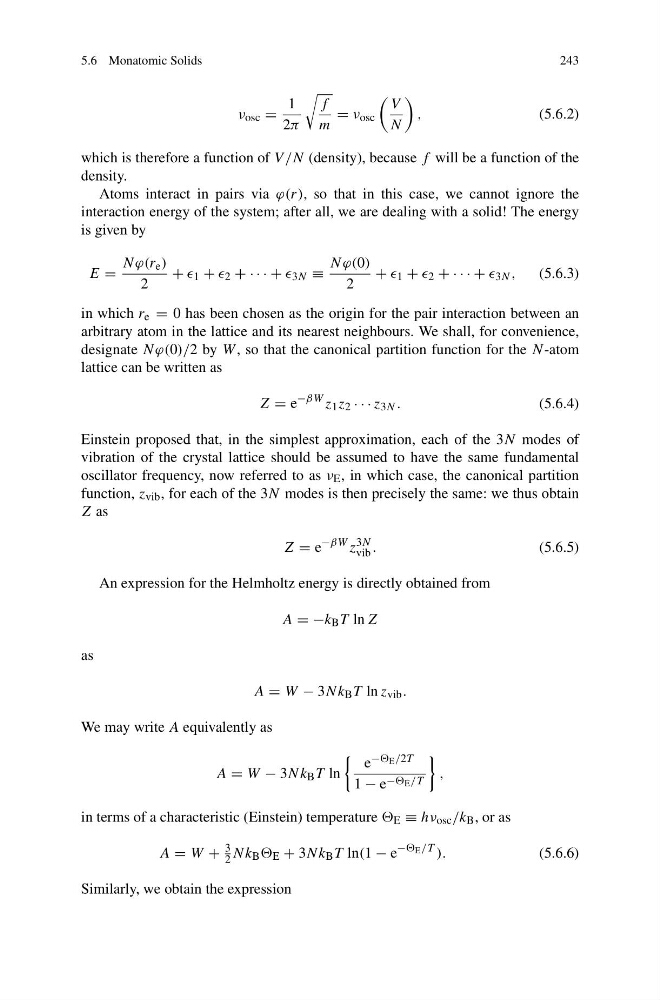
which is therefore a function of V /N (density), because f will be a function of the
density.
Atoms interact in pairs via ϕ(r), so that in this case, we cannot ignore the
interaction energy of the system; after all, we are dealing with a solid! The energy
is given by
E =
Nϕ(r e )
2
+ 1 + 2 + · · · + 3N ≡
Nϕ(0)
2
+ 1 + 2 + · · · + 3N ,
(5.6.3)
in which r e = 0 has been chosen as the origin for the pair interaction between an
arbitrary atom in the lattice and its nearest neighbours. We shall, for convenience,
designate Nϕ(0)/2 by W , so that the canonical partition function for the N-atom
lattice can be written as
Z = e
−βW z 1 z 2 · · · z 3N .
(5.6.4)
Einstein proposed that, in the simplest approximation, each of the 3N modes of
vibration of the crystal lattice should be assumed to have the same fundamental
oscillator frequency, now referred to as ν E , in which case, the canonical partition
function, z vib , for each of the 3N modes is then precisely the same: we thus obtain
Z as
Z = e
−βW z
3N
vib .
(5.6.5)
An expression for the Helmholtz energy is directly obtained from
A = −k B T ln Z
as
A = W − 3Nk B T ln z vib .
We may write A equivalently as
A = W − 3Nk B T ln
e − E /2T
1 − e − E /T
,
in terms of a characteristic (Einstein) temperature E ≡ hν osc /k B , or as
A = W +
3
2 Nk B E + 3Nk B T ln(1 − e
− E /T ).
(5.6.6)
Similarly, we obtain the expression
243
ν osc =
1
2π
f
m
= ν osc
V
N
,
(5.6.2)
which is therefore a function of V /N (density), because f will be a function of the
density.
Atoms interact in pairs via ϕ(r), so that in this case, we cannot ignore the
interaction energy of the system; after all, we are dealing with a solid! The energy
is given by
E =
Nϕ(r e )
2
+ 1 + 2 + · · · + 3N ≡
Nϕ(0)
2
+ 1 + 2 + · · · + 3N ,
(5.6.3)
in which r e = 0 has been chosen as the origin for the pair interaction between an
arbitrary atom in the lattice and its nearest neighbours. We shall, for convenience,
designate Nϕ(0)/2 by W , so that the canonical partition function for the N-atom
lattice can be written as
Z = e
−βW z 1 z 2 · · · z 3N .
(5.6.4)
Einstein proposed that, in the simplest approximation, each of the 3N modes of
vibration of the crystal lattice should be assumed to have the same fundamental
oscillator frequency, now referred to as ν E , in which case, the canonical partition
function, z vib , for each of the 3N modes is then precisely the same: we thus obtain
Z as
Z = e
−βW z
3N
vib .
(5.6.5)
An expression for the Helmholtz energy is directly obtained from
A = −k B T ln Z
as
A = W − 3Nk B T ln z vib .
We may write A equivalently as
A = W − 3Nk B T ln
e − E /2T
1 − e − E /T
,
in terms of a characteristic (Einstein) temperature E ≡ hν osc /k B , or as
A = W +
3
2 Nk B E + 3Nk B T ln(1 − e
− E /T ).
(5.6.6)
Similarly, we obtain the expression