

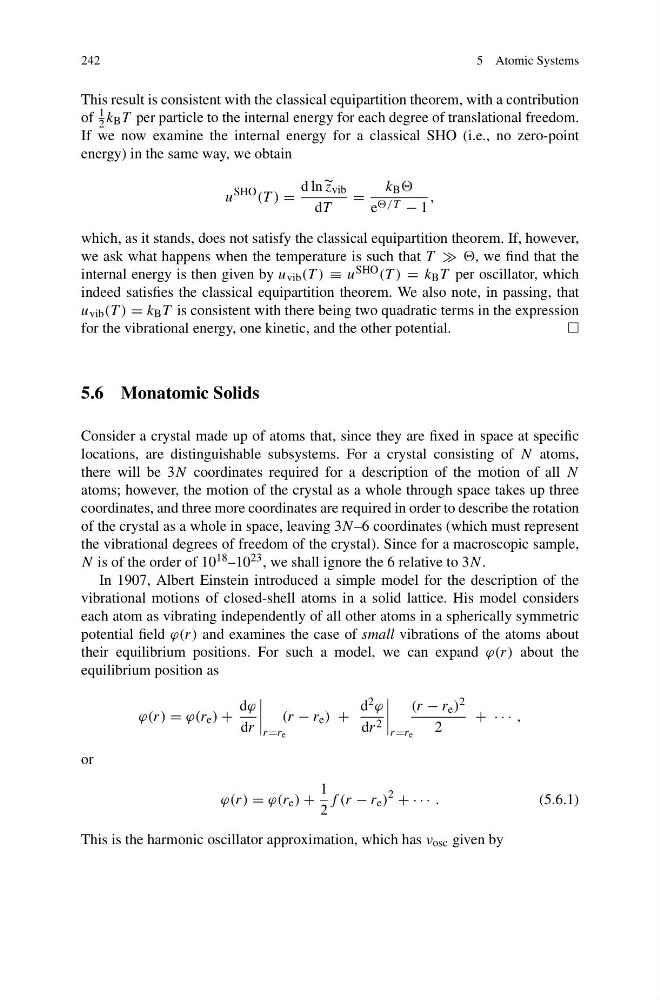
242
5 Atomic Systems
This result is consistent with the classical equipartition theorem, with a contribution
of
1
2 k B T per particle to the internal energy for each degree of translational freedom.
If we now examine the internal energy for a classical SHO (i.e., no zero-point
energy) in the same way, we obtain
u
SHO (T ) =
d ln z vib
dT
=
k B
e − 1
,
which, as it stands, does not satisfy the classical equipartition theorem. If, however,
we ask what happens when the temperature is such that T , we find that the
internal energy is then given by u vib (T ) ≡ u SHO (T ) = k B T per oscillator, which
indeed satisfies the classical equipartition theorem. We also note, in passing, that
u vib (T ) = k B T is consistent with there being two quadratic terms in the expression
for the vibrational energy, one kinetic, and the other potential.
5.6 Monatomic Solids
Consider a crystal made up of atoms that, since they are fixed in space at specific
locations, are distinguishable subsystems. For a crystal consisting of N atoms,
there will be 3N coordinates required for a description of the motion of all N
atoms; however, the motion of the crystal as a whole through space takes up three
coordinates, and three more coordinates are required in order to describe the rotation
of the crystal as a whole in space, leaving 3N–6 coordinates (which must represent
the vibrational degrees of freedom of the crystal). Since for a macroscopic sample,
N is of the order of 10 18 –10 23 , we shall ignore the 6 relative to 3N.
In 1907, Albert Einstein introduced a simple model for the description of the
vibrational motions of closed-shell atoms in a solid lattice. His model considers
each atom as vibrating independently of all other atoms in a spherically symmetric
potential field ϕ(r) and examines the case of small vibrations of the atoms about
their equilibrium positions. For such a model, we can expand ϕ(r) about the
equilibrium position as
ϕ(r) = ϕ(r e ) +
dϕ
dr
r=r e
(r − r e ) +
d 2 ϕ
dr 2
r=r e
(r − r e ) 2
2
+ · · · ,
or
ϕ(r) = ϕ(r e ) +
1
2
f (r − r e )
2
+ · · · .
(5.6.1)
This is the harmonic oscillator approximation, which has ν osc given by
5 Atomic Systems
This result is consistent with the classical equipartition theorem, with a contribution
of
1
2 k B T per particle to the internal energy for each degree of translational freedom.
If we now examine the internal energy for a classical SHO (i.e., no zero-point
energy) in the same way, we obtain
u
SHO (T ) =
d ln z vib
dT
=
k B
e − 1
,
which, as it stands, does not satisfy the classical equipartition theorem. If, however,
we ask what happens when the temperature is such that T , we find that the
internal energy is then given by u vib (T ) ≡ u SHO (T ) = k B T per oscillator, which
indeed satisfies the classical equipartition theorem. We also note, in passing, that
u vib (T ) = k B T is consistent with there being two quadratic terms in the expression
for the vibrational energy, one kinetic, and the other potential.
5.6 Monatomic Solids
Consider a crystal made up of atoms that, since they are fixed in space at specific
locations, are distinguishable subsystems. For a crystal consisting of N atoms,
there will be 3N coordinates required for a description of the motion of all N
atoms; however, the motion of the crystal as a whole through space takes up three
coordinates, and three more coordinates are required in order to describe the rotation
of the crystal as a whole in space, leaving 3N–6 coordinates (which must represent
the vibrational degrees of freedom of the crystal). Since for a macroscopic sample,
N is of the order of 10 18 –10 23 , we shall ignore the 6 relative to 3N.
In 1907, Albert Einstein introduced a simple model for the description of the
vibrational motions of closed-shell atoms in a solid lattice. His model considers
each atom as vibrating independently of all other atoms in a spherically symmetric
potential field ϕ(r) and examines the case of small vibrations of the atoms about
their equilibrium positions. For such a model, we can expand ϕ(r) about the
equilibrium position as
ϕ(r) = ϕ(r e ) +
dϕ
dr
r=r e
(r − r e ) +
d 2 ϕ
dr 2
r=r e
(r − r e ) 2
2
+ · · · ,
or
ϕ(r) = ϕ(r e ) +
1
2
f (r − r e )
2
+ · · · .
(5.6.1)
This is the harmonic oscillator approximation, which has ν osc given by