

5.5 Simple Harmonic Oscillator Ensembles
239
U
SHO
vib (T ; N) =
1
2 Nk B +
Nk B
e − 1
.
(5.5.10)
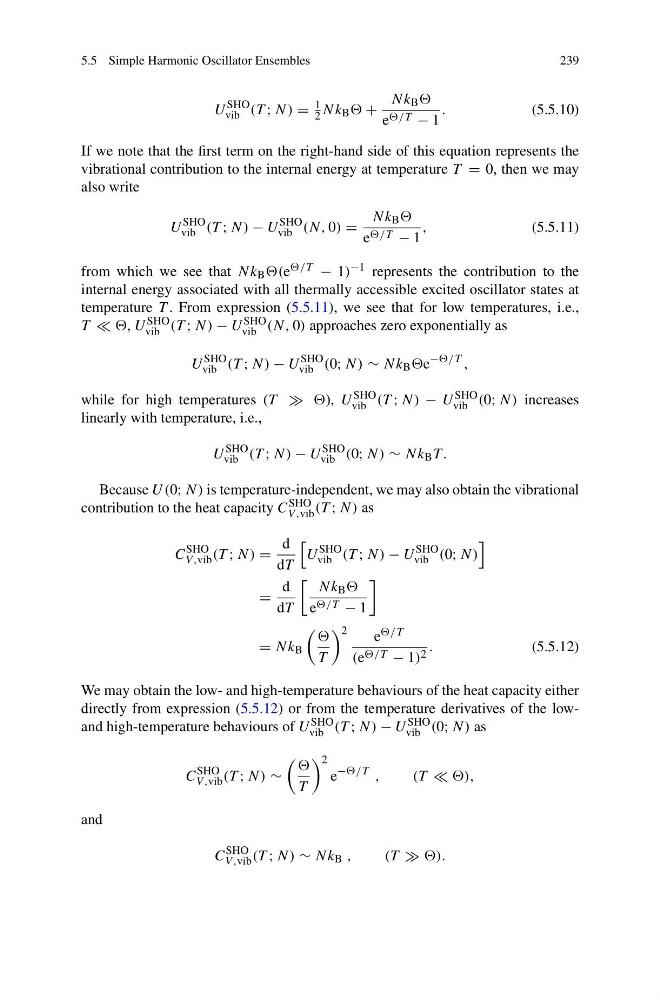
If we note that the first term on the right-hand side of this equation represents the
vibrational contribution to the internal energy at temperature T = 0, then we may
also write
U
SHO
vib (T ; N) − U
SHO
vib (N, 0) =
Nk B
e − 1
,
(5.5.11)
from which we see that Nk B (e /T − 1) −1 represents the contribution to the
internal energy associated with all thermally accessible excited oscillator states at
temperature T . From expression (5.5.11), we see that for low temperatures, i.e.,
T , U SHO
vib (T ; N) − U SHO
vib (N, 0) approaches zero exponentially as
U
SHO
vib (T ; N) − U
SHO
vib (0; N) ∼ Nk B e
− ,
while for high temperatures (T ), U SHO
vib (T ; N) − U SHO
vib (0; N) increases
linearly with temperature, i.e.,
U
SHO
vib (T ; N) − U
SHO
vib (0; N) ∼ Nk B T .
Because U(0; N) is temperature-independent, we may also obtain the vibrational
contribution to the heat capacity C SHO
V ,vib (T ; N) as
C
SHO
V ,vib (T ; N) =
d
dT
U
SHO
vib (T ; N) − U
SHO
vib (0; N)
=
d
dT
Nk B
e − 1
= Nk B
T
2
e /T
(e − 1) 2 .
(5.5.12)
We may obtain the low- and high-temperature behaviours of the heat capacity either
directly from expression (5.5.12) or from the temperature derivatives of the lowand high-temperature behaviours of U SHO
vib (T ; N) − U SHO
vib (0; N) as
C
SHO
V ,vib (T ; N) ∼
T
2
e
− ,
(T ),
and
C
SHO
V ,vib (T ; N) ∼ Nk B ,
(T ).
239
U
SHO
vib (T ; N) =
1
2 Nk B +
Nk B
e − 1
.
(5.5.10)
If we note that the first term on the right-hand side of this equation represents the
vibrational contribution to the internal energy at temperature T = 0, then we may
also write
U
SHO
vib (T ; N) − U
SHO
vib (N, 0) =
Nk B
e − 1
,
(5.5.11)
from which we see that Nk B (e /T − 1) −1 represents the contribution to the
internal energy associated with all thermally accessible excited oscillator states at
temperature T . From expression (5.5.11), we see that for low temperatures, i.e.,
T , U SHO
vib (T ; N) − U SHO
vib (N, 0) approaches zero exponentially as
U
SHO
vib (T ; N) − U
SHO
vib (0; N) ∼ Nk B e
− ,
while for high temperatures (T ), U SHO
vib (T ; N) − U SHO
vib (0; N) increases
linearly with temperature, i.e.,
U
SHO
vib (T ; N) − U
SHO
vib (0; N) ∼ Nk B T .
Because U(0; N) is temperature-independent, we may also obtain the vibrational
contribution to the heat capacity C SHO
V ,vib (T ; N) as
C
SHO
V ,vib (T ; N) =
d
dT
U
SHO
vib (T ; N) − U
SHO
vib (0; N)
=
d
dT
Nk B
e − 1
= Nk B
T
2
e /T
(e − 1) 2 .
(5.5.12)
We may obtain the low- and high-temperature behaviours of the heat capacity either
directly from expression (5.5.12) or from the temperature derivatives of the lowand high-temperature behaviours of U SHO
vib (T ; N) − U SHO
vib (0; N) as
C
SHO
V ,vib (T ; N) ∼
T
2
e
− ,
(T ),
and
C
SHO
V ,vib (T ; N) ∼ Nk B ,
(T ).