

240
5 Atomic Systems
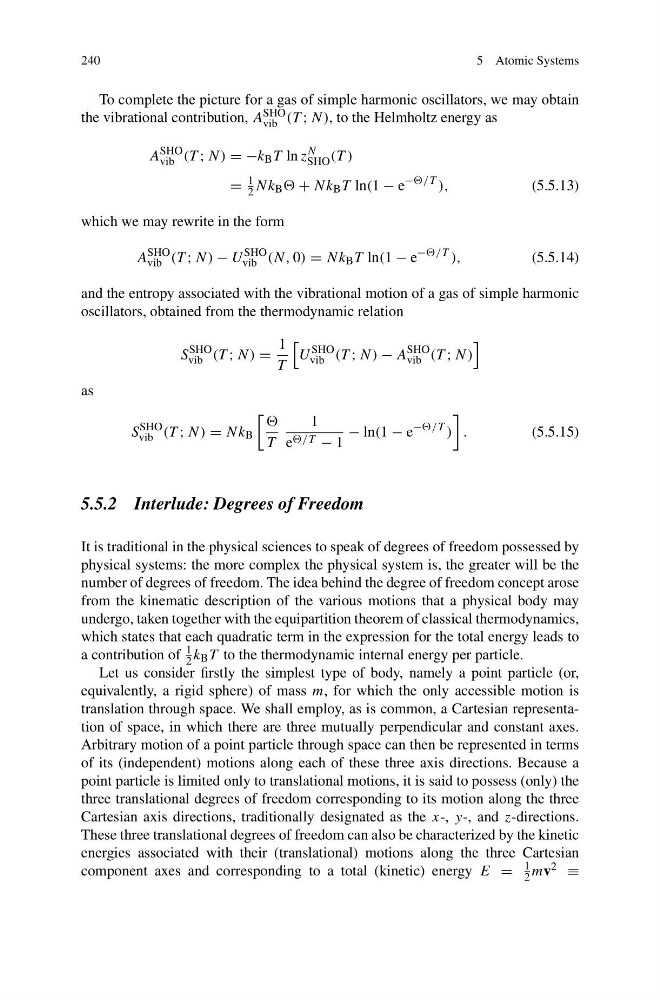
To complete the picture for a gas of simple harmonic oscillators, we may obtain
the vibrational contribution, A SHO
vib (T ; N), to the Helmholtz energy as
A
SHO
vib (T ; N) = −k B T ln z
N
SHO (T )
=
1
2 Nk B + Nk B T ln(1 − e
− ),
(5.5.13)
which we may rewrite in the form
A
SHO
vib (T ; N) − U
SHO
vib (N, 0) = Nk B T ln(1 − e
− ),
(5.5.14)
and the entropy associated with the vibrational motion of a gas of simple harmonic
oscillators, obtained from the thermodynamic relation
S
SHO
vib (T ; N) =
1
T
U
SHO
vib (T ; N) − A
SHO
vib (T ; N)
as
S
SHO
vib (T ; N) = Nk B
T
1
e − 1
− ln(1 − e
− )
.
(5.5.15)
5.5.2 Interlude: Degrees of Freedom
It is traditional in the physical sciences to speak of degrees of freedom possessed by
physical systems: the more complex the physical system is, the greater will be the
number of degrees of freedom. The idea behind the degree of freedom concept arose
from the kinematic description of the various motions that a physical body may
undergo, taken together with the equipartition theorem of classical thermodynamics,
which states that each quadratic term in the expression for the total energy leads to
a contribution of
1
2 k B T to the thermodynamic internal energy per particle.
Let us consider firstly the simplest type of body, namely a point particle (or,
equivalently, a rigid sphere) of mass m, for which the only accessible motion is
translation through space. We shall employ, as is common, a Cartesian representation of space, in which there are three mutually perpendicular and constant axes.
Arbitrary motion of a point particle through space can then be represented in terms
of its (independent) motions along each of these three axis directions. Because a
point particle is limited only to translational motions, it is said to possess (only) the
three translational degrees of freedom corresponding to its motion along the three
Cartesian axis directions, traditionally designated as the x-, y-, and z-directions.
These three translational degrees of freedom can also be characterized by the kinetic
energies associated with their (translational) motions along the three Cartesian
component axes and corresponding to a total (kinetic) energy E =
1
2 mv 2 ≡
5 Atomic Systems
To complete the picture for a gas of simple harmonic oscillators, we may obtain
the vibrational contribution, A SHO
vib (T ; N), to the Helmholtz energy as
A
SHO
vib (T ; N) = −k B T ln z
N
SHO (T )
=
1
2 Nk B + Nk B T ln(1 − e
− ),
(5.5.13)
which we may rewrite in the form
A
SHO
vib (T ; N) − U
SHO
vib (N, 0) = Nk B T ln(1 − e
− ),
(5.5.14)
and the entropy associated with the vibrational motion of a gas of simple harmonic
oscillators, obtained from the thermodynamic relation
S
SHO
vib (T ; N) =
1
T
U
SHO
vib (T ; N) − A
SHO
vib (T ; N)
as
S
SHO
vib (T ; N) = Nk B
T
1
e − 1
− ln(1 − e
− )
.
(5.5.15)
5.5.2 Interlude: Degrees of Freedom
It is traditional in the physical sciences to speak of degrees of freedom possessed by
physical systems: the more complex the physical system is, the greater will be the
number of degrees of freedom. The idea behind the degree of freedom concept arose
from the kinematic description of the various motions that a physical body may
undergo, taken together with the equipartition theorem of classical thermodynamics,
which states that each quadratic term in the expression for the total energy leads to
a contribution of
1
2 k B T to the thermodynamic internal energy per particle.
Let us consider firstly the simplest type of body, namely a point particle (or,
equivalently, a rigid sphere) of mass m, for which the only accessible motion is
translation through space. We shall employ, as is common, a Cartesian representation of space, in which there are three mutually perpendicular and constant axes.
Arbitrary motion of a point particle through space can then be represented in terms
of its (independent) motions along each of these three axis directions. Because a
point particle is limited only to translational motions, it is said to possess (only) the
three translational degrees of freedom corresponding to its motion along the three
Cartesian axis directions, traditionally designated as the x-, y-, and z-directions.
These three translational degrees of freedom can also be characterized by the kinetic
energies associated with their (translational) motions along the three Cartesian
component axes and corresponding to a total (kinetic) energy E =
1
2 mv 2 ≡