

238
5 Atomic Systems
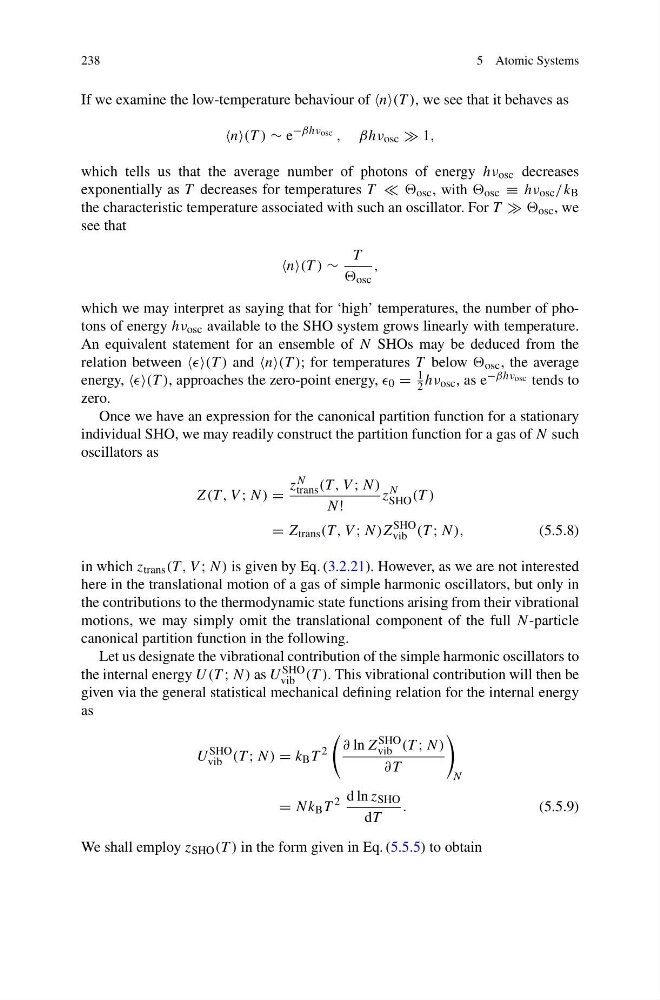
If we examine the low-temperature behaviour of n(T ), we see that it behaves as
n(T ) ∼ e
−βhν osc , βhν osc 1,
which tells us that the average number of photons of energy hν osc decreases
exponentially as T decreases for temperatures T osc , with osc ≡ hν osc /k B
the characteristic temperature associated with such an oscillator. For T osc , we
see that
n(T ) ∼
T
osc
,
which we may interpret as saying that for ‘high’ temperatures, the number of photons of energy hν osc available to the SHO system grows linearly with temperature.
An equivalent statement for an ensemble of N SHOs may be deduced from the
relation between (T ) and n(T ); for temperatures T below osc , the average
energy, (T ), approaches the zero-point energy, 0 =
1
2 hν osc , as e −βhν osc tends to
zero.
Once we have an expression for the canonical partition function for a stationary
individual SHO, we may readily construct the partition function for a gas of N such
oscillators as
Z(T , V ; N) =
z N
trans (T , V ; N)
N!
z
N
SHO (T )
= Z trans (T , V ; N)Z
SHO
vib (T ; N),
(5.5.8)
in which z trans (T , V ; N) is given by Eq. (3.2.21). However, as we are not interested
here in the translational motion of a gas of simple harmonic oscillators, but only in
the contributions to the thermodynamic state functions arising from their vibrational
motions, we may simply omit the translational component of the full N-particle
canonical partition function in the following.
Let us designate the vibrational contribution of the simple harmonic oscillators to
the internal energy U(T ; N) as U SHO
vib (T ). This vibrational contribution will then be
given via the general statistical mechanical defining relation for the internal energy
as
U
SHO
vib (T ; N) = k B T
2
∂ ln Z SHO
vib (T ; N)
∂T
N
= Nk B T
2 d ln z SHO
dT
.
(5.5.9)
We shall employ z SHO (T ) in the form given in Eq. (5.5.5) to obtain
5 Atomic Systems
If we examine the low-temperature behaviour of n(T ), we see that it behaves as
n(T ) ∼ e
−βhν osc , βhν osc 1,
which tells us that the average number of photons of energy hν osc decreases
exponentially as T decreases for temperatures T osc , with osc ≡ hν osc /k B
the characteristic temperature associated with such an oscillator. For T osc , we
see that
n(T ) ∼
T
osc
,
which we may interpret as saying that for ‘high’ temperatures, the number of photons of energy hν osc available to the SHO system grows linearly with temperature.
An equivalent statement for an ensemble of N SHOs may be deduced from the
relation between (T ) and n(T ); for temperatures T below osc , the average
energy, (T ), approaches the zero-point energy, 0 =
1
2 hν osc , as e −βhν osc tends to
zero.
Once we have an expression for the canonical partition function for a stationary
individual SHO, we may readily construct the partition function for a gas of N such
oscillators as
Z(T , V ; N) =
z N
trans (T , V ; N)
N!
z
N
SHO (T )
= Z trans (T , V ; N)Z
SHO
vib (T ; N),
(5.5.8)
in which z trans (T , V ; N) is given by Eq. (3.2.21). However, as we are not interested
here in the translational motion of a gas of simple harmonic oscillators, but only in
the contributions to the thermodynamic state functions arising from their vibrational
motions, we may simply omit the translational component of the full N-particle
canonical partition function in the following.
Let us designate the vibrational contribution of the simple harmonic oscillators to
the internal energy U(T ; N) as U SHO
vib (T ). This vibrational contribution will then be
given via the general statistical mechanical defining relation for the internal energy
as
U
SHO
vib (T ; N) = k B T
2
∂ ln Z SHO
vib (T ; N)
∂T
N
= Nk B T
2 d ln z SHO
dT
.
(5.5.9)
We shall employ z SHO (T ) in the form given in Eq. (5.5.5) to obtain