

5.5 Simple Harmonic Oscillator Ensembles
235
which has the form of Eq. (4.1.6) relating the heat capacity to the energy variance.
The heat capacity at constant pressure, P , is simply related to C V in the usual way
(for an ideal gas) as C P = C V + Nk B . The normal complement of thermodynamic
functions is rounded out by the electronic contribution, μ el (T ), to the chemical
potential, which is given by
μ el (T ) = −k B T ln z el (T ).
(5.4.15)
The above formulae for the various thermodynamic functions all contain the
relatively formidable-looking infinite summation over the electronic states of the
atoms making up the ideal gas. If we look back to our example for the Si atom,
where we identified explicitly the first few of the (in principle infinite) set of excited
states (terms, levels, and configurations) for such an atom, we saw that rather few
of the states lay at energies that are thermally accessible, even for temperatures as
high as a few thousand degrees. What this means in practice, of course, is that these
summations truncate rather quickly, and we have really only a few terms that need to
be retained to obtain all electronic contributions that lie within the accuracy required
for comparison with experiment.
5.5 Simple Harmonic Oscillator Ensembles
5.5.1 The Simple Harmonic Oscillator
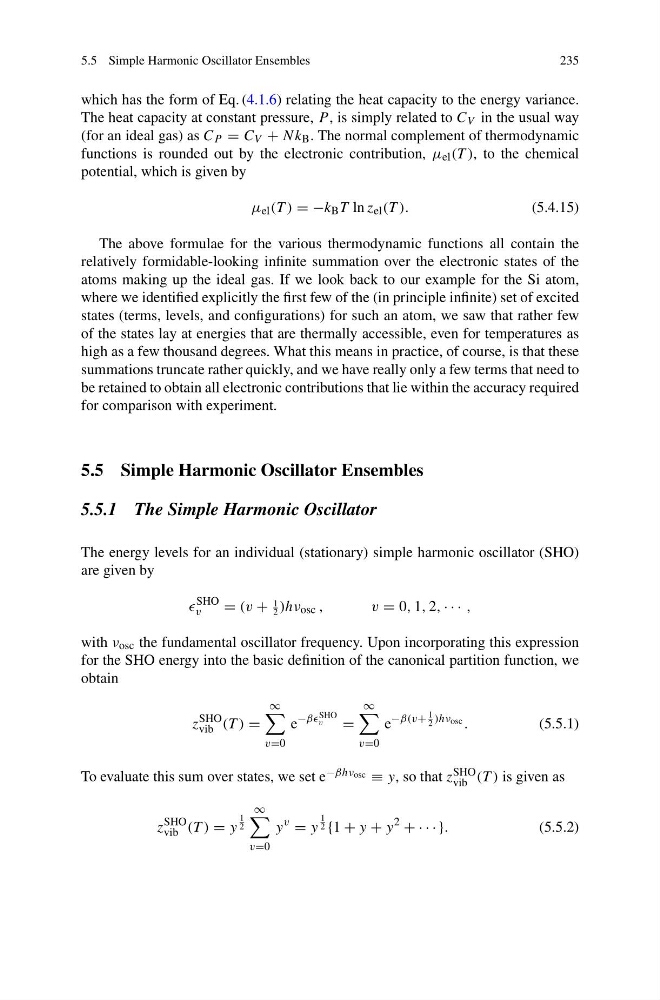
The energy levels for an individual (stationary) simple harmonic oscillator (SHO)
are given by
SHO
v
= (v +
1
2 )hν osc ,
v= 0, 1, 2, · · · ,
with ν osc the fundamental oscillator frequency. Upon incorporating this expression
for the SHO energy into the basic definition of the canonical partition function, we
obtain
z
SHO
vib (T ) =
∞
v=0
e
−ββ SHO
v
=
∞
v=0
e
−β(v+
1
2 )hν osc .
(5.5.1)
To evaluate this sum over states, we set e −βhν osc ≡ y, so that z SHO
vib (T ) is given as
z
SHO
vib (T ) = y
1
2
∞
v=0
y
v
= y
1
2 {1 + y + y
2
+ · · · }.
(5.5.2)
235
which has the form of Eq. (4.1.6) relating the heat capacity to the energy variance.
The heat capacity at constant pressure, P , is simply related to C V in the usual way
(for an ideal gas) as C P = C V + Nk B . The normal complement of thermodynamic
functions is rounded out by the electronic contribution, μ el (T ), to the chemical
potential, which is given by
μ el (T ) = −k B T ln z el (T ).
(5.4.15)
The above formulae for the various thermodynamic functions all contain the
relatively formidable-looking infinite summation over the electronic states of the
atoms making up the ideal gas. If we look back to our example for the Si atom,
where we identified explicitly the first few of the (in principle infinite) set of excited
states (terms, levels, and configurations) for such an atom, we saw that rather few
of the states lay at energies that are thermally accessible, even for temperatures as
high as a few thousand degrees. What this means in practice, of course, is that these
summations truncate rather quickly, and we have really only a few terms that need to
be retained to obtain all electronic contributions that lie within the accuracy required
for comparison with experiment.
5.5 Simple Harmonic Oscillator Ensembles
5.5.1 The Simple Harmonic Oscillator
The energy levels for an individual (stationary) simple harmonic oscillator (SHO)
are given by
SHO
v
= (v +
1
2 )hν osc ,
v= 0, 1, 2, · · · ,
with ν osc the fundamental oscillator frequency. Upon incorporating this expression
for the SHO energy into the basic definition of the canonical partition function, we
obtain
z
SHO
vib (T ) =
∞
v=0
e
−ββ SHO
v
=
∞
v=0
e
−β(v+
1
2 )hν osc .
(5.5.1)
To evaluate this sum over states, we set e −βhν osc ≡ y, so that z SHO
vib (T ) is given as
z
SHO
vib (T ) = y
1
2
∞
v=0
y
v
= y
1
2 {1 + y + y
2
+ · · · }.
(5.5.2)