

234
5 Atomic Systems
U el (T ; N) = N
∞
i=0
e
i ω
e
i
e
−βββ e
i
z el (T )
.
(5.4.11a)
Note that if we recognize that p e
i = ω e
i e
−ββ e
i /z el (T ) represents the probability that
the excited atomic state at energy e
i
≡ e
i − e
0 above the ground electronic state is
occupied at temperature T , we obtain U el (T ) in the form
U el (T ; N) = N
∞
i=0
p
e
i
e
i
or, equivalently, as
U el (T ; N) = N
∞
i=0
p
e
i
e
i ,
(5.4.11b)
provided that e
0 ≡ 0 has been chosen as the energy origin for the atomic electronic
states. As for the case in which there are no thermally accessible excited electronic
states, the pressure, P , is still given by the ideal gas law P = Nk B T /V , as z el (T )
is independent of the volume V .
The electronic contribution to the Helmholtz energy A is given by
A el (T ; N) = −Nk b T ln
∞
i=0
ω
e
i e
−βββ e
i
,
(5.4.12)
from which the electronic contribution to the entropy is obtained as
S el (T ; N) = Nk B
∂
∂T
T ln
∞
i=0
ω
e
i e
−βββ e
i
= Nk B ln
∞
i=0
ω
e
i e
−βββ e
i
+ Nk B
∞
i=0
βω
e
i
e
i
e
−βββ e
i
z el (T )
.
(5.4.13)
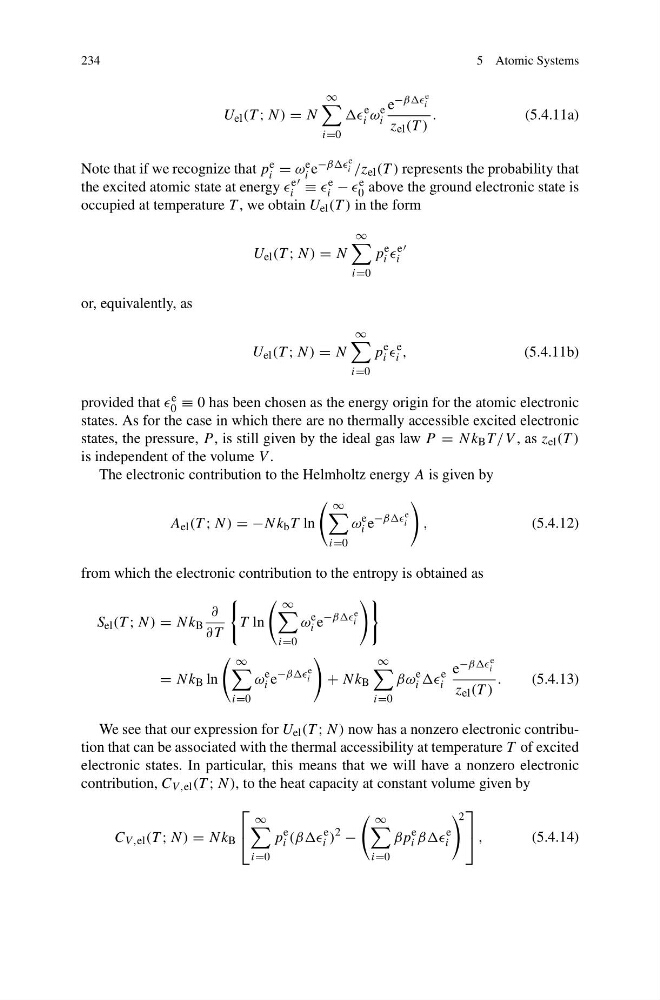
We see that our expression for U el (T ; N) now has a nonzero electronic contribution that can be associated with the thermal accessibility at temperature T of excited
electronic states. In particular, this means that we will have a nonzero electronic
contribution, C V ,el (T ; N), to the heat capacity at constant volume given by
C V ,el (T ; N) = Nk B
⎡
⎣
∞
i=0
p
e
i (βββ
e
i )
2
−
∞
i=0
βp
e
i βββ
e
i
2
⎤
⎦ ,
(5.4.14)
5 Atomic Systems
U el (T ; N) = N
∞
i=0
e
i ω
e
i
e
−βββ e
i
z el (T )
.
(5.4.11a)
Note that if we recognize that p e
i = ω e
i e
−ββ e
i /z el (T ) represents the probability that
the excited atomic state at energy e
i
≡ e
i − e
0 above the ground electronic state is
occupied at temperature T , we obtain U el (T ) in the form
U el (T ; N) = N
∞
i=0
p
e
i
e
i
or, equivalently, as
U el (T ; N) = N
∞
i=0
p
e
i
e
i ,
(5.4.11b)
provided that e
0 ≡ 0 has been chosen as the energy origin for the atomic electronic
states. As for the case in which there are no thermally accessible excited electronic
states, the pressure, P , is still given by the ideal gas law P = Nk B T /V , as z el (T )
is independent of the volume V .
The electronic contribution to the Helmholtz energy A is given by
A el (T ; N) = −Nk b T ln
∞
i=0
ω
e
i e
−βββ e
i
,
(5.4.12)
from which the electronic contribution to the entropy is obtained as
S el (T ; N) = Nk B
∂
∂T
T ln
∞
i=0
ω
e
i e
−βββ e
i
= Nk B ln
∞
i=0
ω
e
i e
−βββ e
i
+ Nk B
∞
i=0
βω
e
i
e
i
e
−βββ e
i
z el (T )
.
(5.4.13)
We see that our expression for U el (T ; N) now has a nonzero electronic contribution that can be associated with the thermal accessibility at temperature T of excited
electronic states. In particular, this means that we will have a nonzero electronic
contribution, C V ,el (T ; N), to the heat capacity at constant volume given by
C V ,el (T ; N) = Nk B
⎡
⎣
∞
i=0
p
e
i (βββ
e
i )
2
−
∞
i=0
βp
e
i βββ
e
i
2
⎤
⎦ ,
(5.4.14)