

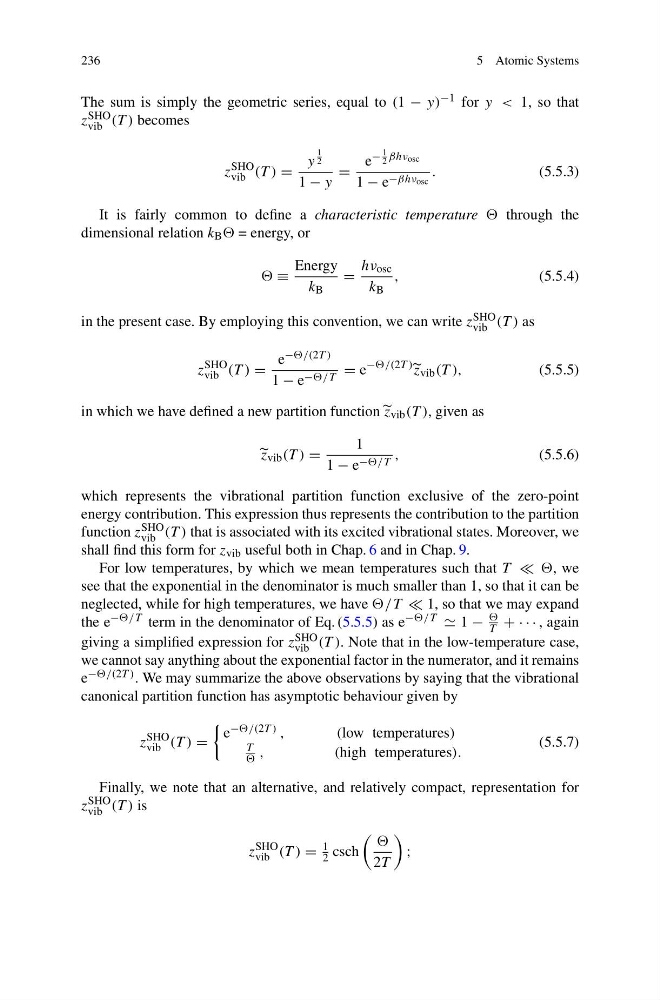
236
5 Atomic Systems
The sum is simply the geometric series, equal to (1 − y) −1 for y < 1, so that
z SHO
vib (T ) becomes
z
SHO
vib (T ) =
y
1
2
1 − y
=
e
−
1
2 βhν osc
1 − e −βhν osc
.
(5.5.3)
It is fairly common to define a characteristic temperature through the
dimensional relation k B = energy, or
≡
Energy
k B
=
hν osc
k B
,
(5.5.4)
in the present case. By employing this convention, we can write z SHO
vib (T ) as
z
SHO
vib (T ) =
e − )
1 − e −/T = e
− )
z vib (T ),
(5.5.5)
in which we have defined a new partition function z vib (T ), given as
z vib (T ) =
1
1 − e − ,
(5.5.6)
which represents the vibrational partition function exclusive of the zero-point
energy contribution. This expression thus represents the contribution to the partition
function z SHO
vib (T ) that is associated with its excited vibrational states. Moreover, we
shall find this form for z vib useful both in Chap. 6 and in Chap. 9.
For low temperatures, by which we mean temperatures such that T , we
see that the exponential in the denominator is much smaller than 1, so that it can be
neglected, while for high temperatures, we have /T 1, so that we may expand
the e − term in the denominator of Eq. (5.5.5) as e − 1 −
T + · · · , again
giving a simplified expression for z SHO
vib (T ). Note that in the low-temperature case,
we cannot say anything about the exponential factor in the numerator, and it remains
e − ) . We may summarize the above observations by saying that the vibrational
canonical partition function has asymptotic behaviour given by
z
SHO
vib (T ) =
e −/(2T ) ,
T
,
(low temperatures)
(high temperatures).
(5.5.7)
Finally, we note that an alternative, and relatively compact, representation for
z SHO
vib (T ) is
z
SHO
vib (T ) =
1
2 csch
2T
;
5 Atomic Systems
The sum is simply the geometric series, equal to (1 − y) −1 for y < 1, so that
z SHO
vib (T ) becomes
z
SHO
vib (T ) =
y
1
2
1 − y
=
e
−
1
2 βhν osc
1 − e −βhν osc
.
(5.5.3)
It is fairly common to define a characteristic temperature through the
dimensional relation k B = energy, or
≡
Energy
k B
=
hν osc
k B
,
(5.5.4)
in the present case. By employing this convention, we can write z SHO
vib (T ) as
z
SHO
vib (T ) =
e − )
1 − e −/T = e
− )
z vib (T ),
(5.5.5)
in which we have defined a new partition function z vib (T ), given as
z vib (T ) =
1
1 − e − ,
(5.5.6)
which represents the vibrational partition function exclusive of the zero-point
energy contribution. This expression thus represents the contribution to the partition
function z SHO
vib (T ) that is associated with its excited vibrational states. Moreover, we
shall find this form for z vib useful both in Chap. 6 and in Chap. 9.
For low temperatures, by which we mean temperatures such that T , we
see that the exponential in the denominator is much smaller than 1, so that it can be
neglected, while for high temperatures, we have /T 1, so that we may expand
the e − term in the denominator of Eq. (5.5.5) as e − 1 −
T + · · · , again
giving a simplified expression for z SHO
vib (T ). Note that in the low-temperature case,
we cannot say anything about the exponential factor in the numerator, and it remains
e − ) . We may summarize the above observations by saying that the vibrational
canonical partition function has asymptotic behaviour given by
z
SHO
vib (T ) =
e −/(2T ) ,
T
,
(low temperatures)
(high temperatures).
(5.5.7)
Finally, we note that an alternative, and relatively compact, representation for
z SHO
vib (T ) is
z
SHO
vib (T ) =
1
2 csch
2T
;