

200
4 Mean Values and Thermodynamics
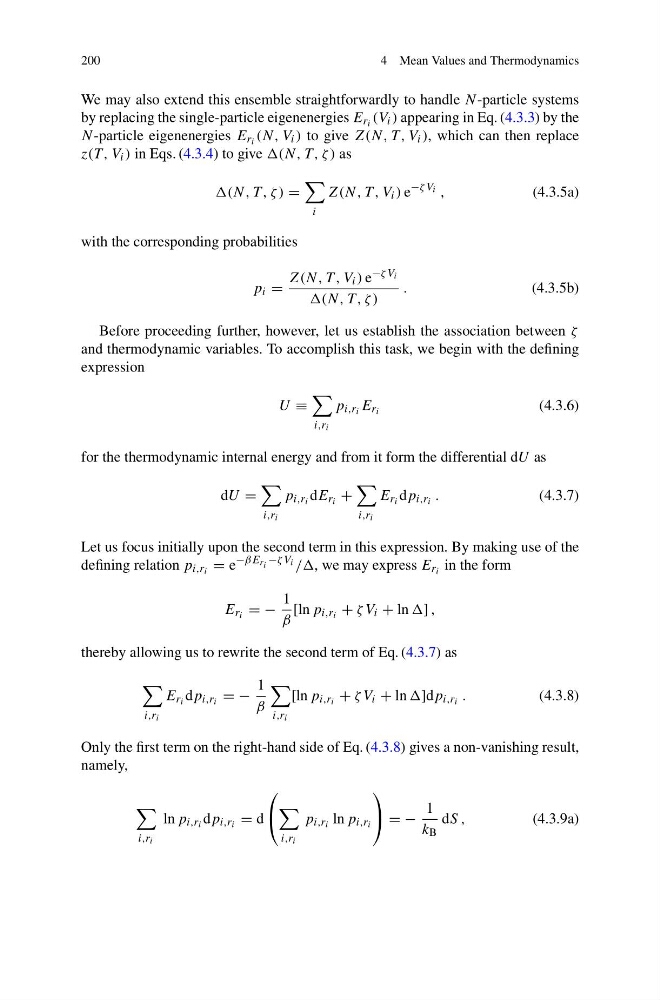
We may also extend this ensemble straightforwardly to handle N-particle systems
by replacing the single-particle eigenenergies E r i (V i ) appearing in Eq. (4.3.3) by the
N-particle eigenenergies E r i (N, V i ) to give Z(N, T , V i ), which can then replace
z(T , V i ) in Eqs. (4.3.4) to give (N, T , ζ ) as
(N, T , ζ ) =
i
Z(N, T , V i ) e
−ζ V i ,
(4.3.5a)
with the corresponding probabilities
p i =
Z(N, T , V i ) e −ζ V i
(N, T , ζ )
.
(4.3.5b)
Before proceeding further, however, let us establish the association between ζ
and thermodynamic variables. To accomplish this task, we begin with the defining
expression
U ≡
i,r i
p i,r i E r i
(4.3.6)
for the thermodynamic internal energy and from it form the differential dU as
dU =
i,r i
p i,r i dE r i +
i,r i
E r i dp i,r i .
(4.3.7)
Let us focus initially upon the second term in this expression. By making use of the
defining relation p i,r i = e
−βE r i −ζ V i //, we may express E r i in the form
E r i = −
1
β
[ln p i,r i + ζ V i + ln ] ,
thereby allowing us to rewrite the second term of Eq. (4.3.7) as
i,r i
E r i dp i,r i = −
1
β
i,r i
[ln p i,r i + ζ V i + ln ]dp i,r i .
(4.3.8)
Only the first term on the right-hand side of Eq. (4.3.8) gives a non-vanishing result,
namely,
i,r i
ln p i,r i dp i,r i = d
⎛
⎝
i,r i
p i,r i ln p i,r i
⎞
⎠ = −
1
k B
dS ,
(4.3.9a)
4 Mean Values and Thermodynamics
We may also extend this ensemble straightforwardly to handle N-particle systems
by replacing the single-particle eigenenergies E r i (V i ) appearing in Eq. (4.3.3) by the
N-particle eigenenergies E r i (N, V i ) to give Z(N, T , V i ), which can then replace
z(T , V i ) in Eqs. (4.3.4) to give (N, T , ζ ) as
(N, T , ζ ) =
i
Z(N, T , V i ) e
−ζ V i ,
(4.3.5a)
with the corresponding probabilities
p i =
Z(N, T , V i ) e −ζ V i
(N, T , ζ )
.
(4.3.5b)
Before proceeding further, however, let us establish the association between ζ
and thermodynamic variables. To accomplish this task, we begin with the defining
expression
U ≡
i,r i
p i,r i E r i
(4.3.6)
for the thermodynamic internal energy and from it form the differential dU as
dU =
i,r i
p i,r i dE r i +
i,r i
E r i dp i,r i .
(4.3.7)
Let us focus initially upon the second term in this expression. By making use of the
defining relation p i,r i = e
−βE r i −ζ V i //, we may express E r i in the form
E r i = −
1
β
[ln p i,r i + ζ V i + ln ] ,
thereby allowing us to rewrite the second term of Eq. (4.3.7) as
i,r i
E r i dp i,r i = −
1
β
i,r i
[ln p i,r i + ζ V i + ln ]dp i,r i .
(4.3.8)
Only the first term on the right-hand side of Eq. (4.3.8) gives a non-vanishing result,
namely,
i,r i
ln p i,r i dp i,r i = d
⎛
⎝
i,r i
p i,r i ln p i,r i
⎞
⎠ = −
1
k B
dS ,
(4.3.9a)