

4.3 The Isothermal–Isobaric Ensemble
201
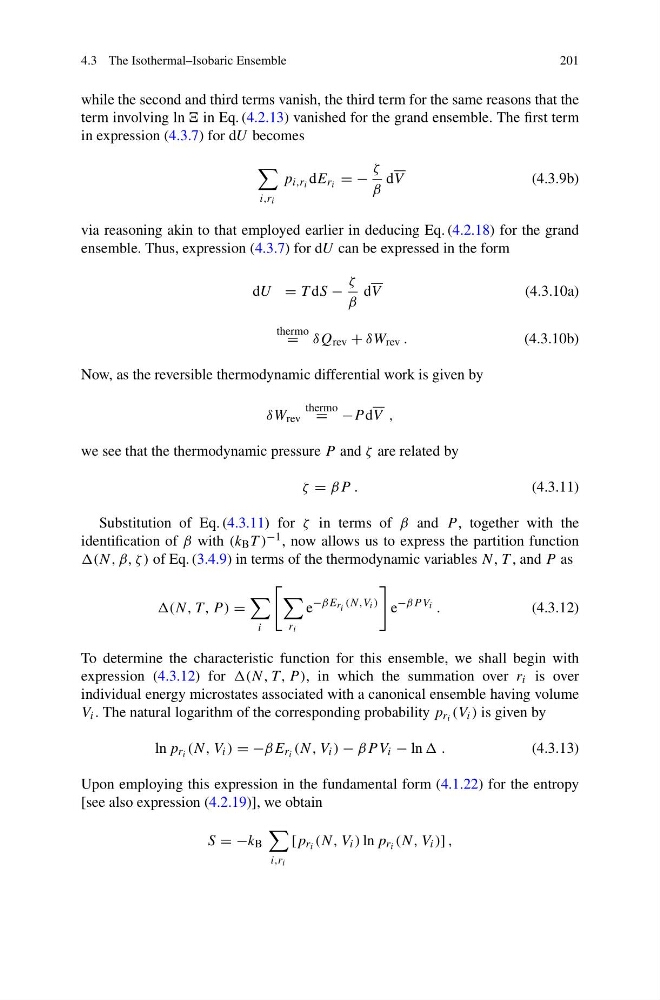
while the second and third terms vanish, the third term for the same reasons that the
term involving ln in Eq. (4.2.13) vanished for the grand ensemble. The first term
in expression (4.3.7) for dU becomes
i,r i
p i,r i dE r i = −
ζ
β
dV
(4.3.9b)
via reasoning akin to that employed earlier in deducing Eq. (4.2.18) for the grand
ensemble. Thus, expression (4.3.7) for dU can be expressed in the form
dU = T dS −
ζ
β
dV
(4.3.10a)
thermo
= δQ rev + δW rev .
(4.3.10b)
Now, as the reversible thermodynamic differential work is given by
δW rev
thermo
= −P dV ,
we see that the thermodynamic pressure P and ζ are related by
ζ = βP .
(4.3.11)
Substitution of Eq. (4.3.11) for ζ in terms of β and P , together with the
identification of β with (k B T ) −1 , now allows us to express the partition function
β, ζ ) of Eq. (3.4.9) in terms of the thermodynamic variables N, T , and P as
T , P ) =
i
r i
e
−βE r i (N,V i )
e
−βP V i .
(4.3.12)
To determine the characteristic function for this ensemble, we shall begin with
expression (4.3.12) for (N, T , P ), in which the summation over r i is over
individual energy microstates associated with a canonical ensemble having volume
V i . The natural logarithm of the corresponding probability p r i (V i ) is given by
ln p r i (N, V i ) = −βE r i (N, V i ) − βP V i − ln .
(4.3.13)
Upon employing this expression in the fundamental form (4.1.22) for the entropy
[see also expression (4.2.19)], we obtain
S = −k B
i,r i
[p r i (N, V i ) ln p r i (N, V i )] ,
201
while the second and third terms vanish, the third term for the same reasons that the
term involving ln in Eq. (4.2.13) vanished for the grand ensemble. The first term
in expression (4.3.7) for dU becomes
i,r i
p i,r i dE r i = −
ζ
β
dV
(4.3.9b)
via reasoning akin to that employed earlier in deducing Eq. (4.2.18) for the grand
ensemble. Thus, expression (4.3.7) for dU can be expressed in the form
dU = T dS −
ζ
β
dV
(4.3.10a)
thermo
= δQ rev + δW rev .
(4.3.10b)
Now, as the reversible thermodynamic differential work is given by
δW rev
thermo
= −P dV ,
we see that the thermodynamic pressure P and ζ are related by
ζ = βP .
(4.3.11)
Substitution of Eq. (4.3.11) for ζ in terms of β and P , together with the
identification of β with (k B T ) −1 , now allows us to express the partition function
β, ζ ) of Eq. (3.4.9) in terms of the thermodynamic variables N, T , and P as
T , P ) =
i
r i
e
−βE r i (N,V i )
e
−βP V i .
(4.3.12)
To determine the characteristic function for this ensemble, we shall begin with
expression (4.3.12) for (N, T , P ), in which the summation over r i is over
individual energy microstates associated with a canonical ensemble having volume
V i . The natural logarithm of the corresponding probability p r i (V i ) is given by
ln p r i (N, V i ) = −βE r i (N, V i ) − βP V i − ln .
(4.3.13)
Upon employing this expression in the fundamental form (4.1.22) for the entropy
[see also expression (4.2.19)], we obtain
S = −k B
i,r i
[p r i (N, V i ) ln p r i (N, V i )] ,