

4.3 The Isothermal–Isobaric Ensemble
199
N =
N ∗ t N ∗
√
2σ N
∞
−∞ e −x 2 dx
= N
∗ ,
(4.2.48)
from which we may conclude that the average number equals the most probable
number.
4.3 The Isothermal–Isobaric Ensemble
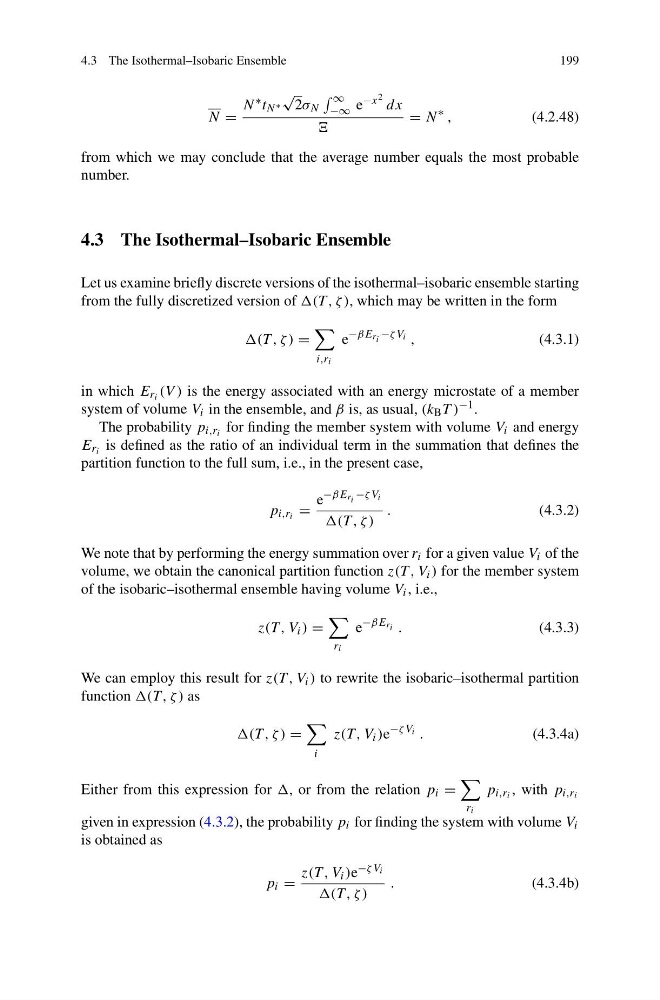
Let us examine briefly discrete versions of the isothermal–isobaric ensemble starting
from the fully discretized version of , ζ ), which may be written in the form
, ζ ) =
i,r i
e
−βE r i −ζ V i ,
(4.3.1)
in which E r i (V ) is the energy associated with an energy microstate of a member
system of volume V i in the ensemble, and β is, as usual, (k B T ) −1 .
The probability p i,r i for finding the member system with volume V i and energy
E r i is defined as the ratio of an individual term in the summation that defines the
partition function to the full sum, i.e., in the present case,
p i,r i =
e
−βE r i −ζ V i
(T , ζ )
.
(4.3.2)
We note that by performing the energy summation over r i for a given value V i of the
volume, we obtain the canonical partition function z(T , V i ) for the member system
of the isobaric–isothermal ensemble having volume V i , i.e.,
z(T , V i ) =
r i
e
−βE r i .
(4.3.3)
We can employ this result for z(T , V i ) to rewrite the isobaric–isothermal partition
function , ζ ) as
(T , ζ ) =
i
z(T , V i )e
−ζ V i .
(4.3.4a)
Either from this expression for , or from the relation p i =
r i
p i,r i , with p i,r i
given in expression (4.3.2), the probability p i for finding the system with volume V i
is obtained as
p i =
z(T , V i )e −ζ V i
(T , ζ )
.
(4.3.4b)
199
N =
N ∗ t N ∗
√
2σ N
∞
−∞ e −x 2 dx
= N
∗ ,
(4.2.48)
from which we may conclude that the average number equals the most probable
number.
4.3 The Isothermal–Isobaric Ensemble
Let us examine briefly discrete versions of the isothermal–isobaric ensemble starting
from the fully discretized version of , ζ ), which may be written in the form
, ζ ) =
i,r i
e
−βE r i −ζ V i ,
(4.3.1)
in which E r i (V ) is the energy associated with an energy microstate of a member
system of volume V i in the ensemble, and β is, as usual, (k B T ) −1 .
The probability p i,r i for finding the member system with volume V i and energy
E r i is defined as the ratio of an individual term in the summation that defines the
partition function to the full sum, i.e., in the present case,
p i,r i =
e
−βE r i −ζ V i
(T , ζ )
.
(4.3.2)
We note that by performing the energy summation over r i for a given value V i of the
volume, we obtain the canonical partition function z(T , V i ) for the member system
of the isobaric–isothermal ensemble having volume V i , i.e.,
z(T , V i ) =
r i
e
−βE r i .
(4.3.3)
We can employ this result for z(T , V i ) to rewrite the isobaric–isothermal partition
function , ζ ) as
(T , ζ ) =
i
z(T , V i )e
−ζ V i .
(4.3.4a)
Either from this expression for , or from the relation p i =
r i
p i,r i , with p i,r i
given in expression (4.3.2), the probability p i for finding the system with volume V i
is obtained as
p i =
z(T , V i )e −ζ V i
(T , ζ )
.
(4.3.4b)