

196
4 Mean Values and Thermodynamics
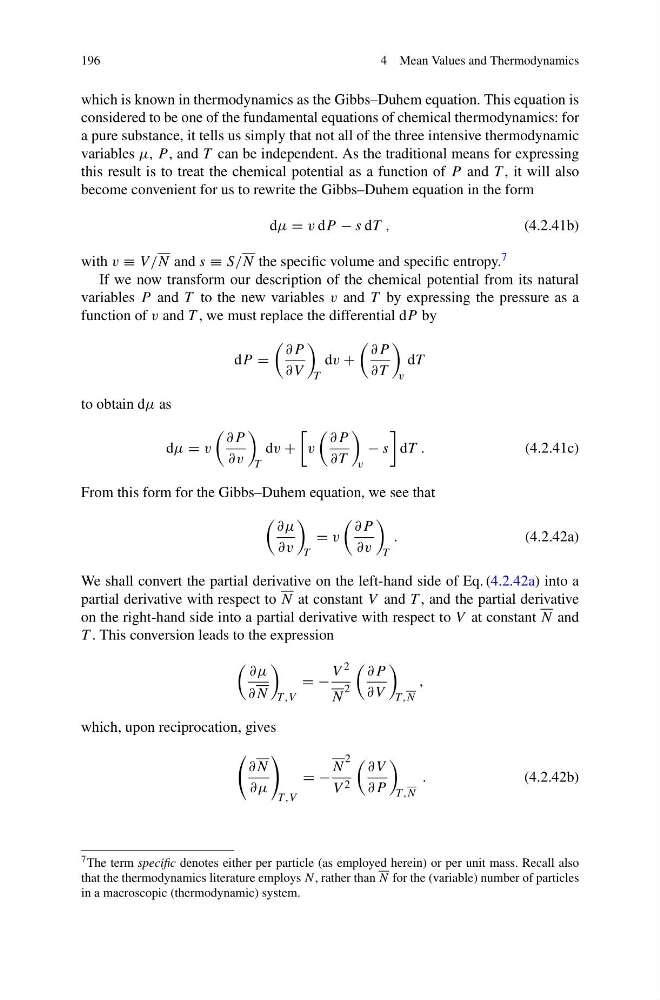
which is known in thermodynamics as the Gibbs–Duhem equation. This equation is
considered to be one of the fundamental equations of chemical thermodynamics: for
a pure substance, it tells us simply that not all of the three intensive thermodynamic
variables μ, P , and T can be independent. As the traditional means for expressing
this result is to treat the chemical potential as a function of P and T , it will also
become convenient for us to rewrite the Gibbs–Duhem equation in the form
dμ = v dP − s dT ,
(4.2.41b)
with v ≡ V /N and s ≡ S/N the specific volume and specific entropy. 7
If we now transform our description of the chemical potential from its natural
variables P and T to the new variables v and T by expressing the pressure as a
function of v and T , we must replace the differential dP by
dP =
∂P
∂V
T
dv +
∂P
∂T
v
dT
to obtain dμ as
dμ = v
∂P
∂v
T
dv +
v
∂P
∂T
v
− s
dT .
(4.2.41c)
From this form for the Gibbs–Duhem equation, we see that
∂μ
∂v
T
= v
∂P
∂v
T
.
(4.2.42a)
We shall convert the partial derivative on the left-hand side of Eq. (4.2.42a) into a
partial derivative with respect to N at constant V and T , and the partial derivative
on the right-hand side into a partial derivative with respect to V at constant N and
T . This conversion leads to the expression
∂μ
∂N
T ,V
= −
V 2
N
2
∂P
∂V
T ,N
,
which, upon reciprocation, gives
∂N
∂μ
T ,V
= −
N
2
V 2
∂V
∂P
T ,N
.
(4.2.42b)
7 The term specific denotes either per particle (as employed herein) or per unit mass. Recall also
that the thermodynamics literature employs N , rather than N for the (variable) number of particles
in a macroscopic (thermodynamic) system.
4 Mean Values and Thermodynamics
which is known in thermodynamics as the Gibbs–Duhem equation. This equation is
considered to be one of the fundamental equations of chemical thermodynamics: for
a pure substance, it tells us simply that not all of the three intensive thermodynamic
variables μ, P , and T can be independent. As the traditional means for expressing
this result is to treat the chemical potential as a function of P and T , it will also
become convenient for us to rewrite the Gibbs–Duhem equation in the form
dμ = v dP − s dT ,
(4.2.41b)
with v ≡ V /N and s ≡ S/N the specific volume and specific entropy. 7
If we now transform our description of the chemical potential from its natural
variables P and T to the new variables v and T by expressing the pressure as a
function of v and T , we must replace the differential dP by
dP =
∂P
∂V
T
dv +
∂P
∂T
v
dT
to obtain dμ as
dμ = v
∂P
∂v
T
dv +
v
∂P
∂T
v
− s
dT .
(4.2.41c)
From this form for the Gibbs–Duhem equation, we see that
∂μ
∂v
T
= v
∂P
∂v
T
.
(4.2.42a)
We shall convert the partial derivative on the left-hand side of Eq. (4.2.42a) into a
partial derivative with respect to N at constant V and T , and the partial derivative
on the right-hand side into a partial derivative with respect to V at constant N and
T . This conversion leads to the expression
∂μ
∂N
T ,V
= −
V 2
N
2
∂P
∂V
T ,N
,
which, upon reciprocation, gives
∂N
∂μ
T ,V
= −
N
2
V 2
∂V
∂P
T ,N
.
(4.2.42b)
7 The term specific denotes either per particle (as employed herein) or per unit mass. Recall also
that the thermodynamics literature employs N , rather than N for the (variable) number of particles
in a macroscopic (thermodynamic) system.