

4.2 Grand Ensemble: Open Systems
195
N = k B T
∂ ln
∂μ
T ,V
,
(4.2.35)
while according to the definition of N, we have
N N =
N
NZ N λ
N .
(4.2.36)
From this latter expression, we obtain the result
∂N
∂μ
T ,V
+ N
∂∂
∂μ
T ,V
=
N
NZ N Nλ
N −1
∂λ
∂μ
T ,V
.
(4.2.37)
But, we know that
∂λ
∂μ
T ,V
= e
μ/k B T 1
k B T
,
(4.2.38)
so that
∂N
∂μ
T ,V
+ N
∂∂
∂μ
T ,V
=
N
N 2 Z N λ N
k B T
=
N 2
k B T
,
and
∂N
∂μ
T ,V
+ N
∂ ln
∂μ
T ,V
=
N 2
k B T
.
(4.2.39)
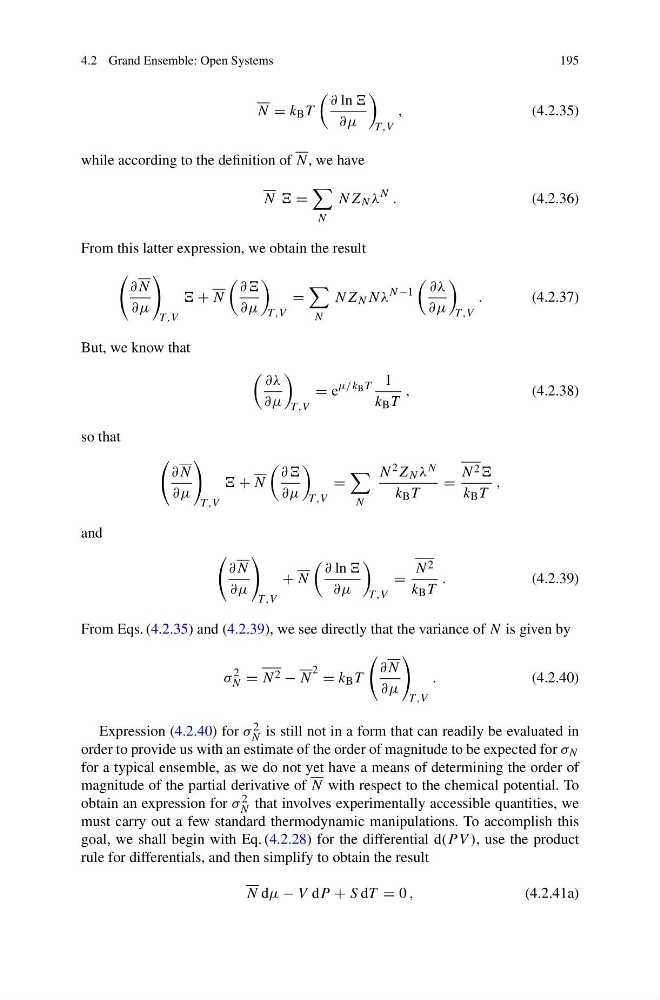
From Eqs. (4.2.35) and (4.2.39), we see directly that the variance of N is given by
σ
2
N = N 2 − N
2 = k B T
∂N
∂μ
T ,V
.
(4.2.40)
Expression (4.2.40) for σ 2
N is still not in a form that can readily be evaluated in
order to provide us with an estimate of the order of magnitude to be expected for σ N
for a typical ensemble, as we do not yet have a means of determining the order of
magnitude of the partial derivative of N with respect to the chemical potential. To
obtain an expression for σ 2
N that involves experimentally accessible quantities, we
must carry out a few standard thermodynamic manipulations. To accomplish this
goal, we shall begin with Eq. (4.2.28) for the differential d(P V ), use the product
rule for differentials, and then simplify to obtain the result
N dμ − V dP + S dT = 0 ,
(4.2.41a)
195
N = k B T
∂ ln
∂μ
T ,V
,
(4.2.35)
while according to the definition of N, we have
N N =
N
NZ N λ
N .
(4.2.36)
From this latter expression, we obtain the result
∂N
∂μ
T ,V
+ N
∂∂
∂μ
T ,V
=
N
NZ N Nλ
N −1
∂λ
∂μ
T ,V
.
(4.2.37)
But, we know that
∂λ
∂μ
T ,V
= e
μ/k B T 1
k B T
,
(4.2.38)
so that
∂N
∂μ
T ,V
+ N
∂∂
∂μ
T ,V
=
N
N 2 Z N λ N
k B T
=
N 2
k B T
,
and
∂N
∂μ
T ,V
+ N
∂ ln
∂μ
T ,V
=
N 2
k B T
.
(4.2.39)
From Eqs. (4.2.35) and (4.2.39), we see directly that the variance of N is given by
σ
2
N = N 2 − N
2 = k B T
∂N
∂μ
T ,V
.
(4.2.40)
Expression (4.2.40) for σ 2
N is still not in a form that can readily be evaluated in
order to provide us with an estimate of the order of magnitude to be expected for σ N
for a typical ensemble, as we do not yet have a means of determining the order of
magnitude of the partial derivative of N with respect to the chemical potential. To
obtain an expression for σ 2
N that involves experimentally accessible quantities, we
must carry out a few standard thermodynamic manipulations. To accomplish this
goal, we shall begin with Eq. (4.2.28) for the differential d(P V ), use the product
rule for differentials, and then simplify to obtain the result
N dμ − V dP + S dT = 0 ,
(4.2.41a)