

160
3 Ensembles: Systems of Particles
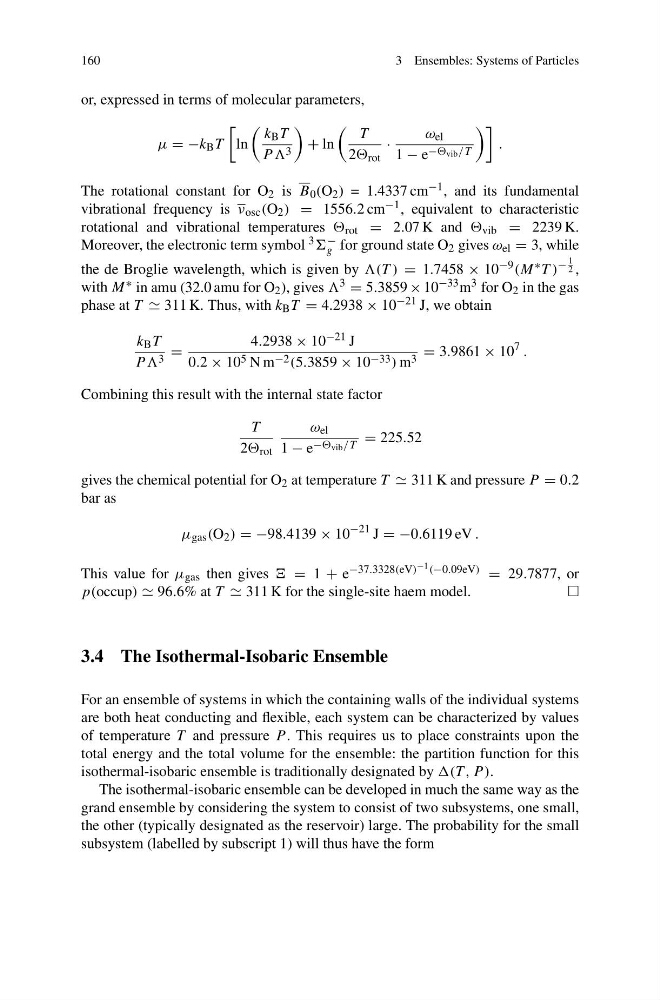
or, expressed in terms of molecular parameters,
μ = −k B T
ln
k B T
P P 3
+ ln
T
2 rot
·
ω el
1 − e − vib /T
.
The rotational constant for O 2 is B 0 (O 2 ) = 1.4337 cm −1 , and its fundamental
vibrational frequency is ν osc (O 2 ) = 1556.2 cm −1 , equivalent to characteristic
rotational and vibrational temperatures rot = 2.07 K and vib = 2239 K.
Moreover, the electronic term symbol 3 −
g for ground state O 2 gives ω el = 3, while
the de Broglie wavelength, which is given by (T ) = 1.7458 × 10 −9 (M ∗ T )
−
1
2 ,
with M ∗ in amu (32.0 amu for O 2 ), gives 3 = 5.3859 × 10 −33 m 3 for O 2 in the gas
phase at T 311 K. Thus, with k B T = 4.2938 × 10 −21 J, we obtain
k B T
P P 3 =
4.2938 × 10 −21 J
0.2 × 10 5 N m −2 (5.3859 × 10 −33 ) m 3 = 3.9861 × 10
7 .
Combining this result with the internal state factor
T
2 rot
ω el
1 − e − vib /T = 225.52
gives the chemical potential for O 2 at temperature T 311 K and pressure P = 0.2
bar as
μ gas (O 2 ) = −98.4139 × 10
−21 J = −0.6119 eV .
This value for μ gas then gives = 1 + e −37.3328(eV) −1 (−0.09eV) = 29.7877, or
p(occup) 96.6% at T 311 K for the single-site haem model.
3.4 The Isothermal-Isobaric Ensemble
For an ensemble of systems in which the containing walls of the individual systems
are both heat conducting and flexible, each system can be characterized by values
of temperature T and pressure P . This requires us to place constraints upon the
total energy and the total volume for the ensemble: the partition function for this
isothermal-isobaric ensemble is traditionally designated by , P ).
The isothermal-isobaric ensemble can be developed in much the same way as the
grand ensemble by considering the system to consist of two subsystems, one small,
the other (typically designated as the reservoir) large. The probability for the small
subsystem (labelled by subscript 1) will thus have the form
3 Ensembles: Systems of Particles
or, expressed in terms of molecular parameters,
μ = −k B T
ln
k B T
P P 3
+ ln
T
2 rot
·
ω el
1 − e − vib /T
.
The rotational constant for O 2 is B 0 (O 2 ) = 1.4337 cm −1 , and its fundamental
vibrational frequency is ν osc (O 2 ) = 1556.2 cm −1 , equivalent to characteristic
rotational and vibrational temperatures rot = 2.07 K and vib = 2239 K.
Moreover, the electronic term symbol 3 −
g for ground state O 2 gives ω el = 3, while
the de Broglie wavelength, which is given by (T ) = 1.7458 × 10 −9 (M ∗ T )
−
1
2 ,
with M ∗ in amu (32.0 amu for O 2 ), gives 3 = 5.3859 × 10 −33 m 3 for O 2 in the gas
phase at T 311 K. Thus, with k B T = 4.2938 × 10 −21 J, we obtain
k B T
P P 3 =
4.2938 × 10 −21 J
0.2 × 10 5 N m −2 (5.3859 × 10 −33 ) m 3 = 3.9861 × 10
7 .
Combining this result with the internal state factor
T
2 rot
ω el
1 − e − vib /T = 225.52
gives the chemical potential for O 2 at temperature T 311 K and pressure P = 0.2
bar as
μ gas (O 2 ) = −98.4139 × 10
−21 J = −0.6119 eV .
This value for μ gas then gives = 1 + e −37.3328(eV) −1 (−0.09eV) = 29.7877, or
p(occup) 96.6% at T 311 K for the single-site haem model.
3.4 The Isothermal-Isobaric Ensemble
For an ensemble of systems in which the containing walls of the individual systems
are both heat conducting and flexible, each system can be characterized by values
of temperature T and pressure P . This requires us to place constraints upon the
total energy and the total volume for the ensemble: the partition function for this
isothermal-isobaric ensemble is traditionally designated by , P ).
The isothermal-isobaric ensemble can be developed in much the same way as the
grand ensemble by considering the system to consist of two subsystems, one small,
the other (typically designated as the reservoir) large. The probability for the small
subsystem (labelled by subscript 1) will thus have the form