

3.4 The Isothermal-Isobaric Ensemble
161
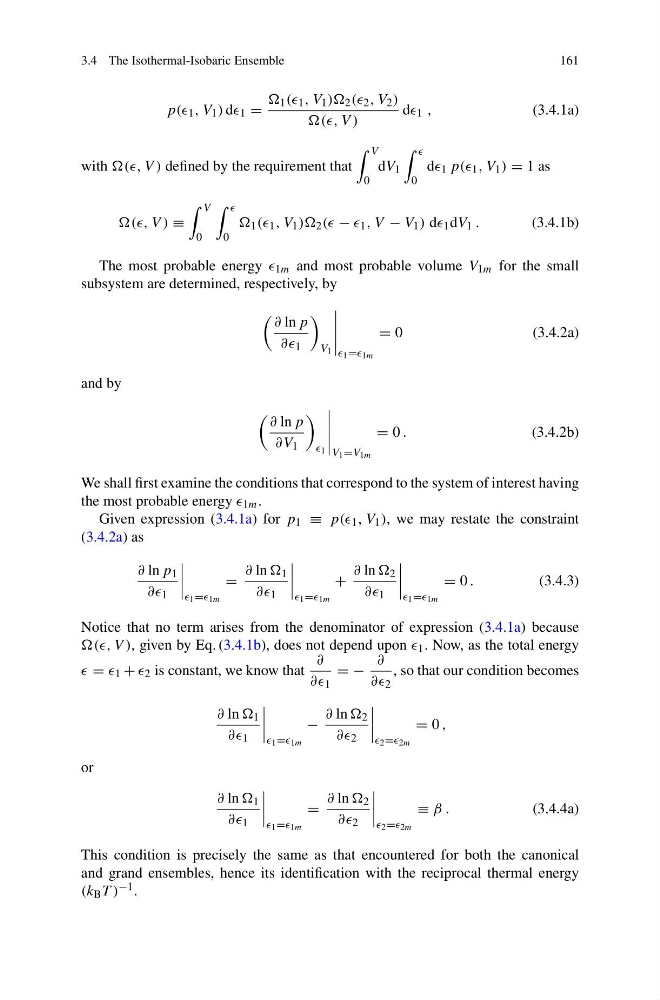
p(( 1 , V 1 ) d 1 =
1 (( 1 , V 1 )) 2 (( 2 , V 2 )
((, V )
d 1 ,
(3.4.1a)
with ((, V ) defined by the requirement that
V
0
dV 1
0
d 1 p(( 1 , V 1 ) = 1 as
((, V ) ≡
V
0
0
1 (( 1 , V 1 )) 2 (( − 1 , V − V 1 ) d 1 dV 1 .
(3.4.1b)
The most probable energy 1m and most probable volume V 1m for the small
subsystem are determined, respectively, by
∂ ln p
∂∂ 1
V 1
1 = 1m
= 0
(3.4.2a)
and by
∂ ln p
∂V 1
1
V 1 =V 1m
= 0 .
(3.4.2b)
We shall first examine the conditions that correspond to the system of interest having
the most probable energy 1m .
Given expression (3.4.1a) for p 1 ≡ p(( 1 , V 1 ), we may restate the constraint
(3.4.2a) as
∂ ln p 1
∂∂ 1
1 = 1m
=
∂ ln 1
∂∂ 1
1 = 1m
+
∂ ln 2
∂∂ 1
1 = 1m
= 0 .
(3.4.3)
Notice that no term arises from the denominator of expression (3.4.1a) because
V ), given by Eq. (3.4.1b), does not depend upon 1 . Now, as the total energy
= 1 + 2 is constant, we know that
∂
∂∂ 1
= −
∂
∂∂ 2
, so that our condition becomes
∂ ln 1
∂∂ 1
1 = 1m
−
∂ ln 2
∂∂ 2
2 = 2m
= 0 ,
or
∂ ln 1
∂∂ 1
1 = 1m
=
∂ ln 2
∂∂ 2
2 = 2m
≡ β .
(3.4.4a)
This condition is precisely the same as that encountered for both the canonical
and grand ensembles, hence its identification with the reciprocal thermal energy
(k B T ) −1 .
161
p(( 1 , V 1 ) d 1 =
1 (( 1 , V 1 )) 2 (( 2 , V 2 )
((, V )
d 1 ,
(3.4.1a)
with ((, V ) defined by the requirement that
V
0
dV 1
0
d 1 p(( 1 , V 1 ) = 1 as
((, V ) ≡
V
0
0
1 (( 1 , V 1 )) 2 (( − 1 , V − V 1 ) d 1 dV 1 .
(3.4.1b)
The most probable energy 1m and most probable volume V 1m for the small
subsystem are determined, respectively, by
∂ ln p
∂∂ 1
V 1
1 = 1m
= 0
(3.4.2a)
and by
∂ ln p
∂V 1
1
V 1 =V 1m
= 0 .
(3.4.2b)
We shall first examine the conditions that correspond to the system of interest having
the most probable energy 1m .
Given expression (3.4.1a) for p 1 ≡ p(( 1 , V 1 ), we may restate the constraint
(3.4.2a) as
∂ ln p 1
∂∂ 1
1 = 1m
=
∂ ln 1
∂∂ 1
1 = 1m
+
∂ ln 2
∂∂ 1
1 = 1m
= 0 .
(3.4.3)
Notice that no term arises from the denominator of expression (3.4.1a) because
V ), given by Eq. (3.4.1b), does not depend upon 1 . Now, as the total energy
= 1 + 2 is constant, we know that
∂
∂∂ 1
= −
∂
∂∂ 2
, so that our condition becomes
∂ ln 1
∂∂ 1
1 = 1m
−
∂ ln 2
∂∂ 2
2 = 2m
= 0 ,
or
∂ ln 1
∂∂ 1
1 = 1m
=
∂ ln 2
∂∂ 2
2 = 2m
≡ β .
(3.4.4a)
This condition is precisely the same as that encountered for both the canonical
and grand ensembles, hence its identification with the reciprocal thermal energy
(k B T ) −1 .