

3.3 The Grand Ensemble: Open Systems
159
The quantity
r N
r N e
−ββ r N e −γ N is sometimes referred to as the Gibbs factor, in
analogy with the term Boltzmann factor for r e −ββ r in the discrete levels analogue
of Eq. (3.2.10).
We shall see more clearly in Sect. 4.2.1 that γ = −βμ, where μ is the chemical
potential (or Gibbs energy per particle). If we accept this interpretation for the
moment, we arrive at formal expressions for the grand partition function analogous
to those given in Eq. (3.2.23), namely,
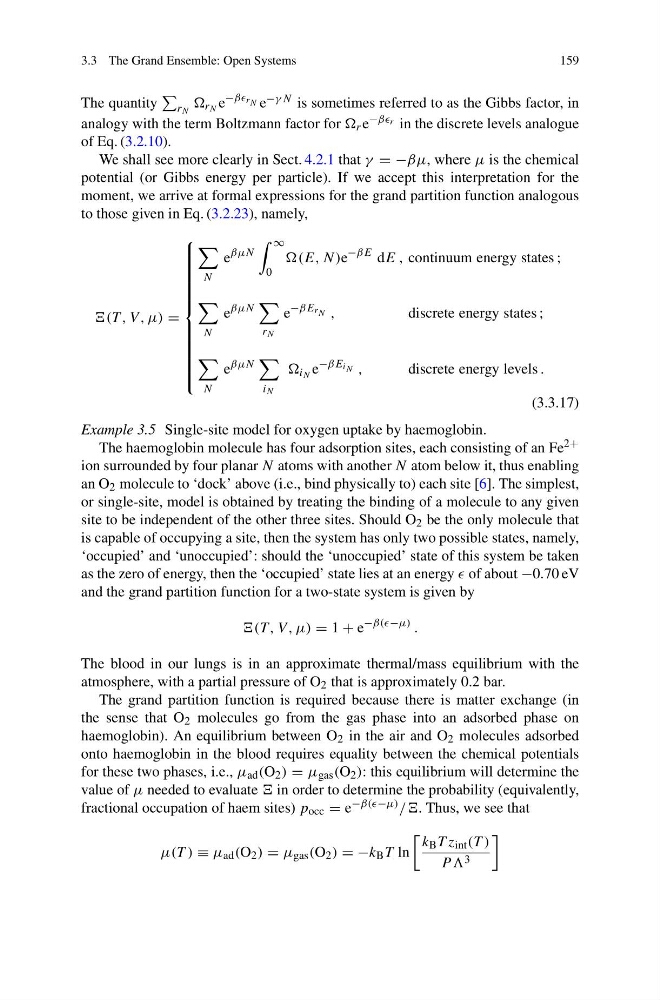
, V , μ) =
⎧
⎪ ⎪ ⎪ ⎪ ⎪ ⎪ ⎪ ⎪ ⎪ ⎪ ⎪ ⎨
⎪ ⎪ ⎪ ⎪ ⎪ ⎪ ⎪ ⎪ ⎪ ⎪ ⎪ ⎩
N
e
βμN
∞
0
(E, N)e
−βE dE , continuum energy states ;
N
e
βμN
r N
e
−βE r N ,
discrete energy states ;
N
e
βμN
i N
i N e
−βE i N ,
discrete energy levels .
(3.3.17)
Example 3.5 Single-site model for oxygen uptake by haemoglobin.
The haemoglobin molecule has four adsorption sites, each consisting of an Fe 2+
ion surrounded by four planar N atoms with another N atom below it, thus enabling
an O 2 molecule to ‘dock’ above (i.e., bind physically to) each site [6]. The simplest,
or single-site, model is obtained by treating the binding of a molecule to any given
site to be independent of the other three sites. Should O 2 be the only molecule that
is capable of occupying a site, then the system has only two possible states, namely,
‘occupied’ and ‘unoccupied’: should the ‘unoccupied’ state of this system be taken
as the zero of energy, then the ‘occupied’ state lies at an energy of about −0.70 eV
and the grand partition function for a two-state system is given by
, V , μ) = 1 + e
−β((−μ) .
The blood in our lungs is in an approximate thermal/mass equilibrium with the
atmosphere, with a partial pressure of O 2 that is approximately 0.2 bar.
The grand partition function is required because there is matter exchange (in
the sense that O 2 molecules go from the gas phase into an adsorbed phase on
haemoglobin). An equilibrium between O 2 in the air and O 2 molecules adsorbed
onto haemoglobin in the blood requires equality between the chemical potentials
for these two phases, i.e., μ ad (O 2 ) = μ gas (O 2 ): this equilibrium will determine the
value of μ needed to evaluate in order to determine the probability (equivalently,
fractional occupation of haem sites) p occ = e −β((−μ) //. Thus, we see that
μ(T ) ≡ μ ad (O 2 ) = μ gas (O 2 ) = −k B T ln
k B T z int (T )
P P 3
159
The quantity
r N
r N e
−ββ r N e −γ N is sometimes referred to as the Gibbs factor, in
analogy with the term Boltzmann factor for r e −ββ r in the discrete levels analogue
of Eq. (3.2.10).
We shall see more clearly in Sect. 4.2.1 that γ = −βμ, where μ is the chemical
potential (or Gibbs energy per particle). If we accept this interpretation for the
moment, we arrive at formal expressions for the grand partition function analogous
to those given in Eq. (3.2.23), namely,
, V , μ) =
⎧
⎪ ⎪ ⎪ ⎪ ⎪ ⎪ ⎪ ⎪ ⎪ ⎪ ⎪ ⎨
⎪ ⎪ ⎪ ⎪ ⎪ ⎪ ⎪ ⎪ ⎪ ⎪ ⎪ ⎩
N
e
βμN
∞
0
(E, N)e
−βE dE , continuum energy states ;
N
e
βμN
r N
e
−βE r N ,
discrete energy states ;
N
e
βμN
i N
i N e
−βE i N ,
discrete energy levels .
(3.3.17)
Example 3.5 Single-site model for oxygen uptake by haemoglobin.
The haemoglobin molecule has four adsorption sites, each consisting of an Fe 2+
ion surrounded by four planar N atoms with another N atom below it, thus enabling
an O 2 molecule to ‘dock’ above (i.e., bind physically to) each site [6]. The simplest,
or single-site, model is obtained by treating the binding of a molecule to any given
site to be independent of the other three sites. Should O 2 be the only molecule that
is capable of occupying a site, then the system has only two possible states, namely,
‘occupied’ and ‘unoccupied’: should the ‘unoccupied’ state of this system be taken
as the zero of energy, then the ‘occupied’ state lies at an energy of about −0.70 eV
and the grand partition function for a two-state system is given by
, V , μ) = 1 + e
−β((−μ) .
The blood in our lungs is in an approximate thermal/mass equilibrium with the
atmosphere, with a partial pressure of O 2 that is approximately 0.2 bar.
The grand partition function is required because there is matter exchange (in
the sense that O 2 molecules go from the gas phase into an adsorbed phase on
haemoglobin). An equilibrium between O 2 in the air and O 2 molecules adsorbed
onto haemoglobin in the blood requires equality between the chemical potentials
for these two phases, i.e., μ ad (O 2 ) = μ gas (O 2 ): this equilibrium will determine the
value of μ needed to evaluate in order to determine the probability (equivalently,
fractional occupation of haem sites) p occ = e −β((−μ) //. Thus, we see that
μ(T ) ≡ μ ad (O 2 ) = μ gas (O 2 ) = −k B T ln
k B T z int (T )
P P 3