

148
3 Ensembles: Systems of Particles
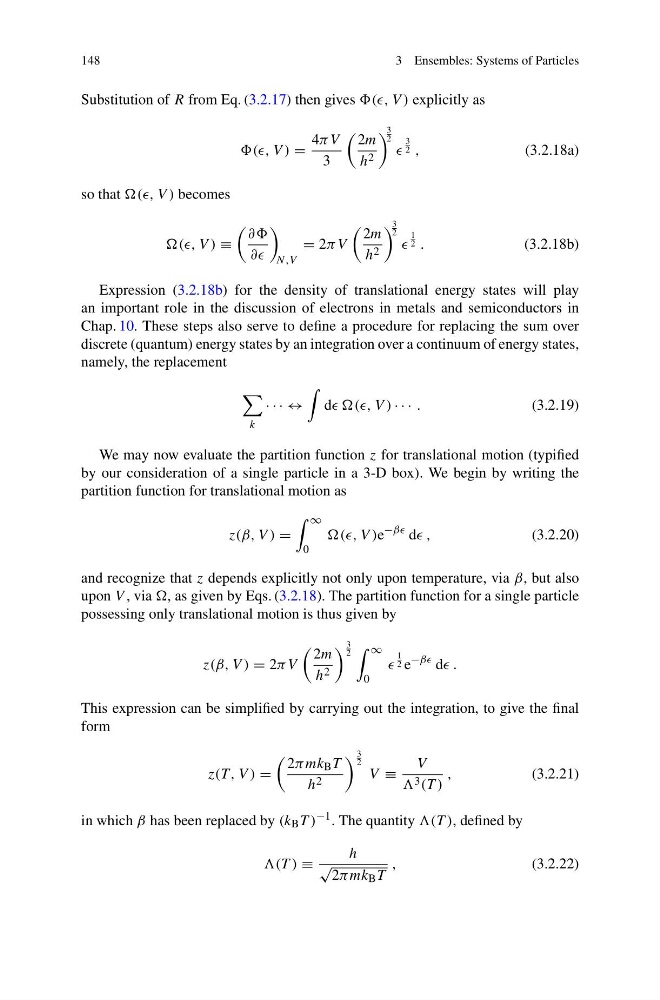
Substitution of R from Eq. (3.2.17) then gives V ) explicitly as
V ) =
4πV
3
2m
h 2
3
2
3
2 ,
(3.2.18a)
so that ((, V ) becomes
(, V ) ≡
∂∂
∂∂
N,V
= 2πV
2m
h 2
3
2
1
2 .
(3.2.18b)
Expression (3.2.18b) for the density of translational energy states will play
an important role in the discussion of electrons in metals and semiconductors in
Chap. 10. These steps also serve to define a procedure for replacing the sum over
discrete (quantum) energy states by an integration over a continuum of energy states,
namely, the replacement
k
· · · ↔
d V ) · · · .
(3.2.19)
We may now evaluate the partition function z for translational motion (typified
by our consideration of a single particle in a 3-D box). We begin by writing the
partition function for translational motion as
z(β, V ) =
∞
0
((, V )e
−ββ d ,
(3.2.20)
and recognize that z depends explicitly not only upon temperature, via β, but also
upon V , via , as given by Eqs. (3.2.18). The partition function for a single particle
possessing only translational motion is thus given by
z(β, V ) = 2πV
2m
h 2
3
2
∞
0
1
2 e
−ββ d .
This expression can be simplified by carrying out the integration, to give the final
form
z(T , V ) =
2πmk B T
h 2
3
2
V ≡
V
3 (T )
,
(3.2.21)
in which β has been replaced by (k B T ) −1 . The quantity (T ), defined by
(T ) ≡
h
√
2πmk B T
,
(3.2.22)
3 Ensembles: Systems of Particles
Substitution of R from Eq. (3.2.17) then gives V ) explicitly as
V ) =
4πV
3
2m
h 2
3
2
3
2 ,
(3.2.18a)
so that ((, V ) becomes
(, V ) ≡
∂∂
∂∂
N,V
= 2πV
2m
h 2
3
2
1
2 .
(3.2.18b)
Expression (3.2.18b) for the density of translational energy states will play
an important role in the discussion of electrons in metals and semiconductors in
Chap. 10. These steps also serve to define a procedure for replacing the sum over
discrete (quantum) energy states by an integration over a continuum of energy states,
namely, the replacement
k
· · · ↔
d V ) · · · .
(3.2.19)
We may now evaluate the partition function z for translational motion (typified
by our consideration of a single particle in a 3-D box). We begin by writing the
partition function for translational motion as
z(β, V ) =
∞
0
((, V )e
−ββ d ,
(3.2.20)
and recognize that z depends explicitly not only upon temperature, via β, but also
upon V , via , as given by Eqs. (3.2.18). The partition function for a single particle
possessing only translational motion is thus given by
z(β, V ) = 2πV
2m
h 2
3
2
∞
0
1
2 e
−ββ d .
This expression can be simplified by carrying out the integration, to give the final
form
z(T , V ) =
2πmk B T
h 2
3
2
V ≡
V
3 (T )
,
(3.2.21)
in which β has been replaced by (k B T ) −1 . The quantity (T ), defined by
(T ) ≡
h
√
2πmk B T
,
(3.2.22)