

3.2 The Canonical Ensemble: Closed Systems
147
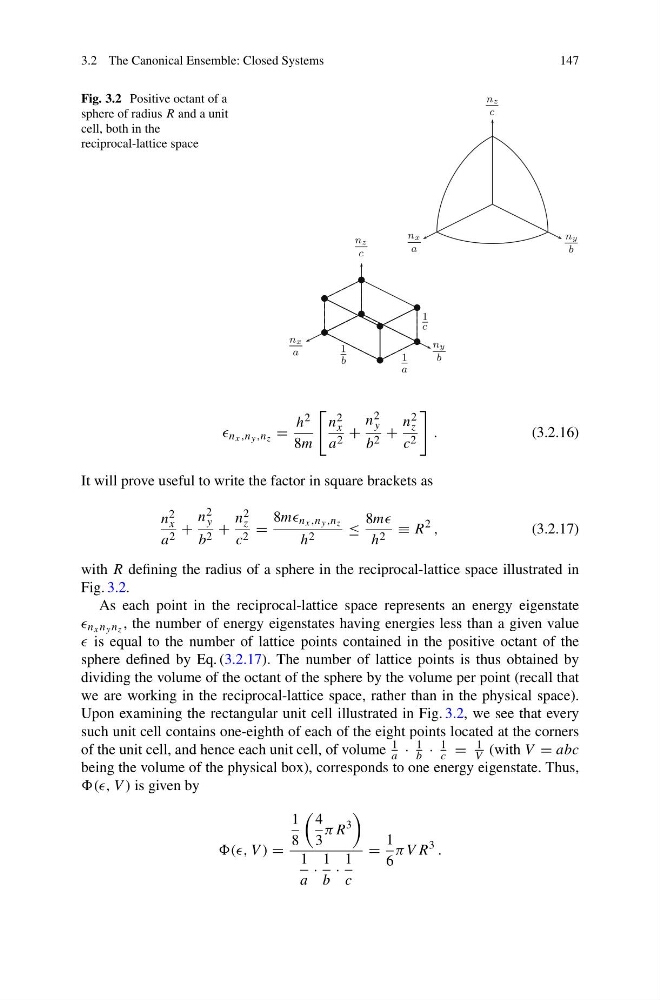
Fig. 3.2 Positive octant of a
sphere of radius R and a unit
cell, both in the
reciprocal-lattice space
nx
a
ny
b
nz
c
nx
a
ny
b
nz
c
1
b
1
a
1
c
n x ,n y ,n z =
h 2
8m
n 2
x
a 2 +
n 2
y
b 2 +
n 2
z
c 2
.
(3.2.16)
It will prove useful to write the factor in square brackets as
n 2
x
a 2 +
n 2
y
b 2 +
n 2
z
c 2 =
8mm n x ,n y ,n z
h 2
≤
8mm
h 2 ≡ R
2 ,
(3.2.17)
with R defining the radius of a sphere in the reciprocal-lattice space illustrated in
Fig. 3.2.
As each point in the reciprocal-lattice space represents an energy eigenstate
n x n y n z , the number of energy eigenstates having energies less than a given value
is equal to the number of lattice points contained in the positive octant of the
sphere defined by Eq. (3.2.17). The number of lattice points is thus obtained by
dividing the volume of the octant of the sphere by the volume per point (recall that
we are working in the reciprocal-lattice space, rather than in the physical space).
Upon examining the rectangular unit cell illustrated in Fig. 3.2, we see that every
such unit cell contains one-eighth of each of the eight points located at the corners
of the unit cell, and hence each unit cell, of volume
1
a ·
1
b ·
1
c =
1
V (with V = abc
being the volume of the physical box), corresponds to one energy eigenstate. Thus,
V ) is given by
V ) =
1
8
4
3
πR
3
1
a
·
1
b
·
1
c
=
1
6
πV R
3 .
147
Fig. 3.2 Positive octant of a
sphere of radius R and a unit
cell, both in the
reciprocal-lattice space
nx
a
ny
b
nz
c
nx
a
ny
b
nz
c
1
b
1
a
1
c
n x ,n y ,n z =
h 2
8m
n 2
x
a 2 +
n 2
y
b 2 +
n 2
z
c 2
.
(3.2.16)
It will prove useful to write the factor in square brackets as
n 2
x
a 2 +
n 2
y
b 2 +
n 2
z
c 2 =
8mm n x ,n y ,n z
h 2
≤
8mm
h 2 ≡ R
2 ,
(3.2.17)
with R defining the radius of a sphere in the reciprocal-lattice space illustrated in
Fig. 3.2.
As each point in the reciprocal-lattice space represents an energy eigenstate
n x n y n z , the number of energy eigenstates having energies less than a given value
is equal to the number of lattice points contained in the positive octant of the
sphere defined by Eq. (3.2.17). The number of lattice points is thus obtained by
dividing the volume of the octant of the sphere by the volume per point (recall that
we are working in the reciprocal-lattice space, rather than in the physical space).
Upon examining the rectangular unit cell illustrated in Fig. 3.2, we see that every
such unit cell contains one-eighth of each of the eight points located at the corners
of the unit cell, and hence each unit cell, of volume
1
a ·
1
b ·
1
c =
1
V (with V = abc
being the volume of the physical box), corresponds to one energy eigenstate. Thus,
V ) is given by
V ) =
1
8
4
3
πR
3
1
a
·
1
b
·
1
c
=
1
6
πV R
3 .