

3.2 The Canonical Ensemble: Closed Systems
149
is referred to as the thermal de Broglie wavelength. This quantity plays an important
role in statistical mechanics, and we shall say more about it later (especially in
Chap. 10).
Example 3.3 Translational states of a Ne atom with energy 3k B T .
Noble gas atoms, like neon (Ne), have ground electronic states that are separated
from their lowest excited electronic states by energies of the order of several electron
volts (eV), and hence at room temperature or thereabouts, the only energy states
accessible to these atoms are translational states. Let us estimate the number of
translational states lying at or below an energy 3k B T that are accessible to a Ne
atom in a box of volume 10 cm 3 for a temperature of 300 K.
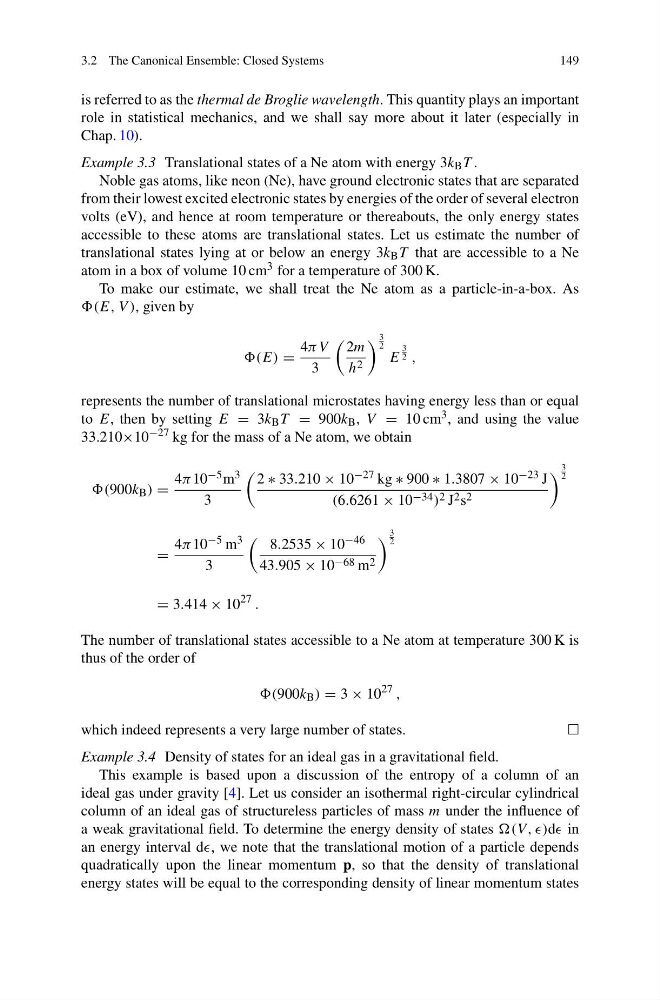
To make our estimate, we shall treat the Ne atom as a particle-in-a-box. As
(E, V ), given by
=
4πV
3
2m
h 2
3
2
E
3
2 ,
represents the number of translational microstates having energy less than or equal
to E, then by setting E = 3k B T = 900k B , V = 10 cm 3 , and using the value
33.210×10 −27 kg for the mass of a Ne atom, we obtain
(900k B ) =
4π 10 −5 m 3
3
2 ∗ 33.210 × 10 −27 kg ∗ 900 ∗ 1.3807 × 10 −23 J
(6.6261 × 10 −34 ) 2 J 2 s 2
3
2
=
4π 10 −5 m 3
3
8.2535 × 10 −46
43.905 × 10 −68 m 2
3
2
= 3.414 × 10
27 .
The number of translational states accessible to a Ne atom at temperature 300 K is
thus of the order of
(900k B ) = 3 × 10
27 ,
which indeed represents a very large number of states.
Example 3.4 Density of states for an ideal gas in a gravitational field.
This example is based upon a discussion of the entropy of a column of an
ideal gas under gravity [4]. Let us consider an isothermal right-circular cylindrical
column of an ideal gas of structureless particles of mass m under the influence of
a weak gravitational field. To determine the energy density of states (V , ,)d in
an energy interval d, we note that the translational motion of a particle depends
quadratically upon the linear momentum p, so that the density of translational
energy states will be equal to the corresponding density of linear momentum states
149
is referred to as the thermal de Broglie wavelength. This quantity plays an important
role in statistical mechanics, and we shall say more about it later (especially in
Chap. 10).
Example 3.3 Translational states of a Ne atom with energy 3k B T .
Noble gas atoms, like neon (Ne), have ground electronic states that are separated
from their lowest excited electronic states by energies of the order of several electron
volts (eV), and hence at room temperature or thereabouts, the only energy states
accessible to these atoms are translational states. Let us estimate the number of
translational states lying at or below an energy 3k B T that are accessible to a Ne
atom in a box of volume 10 cm 3 for a temperature of 300 K.
To make our estimate, we shall treat the Ne atom as a particle-in-a-box. As
(E, V ), given by
=
4πV
3
2m
h 2
3
2
E
3
2 ,
represents the number of translational microstates having energy less than or equal
to E, then by setting E = 3k B T = 900k B , V = 10 cm 3 , and using the value
33.210×10 −27 kg for the mass of a Ne atom, we obtain
(900k B ) =
4π 10 −5 m 3
3
2 ∗ 33.210 × 10 −27 kg ∗ 900 ∗ 1.3807 × 10 −23 J
(6.6261 × 10 −34 ) 2 J 2 s 2
3
2
=
4π 10 −5 m 3
3
8.2535 × 10 −46
43.905 × 10 −68 m 2
3
2
= 3.414 × 10
27 .
The number of translational states accessible to a Ne atom at temperature 300 K is
thus of the order of
(900k B ) = 3 × 10
27 ,
which indeed represents a very large number of states.
Example 3.4 Density of states for an ideal gas in a gravitational field.
This example is based upon a discussion of the entropy of a column of an
ideal gas under gravity [4]. Let us consider an isothermal right-circular cylindrical
column of an ideal gas of structureless particles of mass m under the influence of
a weak gravitational field. To determine the energy density of states (V , ,)d in
an energy interval d, we note that the translational motion of a particle depends
quadratically upon the linear momentum p, so that the density of translational
energy states will be equal to the corresponding density of linear momentum states