

2.8 Thermodynamics of Real Gases
119
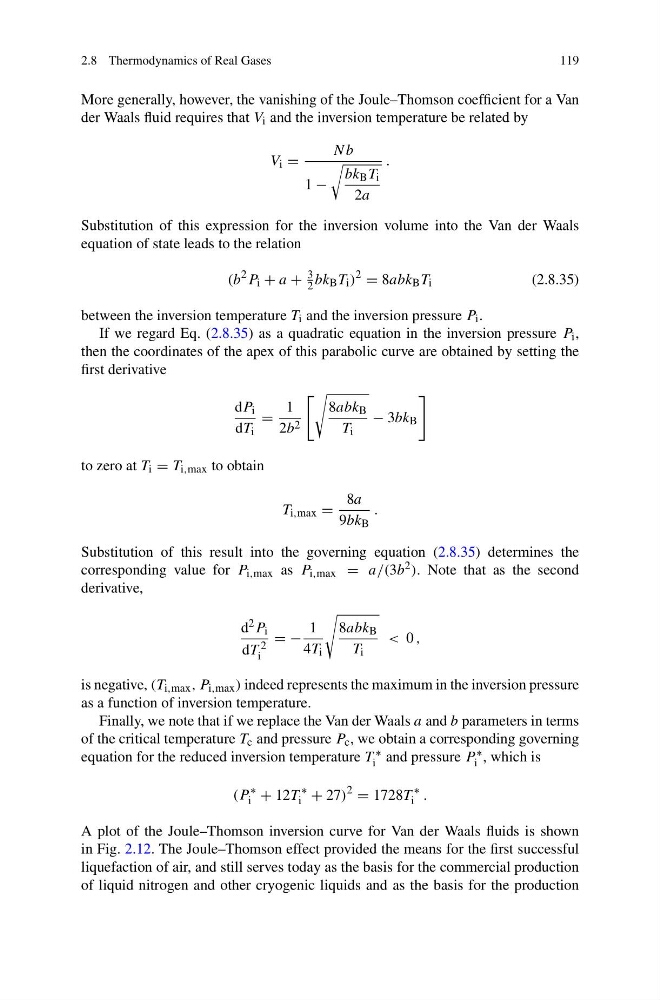
More generally, however, the vanishing of the Joule–Thomson coefficient for a Van
der Waals fluid requires that V i and the inversion temperature be related by
V i =
Nb
1 −
bk B T i
2a
.
Substitution of this expression for the inversion volume into the Van der Waals
equation of state leads to the relation
(b
2 P i + a +
3
2 bk B T i )
2
= 8abk B T i
(2.8.35)
between the inversion temperature T i and the inversion pressure P i .
If we regard Eq. (2.8.35) as a quadratic equation in the inversion pressure P i ,
then the coordinates of the apex of this parabolic curve are obtained by setting the
first derivative
dP i
dT i
=
1
2b 2
8abk B
T i
− 3bk B
to zero at T i = T i,max to obtain
T i,max =
8a
9bk B
.
Substitution of this result into the governing equation (2.8.35) determines the
corresponding value for P i,max as P i,max = a/(3b 2 ). Note that as the second
derivative,
d 2 P i
dT 2
i
= −
1
4T i
8abk B
T i
< 0 ,
is negative, (T i,max , P i,max ) indeed represents the maximum in the inversion pressure
as a function of inversion temperature.
Finally, we note that if we replace the Van der Waals a and b parameters in terms
of the critical temperature T c and pressure P c , we obtain a corresponding governing
equation for the reduced inversion temperature T ∗
i and pressure P ∗
i , which is
(P
∗
i + 12T
∗
i + 27)
2
= 1728T
∗
i .
A plot of the Joule–Thomson inversion curve for Van der Waals fluids is shown
in Fig. 2.12. The Joule–Thomson effect provided the means for the first successful
liquefaction of air, and still serves today as the basis for the commercial production
of liquid nitrogen and other cryogenic liquids and as the basis for the production
119
More generally, however, the vanishing of the Joule–Thomson coefficient for a Van
der Waals fluid requires that V i and the inversion temperature be related by
V i =
Nb
1 −
bk B T i
2a
.
Substitution of this expression for the inversion volume into the Van der Waals
equation of state leads to the relation
(b
2 P i + a +
3
2 bk B T i )
2
= 8abk B T i
(2.8.35)
between the inversion temperature T i and the inversion pressure P i .
If we regard Eq. (2.8.35) as a quadratic equation in the inversion pressure P i ,
then the coordinates of the apex of this parabolic curve are obtained by setting the
first derivative
dP i
dT i
=
1
2b 2
8abk B
T i
− 3bk B
to zero at T i = T i,max to obtain
T i,max =
8a
9bk B
.
Substitution of this result into the governing equation (2.8.35) determines the
corresponding value for P i,max as P i,max = a/(3b 2 ). Note that as the second
derivative,
d 2 P i
dT 2
i
= −
1
4T i
8abk B
T i
< 0 ,
is negative, (T i,max , P i,max ) indeed represents the maximum in the inversion pressure
as a function of inversion temperature.
Finally, we note that if we replace the Van der Waals a and b parameters in terms
of the critical temperature T c and pressure P c , we obtain a corresponding governing
equation for the reduced inversion temperature T ∗
i and pressure P ∗
i , which is
(P
∗
i + 12T
∗
i + 27)
2
= 1728T
∗
i .
A plot of the Joule–Thomson inversion curve for Van der Waals fluids is shown
in Fig. 2.12. The Joule–Thomson effect provided the means for the first successful
liquefaction of air, and still serves today as the basis for the commercial production
of liquid nitrogen and other cryogenic liquids and as the basis for the production