

118
2 Macroscopic Thermodynamics
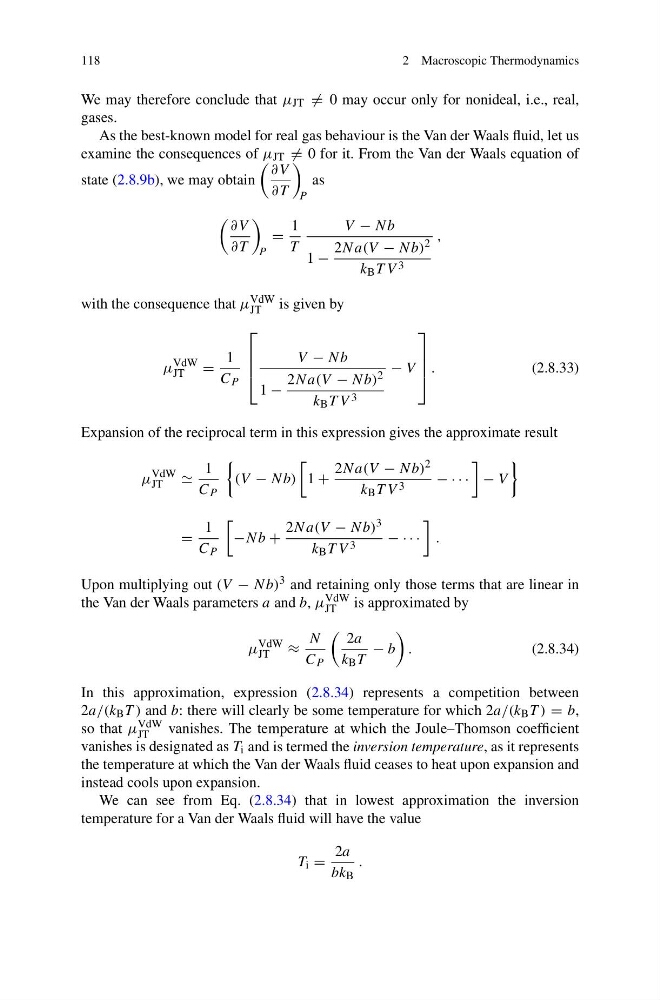
We may therefore conclude that μ JT = 0 may occur only for nonideal, i.e., real,
gases.
As the best-known model for real gas behaviour is the Van der Waals fluid, let us
examine the consequences of μ JT = 0 for it. From the Van der Waals equation of
state (2.8.9b), we may obtain
∂V
∂T
P
as
∂V
∂T
P
=
1
T
V − Nb
1 −
2Na(V − Nb) 2
k B T V 3
,
with the consequence that μ VdW
JT
is given by
μ
VdW
JT
=
1
C P
⎡
⎢
⎢
⎣
V − Nb
1 −
2Na(V − Nb) 2
k B T V 3
− V
⎤
⎥
⎥
⎦ .
(2.8.33)
Expansion of the reciprocal term in this expression gives the approximate result
μ
VdW
JT
1
C P
(V − Nb)
1 +
2Na(V − Nb) 2
k B T V 3
− · · ·
− V
=
1
C P
−Nb +
2Na(V − Nb) 3
k B T V 3
− · · ·
.
Upon multiplying out (V − Nb) 3 and retaining only those terms that are linear in
the Van der Waals parameters a and b, μ VdW
JT
is approximated by
μ
VdW
JT
≈
N
C P
2a
k B T
− b
.
(2.8.34)
In this approximation, expression (2.8.34) represents a competition between
2a/(k B T ) and b: there will clearly be some temperature for which 2a/(k B T ) = b,
so that μ VdW
JT
vanishes. The temperature at which the Joule–Thomson coefficient
vanishes is designated as T i and is termed the inversion temperature, as it represents
the temperature at which the Van der Waals fluid ceases to heat upon expansion and
instead cools upon expansion.
We can see from Eq. (2.8.34) that in lowest approximation the inversion
temperature for a Van der Waals fluid will have the value
T i =
2a
bk B
.
2 Macroscopic Thermodynamics
We may therefore conclude that μ JT = 0 may occur only for nonideal, i.e., real,
gases.
As the best-known model for real gas behaviour is the Van der Waals fluid, let us
examine the consequences of μ JT = 0 for it. From the Van der Waals equation of
state (2.8.9b), we may obtain
∂V
∂T
P
as
∂V
∂T
P
=
1
T
V − Nb
1 −
2Na(V − Nb) 2
k B T V 3
,
with the consequence that μ VdW
JT
is given by
μ
VdW
JT
=
1
C P
⎡
⎢
⎢
⎣
V − Nb
1 −
2Na(V − Nb) 2
k B T V 3
− V
⎤
⎥
⎥
⎦ .
(2.8.33)
Expansion of the reciprocal term in this expression gives the approximate result
μ
VdW
JT
1
C P
(V − Nb)
1 +
2Na(V − Nb) 2
k B T V 3
− · · ·
− V
=
1
C P
−Nb +
2Na(V − Nb) 3
k B T V 3
− · · ·
.
Upon multiplying out (V − Nb) 3 and retaining only those terms that are linear in
the Van der Waals parameters a and b, μ VdW
JT
is approximated by
μ
VdW
JT
≈
N
C P
2a
k B T
− b
.
(2.8.34)
In this approximation, expression (2.8.34) represents a competition between
2a/(k B T ) and b: there will clearly be some temperature for which 2a/(k B T ) = b,
so that μ VdW
JT
vanishes. The temperature at which the Joule–Thomson coefficient
vanishes is designated as T i and is termed the inversion temperature, as it represents
the temperature at which the Van der Waals fluid ceases to heat upon expansion and
instead cools upon expansion.
We can see from Eq. (2.8.34) that in lowest approximation the inversion
temperature for a Van der Waals fluid will have the value
T i =
2a
bk B
.