

2.8 Thermodynamics of Real Gases
117
∂T
∂P
H
∂H
∂T
P
∂P
∂H
T
= −1
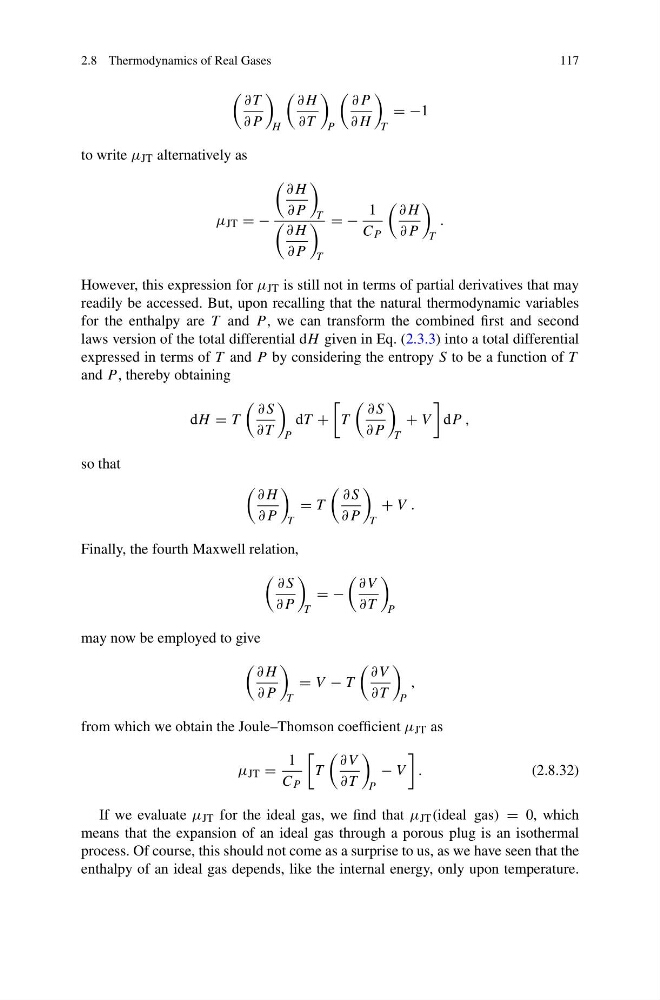
to write μ JT alternatively as
μ JT = −
∂H
∂P
T
∂H
∂P
T
= −
1
C P
∂H
∂P
T
.
However, this expression for μ JT is still not in terms of partial derivatives that may
readily be accessed. But, upon recalling that the natural thermodynamic variables
for the enthalpy are T and P , we can transform the combined first and second
laws version of the total differential dH given in Eq. (2.3.3) into a total differential
expressed in terms of T and P by considering the entropy S to be a function of T
and P , thereby obtaining
dH = T
∂S
∂T
P
dT +
T
∂S
∂P
T
+ V
dP ,
so that
∂H
∂P
T
= T
∂S
∂P
T
+ V .
Finally, the fourth Maxwell relation,
∂S
∂P
T
= −
∂V
∂T
P
may now be employed to give
∂H
∂P
T
= V − T
∂V
∂T
P
,
from which we obtain the Joule–Thomson coefficient μ JT as
μ JT =
1
C P
T
∂V
∂T
P
− V
.
(2.8.32)
If we evaluate μ JT for the ideal gas, we find that μ JT (ideal gas) = 0, which
means that the expansion of an ideal gas through a porous plug is an isothermal
process. Of course, this should not come as a surprise to us, as we have seen that the
enthalpy of an ideal gas depends, like the internal energy, only upon temperature.
117
∂T
∂P
H
∂H
∂T
P
∂P
∂H
T
= −1
to write μ JT alternatively as
μ JT = −
∂H
∂P
T
∂H
∂P
T
= −
1
C P
∂H
∂P
T
.
However, this expression for μ JT is still not in terms of partial derivatives that may
readily be accessed. But, upon recalling that the natural thermodynamic variables
for the enthalpy are T and P , we can transform the combined first and second
laws version of the total differential dH given in Eq. (2.3.3) into a total differential
expressed in terms of T and P by considering the entropy S to be a function of T
and P , thereby obtaining
dH = T
∂S
∂T
P
dT +
T
∂S
∂P
T
+ V
dP ,
so that
∂H
∂P
T
= T
∂S
∂P
T
+ V .
Finally, the fourth Maxwell relation,
∂S
∂P
T
= −
∂V
∂T
P
may now be employed to give
∂H
∂P
T
= V − T
∂V
∂T
P
,
from which we obtain the Joule–Thomson coefficient μ JT as
μ JT =
1
C P
T
∂V
∂T
P
− V
.
(2.8.32)
If we evaluate μ JT for the ideal gas, we find that μ JT (ideal gas) = 0, which
means that the expansion of an ideal gas through a porous plug is an isothermal
process. Of course, this should not come as a surprise to us, as we have seen that the
enthalpy of an ideal gas depends, like the internal energy, only upon temperature.