

116
2 Macroscopic Thermodynamics
W = −
0
V 1
P ext,1 dV −
V 2
0
P ext,2 dV
= −(P 2 V 2 − P 1 V 1 ).
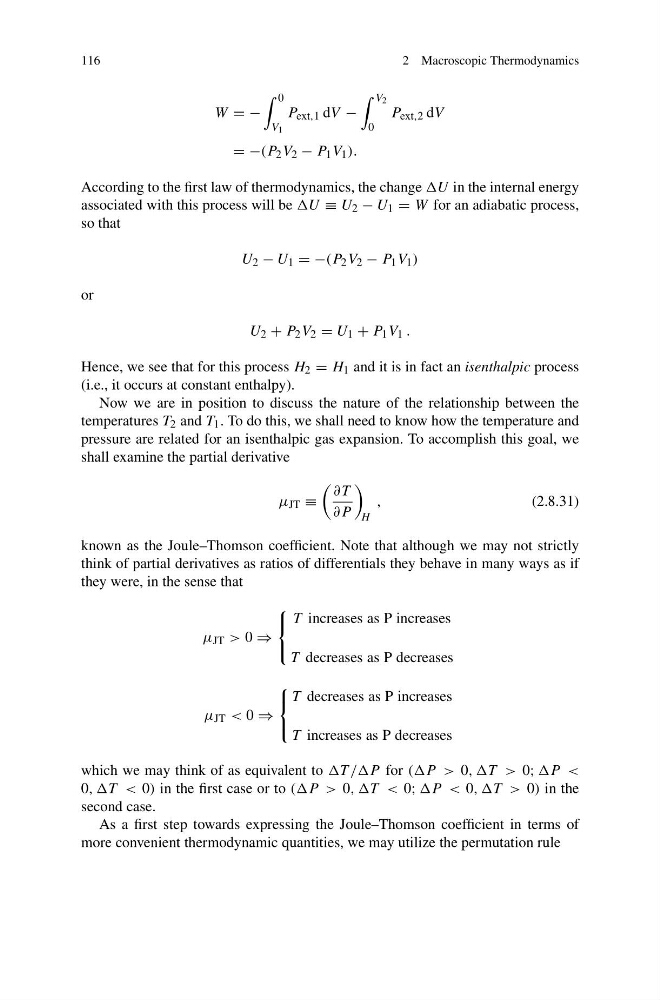
According to the first law of thermodynamics, the change U in the internal energy
associated with this process will be U ≡ U 2 − U 1 = W for an adiabatic process,
so that
U 2 − U 1 = −(P 2 V 2 − P 1 V 1 )
or
U 2 + P 2 V 2 = U 1 + P 1 V 1 .
Hence, we see that for this process H 2 = H 1 and it is in fact an isenthalpic process
(i.e., it occurs at constant enthalpy).
Now we are in position to discuss the nature of the relationship between the
temperatures T 2 and T 1 . To do this, we shall need to know how the temperature and
pressure are related for an isenthalpic gas expansion. To accomplish this goal, we
shall examine the partial derivative
μ JT ≡
∂T
∂P
H
,
(2.8.31)
known as the Joule–Thomson coefficient. Note that although we may not strictly
think of partial derivatives as ratios of differentials they behave in many ways as if
they were, in the sense that
μ JT > 0 ⇒
⎧
⎨
⎩
T increases as P increases
T decreases as P decreases
μ JT < 0 ⇒
⎧
⎨
⎩
T decreases as P increases
T increases as P decreases
which we may think of as equivalent to T //P for ((P > 0, ,T > 0; <
0, ,T < 0) in the first case or to ((P > 0, ,T < 0; < 0, ,T > 0) in the
second case.
As a first step towards expressing the Joule–Thomson coefficient in terms of
more convenient thermodynamic quantities, we may utilize the permutation rule
2 Macroscopic Thermodynamics
W = −
0
V 1
P ext,1 dV −
V 2
0
P ext,2 dV
= −(P 2 V 2 − P 1 V 1 ).
According to the first law of thermodynamics, the change U in the internal energy
associated with this process will be U ≡ U 2 − U 1 = W for an adiabatic process,
so that
U 2 − U 1 = −(P 2 V 2 − P 1 V 1 )
or
U 2 + P 2 V 2 = U 1 + P 1 V 1 .
Hence, we see that for this process H 2 = H 1 and it is in fact an isenthalpic process
(i.e., it occurs at constant enthalpy).
Now we are in position to discuss the nature of the relationship between the
temperatures T 2 and T 1 . To do this, we shall need to know how the temperature and
pressure are related for an isenthalpic gas expansion. To accomplish this goal, we
shall examine the partial derivative
μ JT ≡
∂T
∂P
H
,
(2.8.31)
known as the Joule–Thomson coefficient. Note that although we may not strictly
think of partial derivatives as ratios of differentials they behave in many ways as if
they were, in the sense that
μ JT > 0 ⇒
⎧
⎨
⎩
T increases as P increases
T decreases as P decreases
μ JT < 0 ⇒
⎧
⎨
⎩
T decreases as P increases
T increases as P decreases
which we may think of as equivalent to T //P for ((P > 0, ,T > 0; <
0, ,T < 0) in the first case or to ((P > 0, ,T < 0; < 0, ,T > 0) in the
second case.
As a first step towards expressing the Joule–Thomson coefficient in terms of
more convenient thermodynamic quantities, we may utilize the permutation rule