

2.8 Thermodynamics of Real Gases
115
Compressor
P 1
P 2 < P 1
Porous plug
initial state
final state
P 1
P 2
P 1
P 2
V 1 , T 1
V 2 , T 2
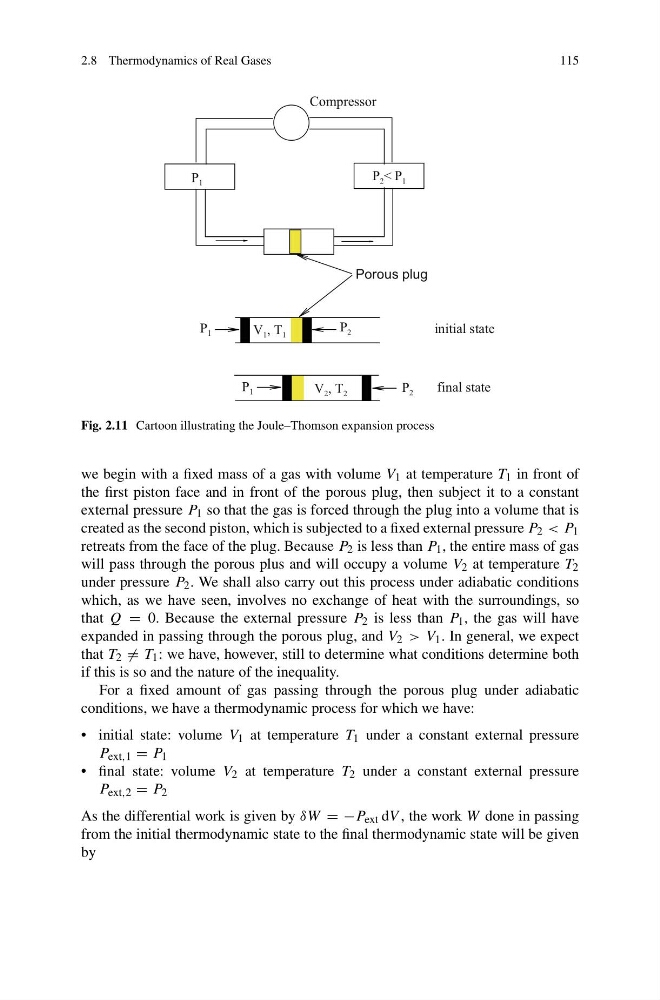
Fig. 2.11 Cartoon illustrating the Joule–Thomson expansion process
we begin with a fixed mass of a gas with volume V 1 at temperature T 1 in front of
the first piston face and in front of the porous plug, then subject it to a constant
external pressure P 1 so that the gas is forced through the plug into a volume that is
created as the second piston, which is subjected to a fixed external pressure P 2 < P 1
retreats from the face of the plug. Because P 2 is less than P 1 , the entire mass of gas
will pass through the porous plus and will occupy a volume V 2 at temperature T 2
under pressure P 2 . We shall also carry out this process under adiabatic conditions
which, as we have seen, involves no exchange of heat with the surroundings, so
that Q = 0. Because the external pressure P 2 is less than P 1 , the gas will have
expanded in passing through the porous plug, and V 2 > V 1 . In general, we expect
that T 2 = T 1 : we have, however, still to determine what conditions determine both
if this is so and the nature of the inequality.
For a fixed amount of gas passing through the porous plug under adiabatic
conditions, we have a thermodynamic process for which we have:
• initial state: volume V 1 at temperature T 1 under a constant external pressure
P ext,1 = P 1
• final state: volume V 2 at temperature T 2 under a constant external pressure
P ext,2 = P 2
As the differential work is given by δW = −P ext dV , the work W done in passing
from the initial thermodynamic state to the final thermodynamic state will be given
by
115
Compressor
P 1
P 2 < P 1
Porous plug
initial state
final state
P 1
P 2
P 1
P 2
V 1 , T 1
V 2 , T 2
Fig. 2.11 Cartoon illustrating the Joule–Thomson expansion process
we begin with a fixed mass of a gas with volume V 1 at temperature T 1 in front of
the first piston face and in front of the porous plug, then subject it to a constant
external pressure P 1 so that the gas is forced through the plug into a volume that is
created as the second piston, which is subjected to a fixed external pressure P 2 < P 1
retreats from the face of the plug. Because P 2 is less than P 1 , the entire mass of gas
will pass through the porous plus and will occupy a volume V 2 at temperature T 2
under pressure P 2 . We shall also carry out this process under adiabatic conditions
which, as we have seen, involves no exchange of heat with the surroundings, so
that Q = 0. Because the external pressure P 2 is less than P 1 , the gas will have
expanded in passing through the porous plug, and V 2 > V 1 . In general, we expect
that T 2 = T 1 : we have, however, still to determine what conditions determine both
if this is so and the nature of the inequality.
For a fixed amount of gas passing through the porous plug under adiabatic
conditions, we have a thermodynamic process for which we have:
• initial state: volume V 1 at temperature T 1 under a constant external pressure
P ext,1 = P 1
• final state: volume V 2 at temperature T 2 under a constant external pressure
P ext,2 = P 2
As the differential work is given by δW = −P ext dV , the work W done in passing
from the initial thermodynamic state to the final thermodynamic state will be given
by