

114
2 Macroscopic Thermodynamics
a =
3P c V 2
c
N 2 ,
b=
V c
3N
,
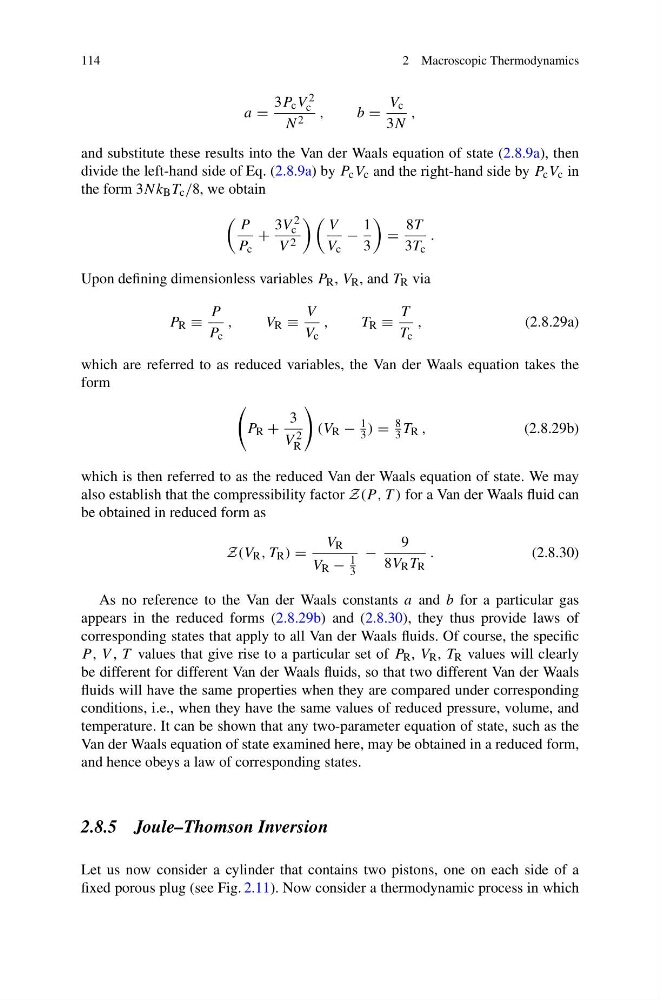
and substitute these results into the Van der Waals equation of state (2.8.9a), then
divide the left-hand side of Eq. (2.8.9a) by P c V c and the right-hand side by P c V c in
the form 3Nk B T c /8, we obtain
P
P c
+
3V 2
c
V 2
V
V c
−
1
3
=
8T
3T c
.
Upon defining dimensionless variables P R , V R , and T R via
P R ≡
P
P c
,
V R ≡
V
V c
,
T R ≡
T
T c
,
(2.8.29a)
which are referred to as reduced variables, the Van der Waals equation takes the
form
P R +
3
V 2
R
(V R −
1
3 ) =
8
3 T R ,
(2.8.29b)
which is then referred to as the reduced Van der Waals equation of state. We may
also establish that the compressibility factor Z(P , T ) for a Van der Waals fluid can
be obtained in reduced form as
Z(V R , T R ) =
V R
V R −
1
3
−
9
8V R T R
.
(2.8.30)
As no reference to the Van der Waals constants a and b for a particular gas
appears in the reduced forms (2.8.29b) and (2.8.30), they thus provide laws of
corresponding states that apply to all Van der Waals fluids. Of course, the specific
P , V , T values that give rise to a particular set of P R , V R , T R values will clearly
be different for different Van der Waals fluids, so that two different Van der Waals
fluids will have the same properties when they are compared under corresponding
conditions, i.e., when they have the same values of reduced pressure, volume, and
temperature. It can be shown that any two-parameter equation of state, such as the
Van der Waals equation of state examined here, may be obtained in a reduced form,
and hence obeys a law of corresponding states.
2.8.5 Joule–Thomson Inversion
Let us now consider a cylinder that contains two pistons, one on each side of a
fixed porous plug (see Fig. 2.11). Now consider a thermodynamic process in which
2 Macroscopic Thermodynamics
a =
3P c V 2
c
N 2 ,
b=
V c
3N
,
and substitute these results into the Van der Waals equation of state (2.8.9a), then
divide the left-hand side of Eq. (2.8.9a) by P c V c and the right-hand side by P c V c in
the form 3Nk B T c /8, we obtain
P
P c
+
3V 2
c
V 2
V
V c
−
1
3
=
8T
3T c
.
Upon defining dimensionless variables P R , V R , and T R via
P R ≡
P
P c
,
V R ≡
V
V c
,
T R ≡
T
T c
,
(2.8.29a)
which are referred to as reduced variables, the Van der Waals equation takes the
form
P R +
3
V 2
R
(V R −
1
3 ) =
8
3 T R ,
(2.8.29b)
which is then referred to as the reduced Van der Waals equation of state. We may
also establish that the compressibility factor Z(P , T ) for a Van der Waals fluid can
be obtained in reduced form as
Z(V R , T R ) =
V R
V R −
1
3
−
9
8V R T R
.
(2.8.30)
As no reference to the Van der Waals constants a and b for a particular gas
appears in the reduced forms (2.8.29b) and (2.8.30), they thus provide laws of
corresponding states that apply to all Van der Waals fluids. Of course, the specific
P , V , T values that give rise to a particular set of P R , V R , T R values will clearly
be different for different Van der Waals fluids, so that two different Van der Waals
fluids will have the same properties when they are compared under corresponding
conditions, i.e., when they have the same values of reduced pressure, volume, and
temperature. It can be shown that any two-parameter equation of state, such as the
Van der Waals equation of state examined here, may be obtained in a reduced form,
and hence obeys a law of corresponding states.
2.8.5 Joule–Thomson Inversion
Let us now consider a cylinder that contains two pistons, one on each side of a
fixed porous plug (see Fig. 2.11). Now consider a thermodynamic process in which