

2.8 Thermodynamics of Real Gases
113
a result often referred to [19] as the lever rule. 13 For example, the lever rule as applied to the liquid-gaseous mixture at total pressure P 0 and having total volume V
(located at B in Fig. 2.10) may be expressed as n L = n g L g , with L = V − V
and L g = V g − V representing the lengths of the tie-line from the end-points A and
C, respectively.
The isotherm in Fig. 2.10 that has only an inflection point is called the critical
isotherm, its temperature is called the critical temperature, T c . The inflection point
is called the critical point of the Van der Waals fluid, and is characterized by the
critical volume, V c , and critical pressure, P c . The critical values T c and V c for a Van
der Waals fluid may be obtained from the conditions
∂P
∂V
T c
=
∂ 2 P
∂V 2
T c
= 0
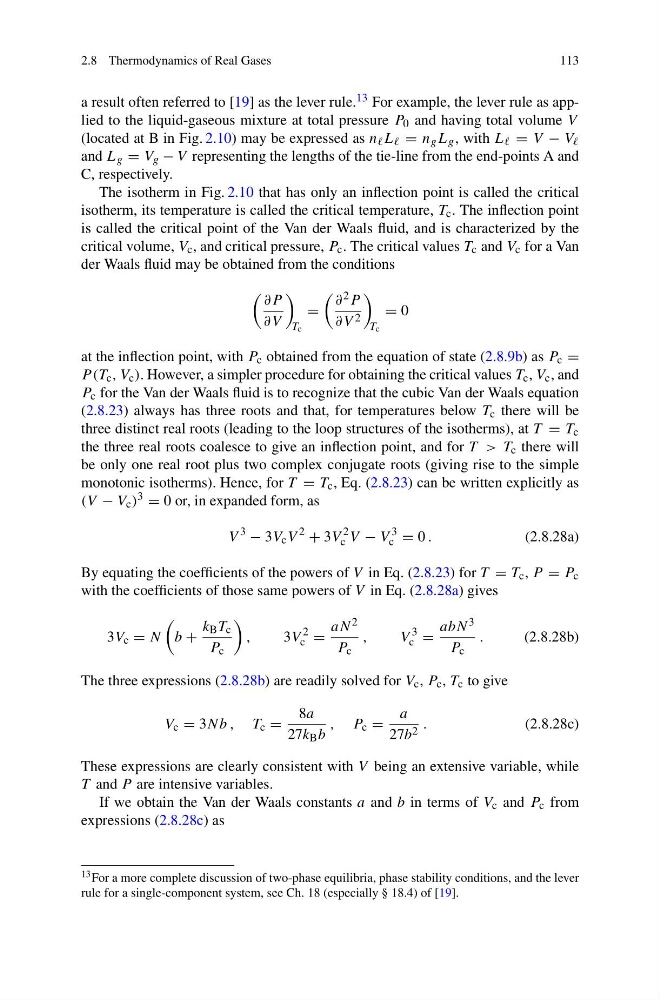
at the inflection point, with P c obtained from the equation of state (2.8.9b) as P c =
P (T c , V c ). However, a simpler procedure for obtaining the critical values T c , V c , and
P c for the Van der Waals fluid is to recognize that the cubic Van der Waals equation
(2.8.23) always has three roots and that, for temperatures below T c there will be
three distinct real roots (leading to the loop structures of the isotherms), at T = T c
the three real roots coalesce to give an inflection point, and for T > T c there will
be only one real root plus two complex conjugate roots (giving rise to the simple
monotonic isotherms). Hence, for T = T c , Eq. (2.8.23) can be written explicitly as
(V − V c ) 3 = 0 or, in expanded form, as
V
3
− 3V c V
2
+ 3V
2
c V − V
3
c = 0 .
(2.8.28a)
By equating the coefficients of the powers of V in Eq. (2.8.23) for T = T c , P = P c
with the coefficients of those same powers of V in Eq. (2.8.28a) gives
3V c = N
b +
k B T c
P c
,
3V
2
c =
aN 2
P c
,
V
3
c =
abN 3
P c
.
(2.8.28b)
The three expressions (2.8.28b) are readily solved for V c , P c , T c to give
V c = 3Nb , T c =
8a
27k B b
, P c =
a
27b 2 .
(2.8.28c)
These expressions are clearly consistent with V being an extensive variable, while
T and P are intensive variables.
If we obtain the Van der Waals constants a and b in terms of V c and P c from
expressions (2.8.28c) as
13 For a more complete discussion of two-phase equilibria, phase stability conditions, and the lever
rule for a single-component system, see Ch. 18 (especially § 18.4) of [19].
113
a result often referred to [19] as the lever rule. 13 For example, the lever rule as applied to the liquid-gaseous mixture at total pressure P 0 and having total volume V
(located at B in Fig. 2.10) may be expressed as n L = n g L g , with L = V − V
and L g = V g − V representing the lengths of the tie-line from the end-points A and
C, respectively.
The isotherm in Fig. 2.10 that has only an inflection point is called the critical
isotherm, its temperature is called the critical temperature, T c . The inflection point
is called the critical point of the Van der Waals fluid, and is characterized by the
critical volume, V c , and critical pressure, P c . The critical values T c and V c for a Van
der Waals fluid may be obtained from the conditions
∂P
∂V
T c
=
∂ 2 P
∂V 2
T c
= 0
at the inflection point, with P c obtained from the equation of state (2.8.9b) as P c =
P (T c , V c ). However, a simpler procedure for obtaining the critical values T c , V c , and
P c for the Van der Waals fluid is to recognize that the cubic Van der Waals equation
(2.8.23) always has three roots and that, for temperatures below T c there will be
three distinct real roots (leading to the loop structures of the isotherms), at T = T c
the three real roots coalesce to give an inflection point, and for T > T c there will
be only one real root plus two complex conjugate roots (giving rise to the simple
monotonic isotherms). Hence, for T = T c , Eq. (2.8.23) can be written explicitly as
(V − V c ) 3 = 0 or, in expanded form, as
V
3
− 3V c V
2
+ 3V
2
c V − V
3
c = 0 .
(2.8.28a)
By equating the coefficients of the powers of V in Eq. (2.8.23) for T = T c , P = P c
with the coefficients of those same powers of V in Eq. (2.8.28a) gives
3V c = N
b +
k B T c
P c
,
3V
2
c =
aN 2
P c
,
V
3
c =
abN 3
P c
.
(2.8.28b)
The three expressions (2.8.28b) are readily solved for V c , P c , T c to give
V c = 3Nb , T c =
8a
27k B b
, P c =
a
27b 2 .
(2.8.28c)
These expressions are clearly consistent with V being an extensive variable, while
T and P are intensive variables.
If we obtain the Van der Waals constants a and b in terms of V c and P c from
expressions (2.8.28c) as
13 For a more complete discussion of two-phase equilibria, phase stability conditions, and the lever
rule for a single-component system, see Ch. 18 (especially § 18.4) of [19].