

2.8 Thermodynamics of Real Gases
105
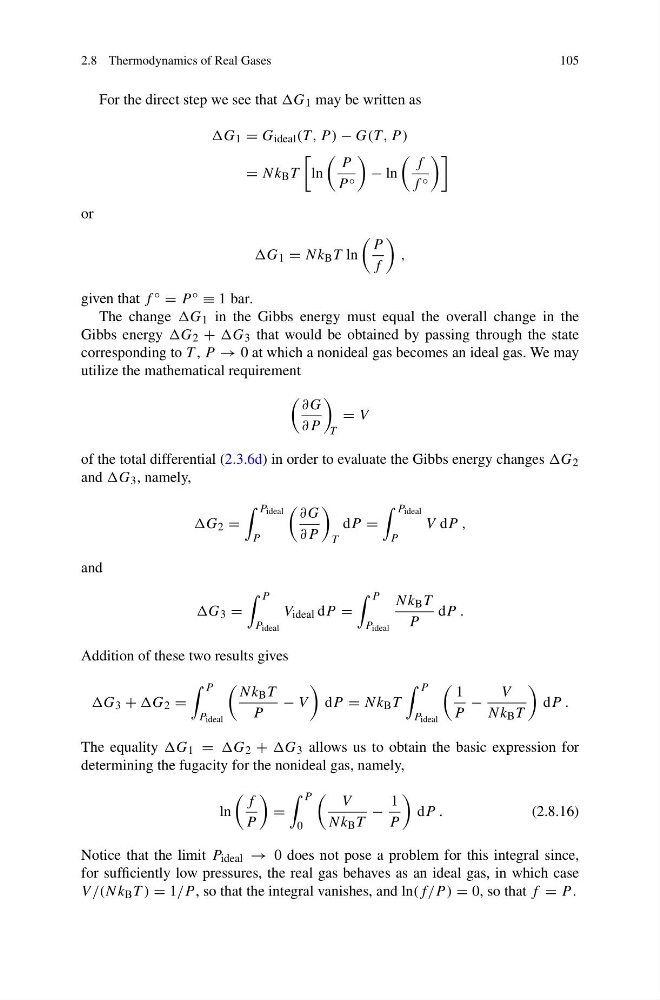
For the direct step we see that G 1 may be written as
G 1 = G ideal (T , P ) − G(T , P )
= Nk B T
ln
P
P ◦
− ln
f
f ◦
or
G 1 = Nk B T ln
P
f
,
given that f ◦ = P ◦ ≡ 1 bar.
The change G 1 in the Gibbs energy must equal the overall change in the
Gibbs energy G 2 + G 3 that would be obtained by passing through the state
corresponding to T , P → 0 at which a nonideal gas becomes an ideal gas. We may
utilize the mathematical requirement
∂G
∂P
T
= V
of the total differential (2.3.6d) in order to evaluate the Gibbs energy changes G 2
and G 3 , namely,
G 2 =
P ideal
P
∂G
∂P
T
dP =
P ideal
P
V dP ,
and
G 3 =
P
P ideal
V ideal dP =
P
P ideal
Nk B T
P
dP .
Addition of these two results gives
G 3 + G 2 =
P
P ideal
Nk B T
P
− V
dP = Nk B T
P
P ideal
1
P
−
V
Nk B T
dP .
The equality G 1 = G 2 + G 3 allows us to obtain the basic expression for
determining the fugacity for the nonideal gas, namely,
ln
f
P
=
P
0
V
Nk B T
−
1
P
dP .
(2.8.16)
Notice that the limit P ideal → 0 does not pose a problem for this integral since,
for sufficiently low pressures, the real gas behaves as an ideal gas, in which case
V /(Nk B T ) = 1/P , so that the integral vanishes, and ln(f/P ) = 0, so that f = P .
105
For the direct step we see that G 1 may be written as
G 1 = G ideal (T , P ) − G(T , P )
= Nk B T
ln
P
P ◦
− ln
f
f ◦
or
G 1 = Nk B T ln
P
f
,
given that f ◦ = P ◦ ≡ 1 bar.
The change G 1 in the Gibbs energy must equal the overall change in the
Gibbs energy G 2 + G 3 that would be obtained by passing through the state
corresponding to T , P → 0 at which a nonideal gas becomes an ideal gas. We may
utilize the mathematical requirement
∂G
∂P
T
= V
of the total differential (2.3.6d) in order to evaluate the Gibbs energy changes G 2
and G 3 , namely,
G 2 =
P ideal
P
∂G
∂P
T
dP =
P ideal
P
V dP ,
and
G 3 =
P
P ideal
V ideal dP =
P
P ideal
Nk B T
P
dP .
Addition of these two results gives
G 3 + G 2 =
P
P ideal
Nk B T
P
− V
dP = Nk B T
P
P ideal
1
P
−
V
Nk B T
dP .
The equality G 1 = G 2 + G 3 allows us to obtain the basic expression for
determining the fugacity for the nonideal gas, namely,
ln
f
P
=
P
0
V
Nk B T
−
1
P
dP .
(2.8.16)
Notice that the limit P ideal → 0 does not pose a problem for this integral since,
for sufficiently low pressures, the real gas behaves as an ideal gas, in which case
V /(Nk B T ) = 1/P , so that the integral vanishes, and ln(f/P ) = 0, so that f = P .