

104
2 Macroscopic Thermodynamics
so that all gas nonideality is assigned to the fugacity f (T , P ). Of course, we must
have the condition
lim
P →0
f (T , P ) = P ,
(2.8.14b)
in order that the generalized expression reduces to the ideal gas expression in the
limit of an ideal gas (as all gases behave ideally for pressures sufficiently low).
If we rewrite our virial expression for G(T , P ) in the form
G(T , P ) = G
◦ (T ) + Nk B T ln
P
P ◦ e
[B
2 (T )P +
1
2 B
3 (T )P 2 +··· ]
,
and compare the result with Eq. (2.8.14a), we see that the fugacity must obey the
equation
f (T , P )
f ◦
=
P
P ◦ exp
B
2 (T )P +
1
2 B
3 (T )P
2
+ · · ·
.
This result suggests that f ◦ = P ◦ , and that f (T , P ) has the form
f (T , P ) = P exp
B
2 (T )P +
1
2 B
3 (T )P
2
+ · · ·
.
(2.8.15)
• Notice that G ◦ (T ) appearing in Eqs. (2.8.13), (2.8.14a) is the same quantity,
namely, the Gibbs energy for the ideal gas at a pressure of 1 bar. This means that
the standard state of the nonideal gas is 1 bar once it has been adjusted to ideal
behaviour, i.e., f ◦ = P ◦ .
• Notice also that this choice of standard state both allows all gases to be brought
to a single common state (that of a hypothetical ideal gas at P = P ◦ ) and, as
we shall see, provides a means for calculating f (T , P ) at any temperature and
pressure.
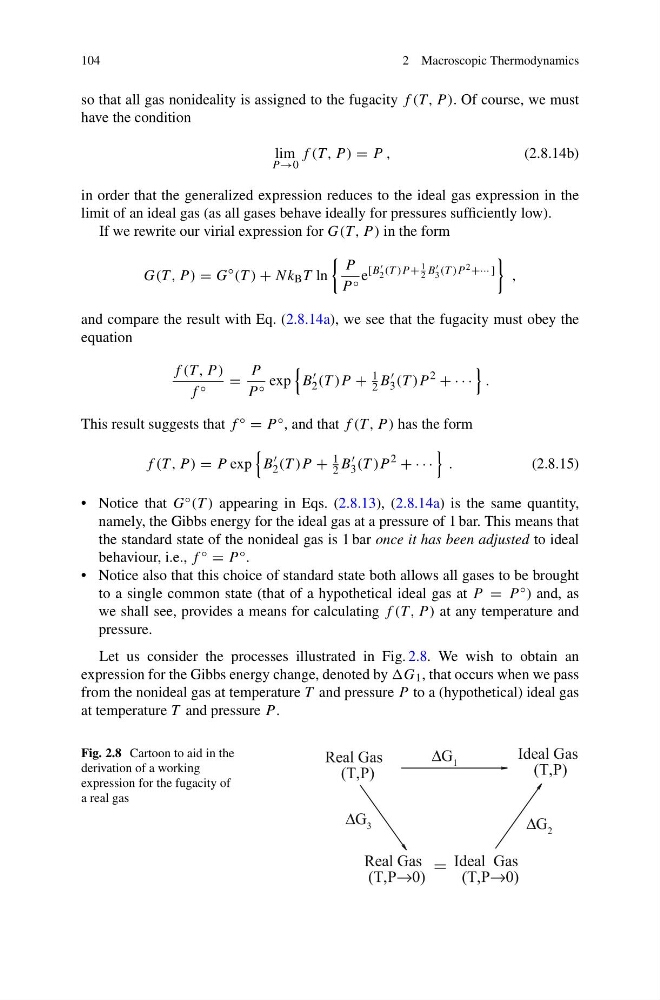
Let us consider the processes illustrated in Fig. 2.8. We wish to obtain an
expression for the Gibbs energy change, denoted by G 1 , that occurs when we pass
from the nonideal gas at temperature T and pressure P to a (hypothetical) ideal gas
at temperature T and pressure P .
Fig. 2.8 Cartoon to aid in the
derivation of a working
expression for the fugacity of
a real gas
2 Macroscopic Thermodynamics
so that all gas nonideality is assigned to the fugacity f (T , P ). Of course, we must
have the condition
lim
P →0
f (T , P ) = P ,
(2.8.14b)
in order that the generalized expression reduces to the ideal gas expression in the
limit of an ideal gas (as all gases behave ideally for pressures sufficiently low).
If we rewrite our virial expression for G(T , P ) in the form
G(T , P ) = G
◦ (T ) + Nk B T ln
P
P ◦ e
[B
2 (T )P +
1
2 B
3 (T )P 2 +··· ]
,
and compare the result with Eq. (2.8.14a), we see that the fugacity must obey the
equation
f (T , P )
f ◦
=
P
P ◦ exp
B
2 (T )P +
1
2 B
3 (T )P
2
+ · · ·
.
This result suggests that f ◦ = P ◦ , and that f (T , P ) has the form
f (T , P ) = P exp
B
2 (T )P +
1
2 B
3 (T )P
2
+ · · ·
.
(2.8.15)
• Notice that G ◦ (T ) appearing in Eqs. (2.8.13), (2.8.14a) is the same quantity,
namely, the Gibbs energy for the ideal gas at a pressure of 1 bar. This means that
the standard state of the nonideal gas is 1 bar once it has been adjusted to ideal
behaviour, i.e., f ◦ = P ◦ .
• Notice also that this choice of standard state both allows all gases to be brought
to a single common state (that of a hypothetical ideal gas at P = P ◦ ) and, as
we shall see, provides a means for calculating f (T , P ) at any temperature and
pressure.
Let us consider the processes illustrated in Fig. 2.8. We wish to obtain an
expression for the Gibbs energy change, denoted by G 1 , that occurs when we pass
from the nonideal gas at temperature T and pressure P to a (hypothetical) ideal gas
at temperature T and pressure P .
Fig. 2.8 Cartoon to aid in the
derivation of a working
expression for the fugacity of
a real gas