

106
2 Macroscopic Thermodynamics
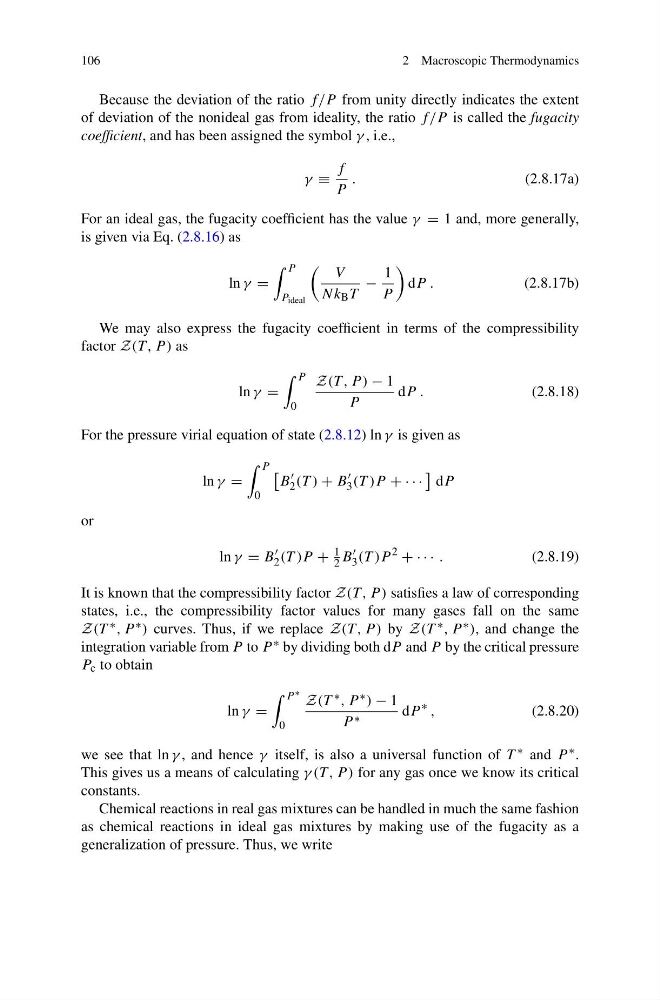
Because the deviation of the ratio f/P from unity directly indicates the extent
of deviation of the nonideal gas from ideality, the ratio f/P is called the fugacity
coefficient, and has been assigned the symbol γ , i.e.,
γ ≡
f
P
.
(2.8.17a)
For an ideal gas, the fugacity coefficient has the value γ = 1 and, more generally,
is given via Eq. (2.8.16) as
ln γ =
P
P ideal
V
Nk B T
−
1
P
dP .
(2.8.17b)
We may also express the fugacity coefficient in terms of the compressibility
factor Z(T , P ) as
ln γ =
P
0
Z(T , P ) − 1
P
dP .
(2.8.18)
For the pressure virial equation of state (2.8.12) ln γ is given as
ln γ =
P
0
B
2 (T ) + B
3 (T )P + · · ·
dP
or
ln γ = B
2 (T )P +
1
2 B
3 (T )P
2
+ · · · .
(2.8.19)
It is known that the compressibility factor Z(T , P ) satisfies a law of corresponding
states, i.e., the compressibility factor values for many gases fall on the same
Z(T ∗ , P ∗ ) curves. Thus, if we replace Z(T , P ) by Z(T ∗ , P ∗ ), and change the
integration variable from P to P ∗ by dividing both dP and P by the critical pressure
P c to obtain
ln γ =
P ∗
0
Z(T ∗ , P ∗ ) − 1
P ∗
dP
∗ ,
(2.8.20)
we see that ln γ , and hence γ itself, is also a universal function of T ∗ and P ∗ .
This gives us a means of calculating γ (T , P ) for any gas once we know its critical
constants.
Chemical reactions in real gas mixtures can be handled in much the same fashion
as chemical reactions in ideal gas mixtures by making use of the fugacity as a
generalization of pressure. Thus, we write
2 Macroscopic Thermodynamics
Because the deviation of the ratio f/P from unity directly indicates the extent
of deviation of the nonideal gas from ideality, the ratio f/P is called the fugacity
coefficient, and has been assigned the symbol γ , i.e.,
γ ≡
f
P
.
(2.8.17a)
For an ideal gas, the fugacity coefficient has the value γ = 1 and, more generally,
is given via Eq. (2.8.16) as
ln γ =
P
P ideal
V
Nk B T
−
1
P
dP .
(2.8.17b)
We may also express the fugacity coefficient in terms of the compressibility
factor Z(T , P ) as
ln γ =
P
0
Z(T , P ) − 1
P
dP .
(2.8.18)
For the pressure virial equation of state (2.8.12) ln γ is given as
ln γ =
P
0
B
2 (T ) + B
3 (T )P + · · ·
dP
or
ln γ = B
2 (T )P +
1
2 B
3 (T )P
2
+ · · · .
(2.8.19)
It is known that the compressibility factor Z(T , P ) satisfies a law of corresponding
states, i.e., the compressibility factor values for many gases fall on the same
Z(T ∗ , P ∗ ) curves. Thus, if we replace Z(T , P ) by Z(T ∗ , P ∗ ), and change the
integration variable from P to P ∗ by dividing both dP and P by the critical pressure
P c to obtain
ln γ =
P ∗
0
Z(T ∗ , P ∗ ) − 1
P ∗
dP
∗ ,
(2.8.20)
we see that ln γ , and hence γ itself, is also a universal function of T ∗ and P ∗ .
This gives us a means of calculating γ (T , P ) for any gas once we know its critical
constants.
Chemical reactions in real gas mixtures can be handled in much the same fashion
as chemical reactions in ideal gas mixtures by making use of the fugacity as a
generalization of pressure. Thus, we write