

96
2 Macroscopic Thermodynamics
thus say, equivalently, that for ((G) react < 0, the reaction proceeds spontaneously
from left to right, while for ((G) react > 0 (i.e., Q > K P ), the reaction proceeds
spontaneously from right to left, until equilibrium is established.
2.8 Thermodynamics of Real Gases
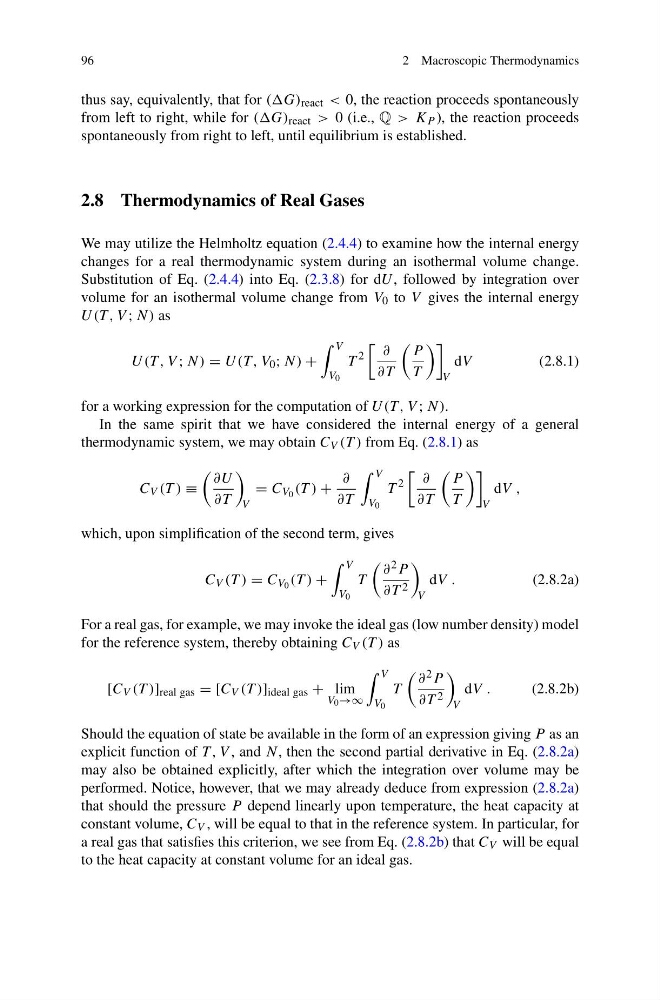
We may utilize the Helmholtz equation (2.4.4) to examine how the internal energy
changes for a real thermodynamic system during an isothermal volume change.
Substitution of Eq. (2.4.4) into Eq. (2.3.8) for dU , followed by integration over
volume for an isothermal volume change from V 0 to V gives the internal energy
U(T , V ; N) as
U(T , V ; N) = U(T , V 0 ; N) +
V
V 0
T
2
∂
∂T
P
T
V
dV
(2.8.1)
for a working expression for the computation of U(T , V ; N).
In the same spirit that we have considered the internal energy of a general
thermodynamic system, we may obtain C V (T ) from Eq. (2.8.1) as
C V (T ) ≡
∂U
∂T
V
= C V 0 (T ) +
∂
∂T
V
V 0
T
2
∂
∂T
P
T
V
dV ,
which, upon simplification of the second term, gives
C V (T ) = C V 0 (T ) +
V
V 0
T
∂ 2 P
∂T 2
V
dV .
(2.8.2a)
For a real gas, for example, we may invoke the ideal gas (low number density) model
for the reference system, thereby obtaining C V (T ) as
[C V (T )] real gas = [C V (T )] ideal gas + lim
V 0 →∞
V
V 0
T
∂ 2 P
∂T 2
V
dV .
(2.8.2b)
Should the equation of state be available in the form of an expression giving P as an
explicit function of T , V , and N, then the second partial derivative in Eq. (2.8.2a)
may also be obtained explicitly, after which the integration over volume may be
performed. Notice, however, that we may already deduce from expression (2.8.2a)
that should the pressure P depend linearly upon temperature, the heat capacity at
constant volume, C V , will be equal to that in the reference system. In particular, for
a real gas that satisfies this criterion, we see from Eq. (2.8.2b) that C V will be equal
to the heat capacity at constant volume for an ideal gas.
2 Macroscopic Thermodynamics
thus say, equivalently, that for ((G) react < 0, the reaction proceeds spontaneously
from left to right, while for ((G) react > 0 (i.e., Q > K P ), the reaction proceeds
spontaneously from right to left, until equilibrium is established.
2.8 Thermodynamics of Real Gases
We may utilize the Helmholtz equation (2.4.4) to examine how the internal energy
changes for a real thermodynamic system during an isothermal volume change.
Substitution of Eq. (2.4.4) into Eq. (2.3.8) for dU , followed by integration over
volume for an isothermal volume change from V 0 to V gives the internal energy
U(T , V ; N) as
U(T , V ; N) = U(T , V 0 ; N) +
V
V 0
T
2
∂
∂T
P
T
V
dV
(2.8.1)
for a working expression for the computation of U(T , V ; N).
In the same spirit that we have considered the internal energy of a general
thermodynamic system, we may obtain C V (T ) from Eq. (2.8.1) as
C V (T ) ≡
∂U
∂T
V
= C V 0 (T ) +
∂
∂T
V
V 0
T
2
∂
∂T
P
T
V
dV ,
which, upon simplification of the second term, gives
C V (T ) = C V 0 (T ) +
V
V 0
T
∂ 2 P
∂T 2
V
dV .
(2.8.2a)
For a real gas, for example, we may invoke the ideal gas (low number density) model
for the reference system, thereby obtaining C V (T ) as
[C V (T )] real gas = [C V (T )] ideal gas + lim
V 0 →∞
V
V 0
T
∂ 2 P
∂T 2
V
dV .
(2.8.2b)
Should the equation of state be available in the form of an expression giving P as an
explicit function of T , V , and N, then the second partial derivative in Eq. (2.8.2a)
may also be obtained explicitly, after which the integration over volume may be
performed. Notice, however, that we may already deduce from expression (2.8.2a)
that should the pressure P depend linearly upon temperature, the heat capacity at
constant volume, C V , will be equal to that in the reference system. In particular, for
a real gas that satisfies this criterion, we see from Eq. (2.8.2b) that C V will be equal
to the heat capacity at constant volume for an ideal gas.