

2.8 Thermodynamics of Real Gases
97
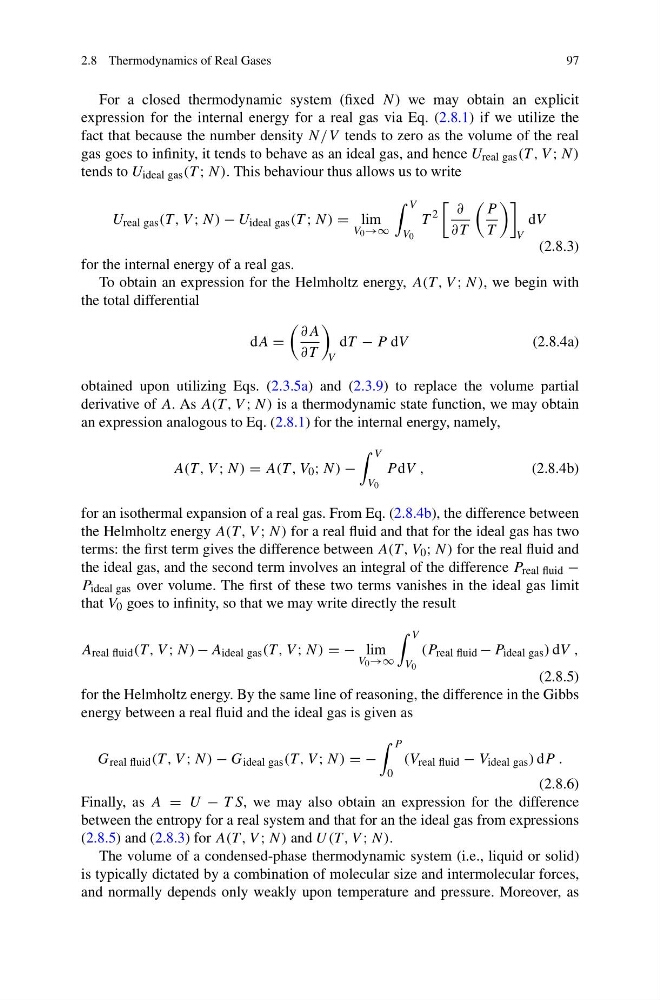
For a closed thermodynamic system (fixed N) we may obtain an explicit
expression for the internal energy for a real gas via Eq. (2.8.1) if we utilize the
fact that because the number density N/V tends to zero as the volume of the real
gas goes to infinity, it tends to behave as an ideal gas, and hence U real gas (T , V ; N)
tends to U ideal gas (T ; N). This behaviour thus allows us to write
U real gas (T , V ; N) − U ideal gas (T ; N) = lim
V 0 →∞
V
V 0
T
2
∂
∂T
P
T
V
dV
(2.8.3)
for the internal energy of a real gas.
To obtain an expression for the Helmholtz energy, A(T , V ; N), we begin with
the total differential
dA =
∂A
∂T
V
dT − P dV
(2.8.4a)
obtained upon utilizing Eqs. (2.3.5a) and (2.3.9) to replace the volume partial
derivative of A. As A(T , V ; N) is a thermodynamic state function, we may obtain
an expression analogous to Eq. (2.8.1) for the internal energy, namely,
A(T , V ; N) = A(T , V 0 ; N) −
V
V 0
P dV ,
(2.8.4b)
for an isothermal expansion of a real gas. From Eq. (2.8.4b), the difference between
the Helmholtz energy A(T , V ; N) for a real fluid and that for the ideal gas has two
terms: the first term gives the difference between A(T , V 0 ; N) for the real fluid and
the ideal gas, and the second term involves an integral of the difference P real fluid −
P ideal gas over volume. The first of these two terms vanishes in the ideal gas limit
that V 0 goes to infinity, so that we may write directly the result
A real fluid (T , V ; N) − A ideal gas (T , V ; N) = − lim
V 0 →∞
V
V 0
(P real fluid − P ideal gas ) dV ,
(2.8.5)
for the Helmholtz energy. By the same line of reasoning, the difference in the Gibbs
energy between a real fluid and the ideal gas is given as
G real fluid (T , V ; N) − G ideal gas (T , V ; N) = −
P
0
(V real fluid − V ideal gas ) dP .
(2.8.6)
Finally, as A = U − T S, we may also obtain an expression for the difference
between the entropy for a real system and that for an the ideal gas from expressions
(2.8.5) and (2.8.3) for A(T , V ; N) and U(T , V ; N).
The volume of a condensed-phase thermodynamic system (i.e., liquid or solid)
is typically dictated by a combination of molecular size and intermolecular forces,
and normally depends only weakly upon temperature and pressure. Moreover, as
97
For a closed thermodynamic system (fixed N) we may obtain an explicit
expression for the internal energy for a real gas via Eq. (2.8.1) if we utilize the
fact that because the number density N/V tends to zero as the volume of the real
gas goes to infinity, it tends to behave as an ideal gas, and hence U real gas (T , V ; N)
tends to U ideal gas (T ; N). This behaviour thus allows us to write
U real gas (T , V ; N) − U ideal gas (T ; N) = lim
V 0 →∞
V
V 0
T
2
∂
∂T
P
T
V
dV
(2.8.3)
for the internal energy of a real gas.
To obtain an expression for the Helmholtz energy, A(T , V ; N), we begin with
the total differential
dA =
∂A
∂T
V
dT − P dV
(2.8.4a)
obtained upon utilizing Eqs. (2.3.5a) and (2.3.9) to replace the volume partial
derivative of A. As A(T , V ; N) is a thermodynamic state function, we may obtain
an expression analogous to Eq. (2.8.1) for the internal energy, namely,
A(T , V ; N) = A(T , V 0 ; N) −
V
V 0
P dV ,
(2.8.4b)
for an isothermal expansion of a real gas. From Eq. (2.8.4b), the difference between
the Helmholtz energy A(T , V ; N) for a real fluid and that for the ideal gas has two
terms: the first term gives the difference between A(T , V 0 ; N) for the real fluid and
the ideal gas, and the second term involves an integral of the difference P real fluid −
P ideal gas over volume. The first of these two terms vanishes in the ideal gas limit
that V 0 goes to infinity, so that we may write directly the result
A real fluid (T , V ; N) − A ideal gas (T , V ; N) = − lim
V 0 →∞
V
V 0
(P real fluid − P ideal gas ) dV ,
(2.8.5)
for the Helmholtz energy. By the same line of reasoning, the difference in the Gibbs
energy between a real fluid and the ideal gas is given as
G real fluid (T , V ; N) − G ideal gas (T , V ; N) = −
P
0
(V real fluid − V ideal gas ) dP .
(2.8.6)
Finally, as A = U − T S, we may also obtain an expression for the difference
between the entropy for a real system and that for an the ideal gas from expressions
(2.8.5) and (2.8.3) for A(T , V ; N) and U(T , V ; N).
The volume of a condensed-phase thermodynamic system (i.e., liquid or solid)
is typically dictated by a combination of molecular size and intermolecular forces,
and normally depends only weakly upon temperature and pressure. Moreover, as