

2.7 Extension to Multicomponent Systems
95
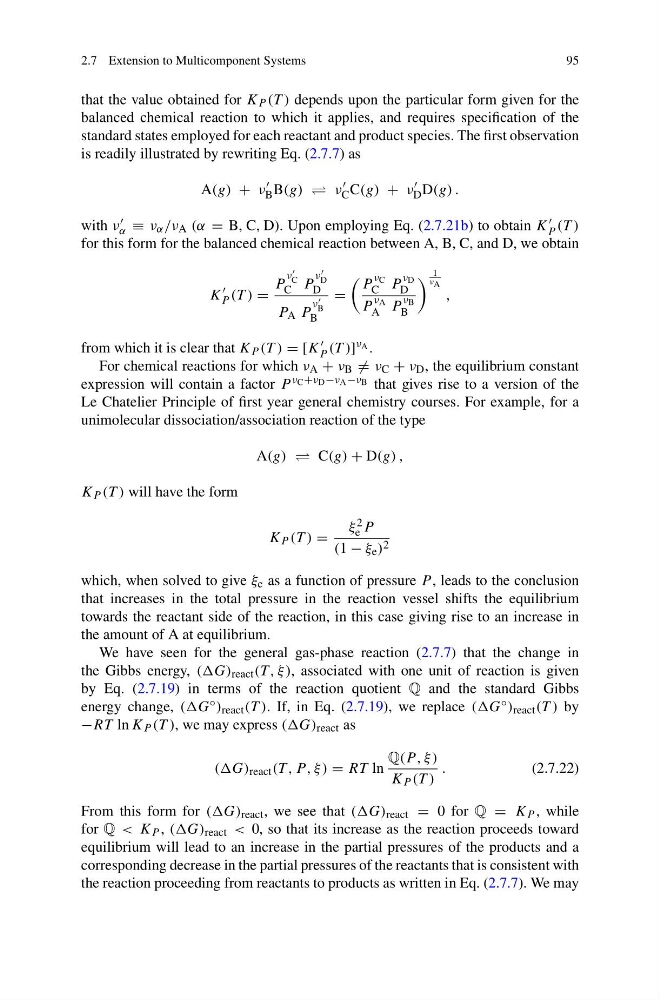
that the value obtained for K P (T ) depends upon the particular form given for the
balanced chemical reaction to which it applies, and requires specification of the
standard states employed for each reactant and product species. The first observation
is readily illustrated by rewriting Eq. (2.7.7) as
A(g) + ν
B B(g) ν
C C(g) + ν
D D(g) .
with ν
α ≡ ν α /ν A (α = B, C, D). Upon employing Eq. (2.7.21b) to obtain K
P (T )
for this form for the balanced chemical reaction between A, B, C, and D, we obtain
K
P (T ) =
P
ν
C
C P
ν
D
D
P A P
ν
B
B
=
P
ν C
C P
ν D
D
P
ν A
A P
ν B
B
1
ν A
,
from which it is clear that K P (T ) = [K
P (T )] ν A .
For chemical reactions for which ν A + ν B = ν C + ν D , the equilibrium constant
expression will contain a factor P ν C +ν D −ν A −ν B that gives rise to a version of the
Le Chatelier Principle of first year general chemistry courses. For example, for a
unimolecular dissociation/association reaction of the type
A(g) C(g) + D(g) ,
K P (T ) will have the form
K P (T ) =
ξ 2
e P
(1 − ξ e ) 2
which, when solved to give ξ e as a function of pressure P , leads to the conclusion
that increases in the total pressure in the reaction vessel shifts the equilibrium
towards the reactant side of the reaction, in this case giving rise to an increase in
the amount of A at equilibrium.
We have seen for the general gas-phase reaction (2.7.7) that the change in
the Gibbs energy, ((G) react (T , ξ ), associated with one unit of reaction is given
by Eq. (2.7.19) in terms of the reaction quotient Q and the standard Gibbs
energy change, ((G ◦ ) react (T ). If, in Eq. (2.7.19), we replace ((G ◦ ) react (T ) by
−RT ln K P (T ), we may express ((G) react as
((G) react (T , P , ξ) = RT ln
Q(P , ξ )
K P (T )
.
(2.7.22)
From this form for ((G) react , we see that ((G) react = 0 for Q = K P , while
for Q < K P , ((G) react < 0, so that its increase as the reaction proceeds toward
equilibrium will lead to an increase in the partial pressures of the products and a
corresponding decrease in the partial pressures of the reactants that is consistent with
the reaction proceeding from reactants to products as written in Eq. (2.7.7). We may
95
that the value obtained for K P (T ) depends upon the particular form given for the
balanced chemical reaction to which it applies, and requires specification of the
standard states employed for each reactant and product species. The first observation
is readily illustrated by rewriting Eq. (2.7.7) as
A(g) + ν
B B(g) ν
C C(g) + ν
D D(g) .
with ν
α ≡ ν α /ν A (α = B, C, D). Upon employing Eq. (2.7.21b) to obtain K
P (T )
for this form for the balanced chemical reaction between A, B, C, and D, we obtain
K
P (T ) =
P
ν
C
C P
ν
D
D
P A P
ν
B
B
=
P
ν C
C P
ν D
D
P
ν A
A P
ν B
B
1
ν A
,
from which it is clear that K P (T ) = [K
P (T )] ν A .
For chemical reactions for which ν A + ν B = ν C + ν D , the equilibrium constant
expression will contain a factor P ν C +ν D −ν A −ν B that gives rise to a version of the
Le Chatelier Principle of first year general chemistry courses. For example, for a
unimolecular dissociation/association reaction of the type
A(g) C(g) + D(g) ,
K P (T ) will have the form
K P (T ) =
ξ 2
e P
(1 − ξ e ) 2
which, when solved to give ξ e as a function of pressure P , leads to the conclusion
that increases in the total pressure in the reaction vessel shifts the equilibrium
towards the reactant side of the reaction, in this case giving rise to an increase in
the amount of A at equilibrium.
We have seen for the general gas-phase reaction (2.7.7) that the change in
the Gibbs energy, ((G) react (T , ξ ), associated with one unit of reaction is given
by Eq. (2.7.19) in terms of the reaction quotient Q and the standard Gibbs
energy change, ((G ◦ ) react (T ). If, in Eq. (2.7.19), we replace ((G ◦ ) react (T ) by
−RT ln K P (T ), we may express ((G) react as
((G) react (T , P , ξ) = RT ln
Q(P , ξ )
K P (T )
.
(2.7.22)
From this form for ((G) react , we see that ((G) react = 0 for Q = K P , while
for Q < K P , ((G) react < 0, so that its increase as the reaction proceeds toward
equilibrium will lead to an increase in the partial pressures of the products and a
corresponding decrease in the partial pressures of the reactants that is consistent with
the reaction proceeding from reactants to products as written in Eq. (2.7.7). We may