

94
2 Macroscopic Thermodynamics
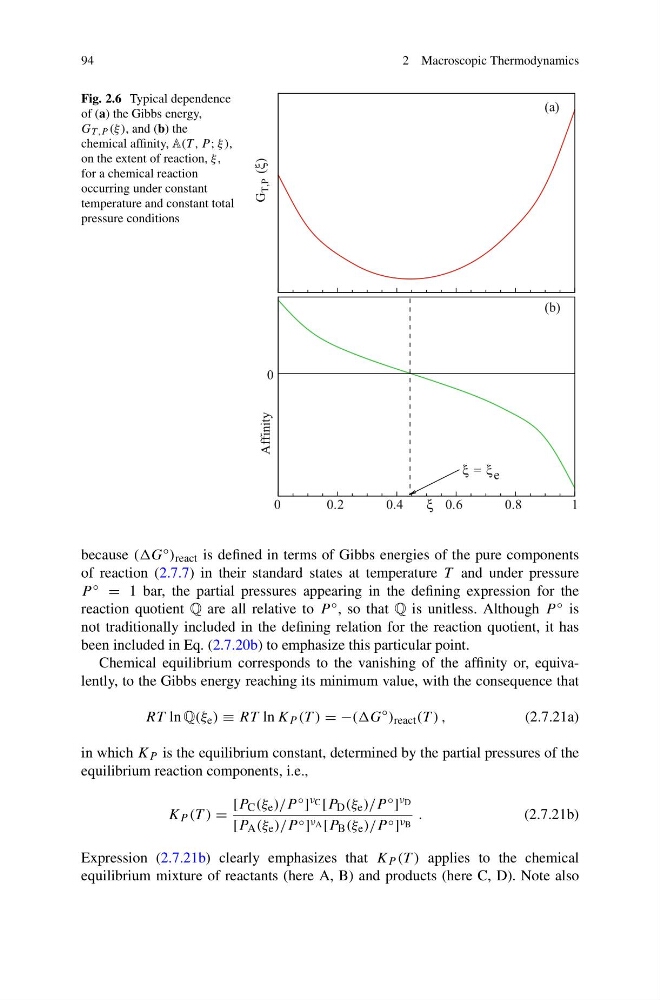
Fig. 2.6 Typical dependence
of (a) the Gibbs energy,
G T ,P (ξ ), and (b) the
chemical affinity, A(T , P ; ξ),
on the extent of reaction, ξ ,
for a chemical reaction
occurring under constant
temperature and constant total
pressure conditions
0
0.2
0.4
0.6
0.8
1
ξ
0
Affinity
(b)
ξ = ξ e
G
T,P (ξ)
(a)
because ((G ◦ ) react is defined in terms of Gibbs energies of the pure components
of reaction (2.7.7) in their standard states at temperature T and under pressure
P ◦ = 1 bar, the partial pressures appearing in the defining expression for the
reaction quotient Q are all relative to P ◦ , so that Q is unitless. Although P ◦ is
not traditionally included in the defining relation for the reaction quotient, it has
been included in Eq. (2.7.20b) to emphasize this particular point.
Chemical equilibrium corresponds to the vanishing of the affinity or, equivalently, to the Gibbs energy reaching its minimum value, with the consequence that
RT ln Q(ξ e ) ≡ RT ln K P (T ) = −((G
◦ ) react (T ) ,
(2.7.21a)
in which K P is the equilibrium constant, determined by the partial pressures of the
equilibrium reaction components, i.e.,
K P (T ) =
[P C (ξ e )/P ◦ ] ν C [P D (ξ e )/P ◦ ] ν D
[P A (ξ e )/P ◦ ] ν A [P B (ξ e )/P ◦ ] ν B
.
(2.7.21b)
Expression (2.7.21b) clearly emphasizes that K P (T ) applies to the chemical
equilibrium mixture of reactants (here A, B) and products (here C, D). Note also
2 Macroscopic Thermodynamics
Fig. 2.6 Typical dependence
of (a) the Gibbs energy,
G T ,P (ξ ), and (b) the
chemical affinity, A(T , P ; ξ),
on the extent of reaction, ξ ,
for a chemical reaction
occurring under constant
temperature and constant total
pressure conditions
0
0.2
0.4
0.6
0.8
1
ξ
0
Affinity
(b)
ξ = ξ e
G
T,P (ξ)
(a)
because ((G ◦ ) react is defined in terms of Gibbs energies of the pure components
of reaction (2.7.7) in their standard states at temperature T and under pressure
P ◦ = 1 bar, the partial pressures appearing in the defining expression for the
reaction quotient Q are all relative to P ◦ , so that Q is unitless. Although P ◦ is
not traditionally included in the defining relation for the reaction quotient, it has
been included in Eq. (2.7.20b) to emphasize this particular point.
Chemical equilibrium corresponds to the vanishing of the affinity or, equivalently, to the Gibbs energy reaching its minimum value, with the consequence that
RT ln Q(ξ e ) ≡ RT ln K P (T ) = −((G
◦ ) react (T ) ,
(2.7.21a)
in which K P is the equilibrium constant, determined by the partial pressures of the
equilibrium reaction components, i.e.,
K P (T ) =
[P C (ξ e )/P ◦ ] ν C [P D (ξ e )/P ◦ ] ν D
[P A (ξ e )/P ◦ ] ν A [P B (ξ e )/P ◦ ] ν B
.
(2.7.21b)
Expression (2.7.21b) clearly emphasizes that K P (T ) applies to the chemical
equilibrium mixture of reactants (here A, B) and products (here C, D). Note also