

2.7 Extension to Multicomponent Systems
93
ical data generated by the U. S. National Institute for Standards and Technology
(NIST) and known as the JANAF (for Joint Army, Navy, Air Force) tables [18]. 12
By convention the Gibbs energy of formation is set to zero for an element in its most
stable form at 1 bar pressure and the temperature of interest.
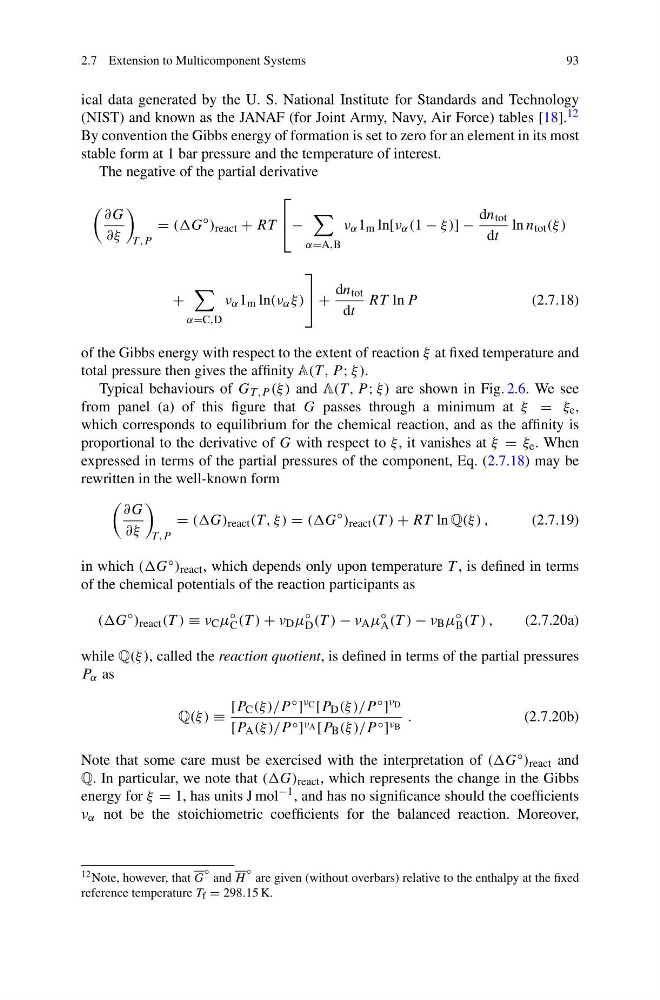
The negative of the partial derivative
∂G
∂ξ
T ,P
= ((G
◦ ) react + RT
⎡
⎣ −
α=A,B
ν α 1 m ln[ν α (1 − ξ)] −
dn tot
dt
ln n tot (ξ )
+
α=C,D
ν α 1 m ln(ν α ξ)
⎤
⎦ +
dn tot
dt
RT ln P
(2.7.18)
of the Gibbs energy with respect to the extent of reaction ξ at fixed temperature and
total pressure then gives the affinity A(T , P ; ξ).
Typical behaviours of G T ,P (ξ ) and A(T , P ; ξ) are shown in Fig. 2.6. We see
from panel (a) of this figure that G passes through a minimum at ξ = ξ e ,
which corresponds to equilibrium for the chemical reaction, and as the affinity is
proportional to the derivative of G with respect to ξ , it vanishes at ξ = ξ e . When
expressed in terms of the partial pressures of the component, Eq. (2.7.18) may be
rewritten in the well-known form
∂G
∂ξ
T ,P
= ((G) react (T , ξ ) = ((G
◦ ) react (T ) + RT ln Q(ξ ) ,
(2.7.19)
in which ((G ◦ ) react , which depends only upon temperature T , is defined in terms
of the chemical potentials of the reaction participants as
((G
◦ ) react (T ) ≡ ν C μ
◦
C (T ) + ν D μ
◦
D (T ) − ν A μ
◦
A (T ) − ν B μ
◦
B (T ) ,
(2.7.20a)
while Q(ξ ), called the reaction quotient, is defined in terms of the partial pressures
P α as
Q(ξ ) ≡
[P C (ξ )/P ◦ ] ν C [P D (ξ )/P ◦ ] ν D
[P A (ξ )/P ◦ ] ν A [P B (ξ )/P ◦ ] ν B
.
(2.7.20b)
Note that some care must be exercised with the interpretation of ((G ◦ ) react and
Q. In particular, we note that ((G) react , which represents the change in the Gibbs
energy for ξ = 1, has units J mol
−1 , and has no significance should the coefficients
ν α not be the stoichiometric coefficients for the balanced reaction. Moreover,
12 Note, however, that G
◦ and H
◦ are given (without overbars) relative to the enthalpy at the fixed
reference temperature T f = 298.15 K.
93
ical data generated by the U. S. National Institute for Standards and Technology
(NIST) and known as the JANAF (for Joint Army, Navy, Air Force) tables [18]. 12
By convention the Gibbs energy of formation is set to zero for an element in its most
stable form at 1 bar pressure and the temperature of interest.
The negative of the partial derivative
∂G
∂ξ
T ,P
= ((G
◦ ) react + RT
⎡
⎣ −
α=A,B
ν α 1 m ln[ν α (1 − ξ)] −
dn tot
dt
ln n tot (ξ )
+
α=C,D
ν α 1 m ln(ν α ξ)
⎤
⎦ +
dn tot
dt
RT ln P
(2.7.18)
of the Gibbs energy with respect to the extent of reaction ξ at fixed temperature and
total pressure then gives the affinity A(T , P ; ξ).
Typical behaviours of G T ,P (ξ ) and A(T , P ; ξ) are shown in Fig. 2.6. We see
from panel (a) of this figure that G passes through a minimum at ξ = ξ e ,
which corresponds to equilibrium for the chemical reaction, and as the affinity is
proportional to the derivative of G with respect to ξ , it vanishes at ξ = ξ e . When
expressed in terms of the partial pressures of the component, Eq. (2.7.18) may be
rewritten in the well-known form
∂G
∂ξ
T ,P
= ((G) react (T , ξ ) = ((G
◦ ) react (T ) + RT ln Q(ξ ) ,
(2.7.19)
in which ((G ◦ ) react , which depends only upon temperature T , is defined in terms
of the chemical potentials of the reaction participants as
((G
◦ ) react (T ) ≡ ν C μ
◦
C (T ) + ν D μ
◦
D (T ) − ν A μ
◦
A (T ) − ν B μ
◦
B (T ) ,
(2.7.20a)
while Q(ξ ), called the reaction quotient, is defined in terms of the partial pressures
P α as
Q(ξ ) ≡
[P C (ξ )/P ◦ ] ν C [P D (ξ )/P ◦ ] ν D
[P A (ξ )/P ◦ ] ν A [P B (ξ )/P ◦ ] ν B
.
(2.7.20b)
Note that some care must be exercised with the interpretation of ((G ◦ ) react and
Q. In particular, we note that ((G) react , which represents the change in the Gibbs
energy for ξ = 1, has units J mol
−1 , and has no significance should the coefficients
ν α not be the stoichiometric coefficients for the balanced reaction. Moreover,
12 Note, however, that G
◦ and H
◦ are given (without overbars) relative to the enthalpy at the fixed
reference temperature T f = 298.15 K.