

92
2 Macroscopic Thermodynamics
x A =
ν A (1 m − ξ)
n tot (ξ )
, x B =
ν B (1 m − ξ)
n tot (ξ )
, x C =
ν C ξ
n tot (ξ )
, x D =
ν D ξ
n tot (ξ )
,
(2.7.15a)
with n tot (ξ ) given by
n tot (ξ ) = (ν A + ν B )1 m + (ν C + ν D − ν A − ν B )ξ .
(2.7.15b)
The corresponding partial pressures are related to the total pressure via Dalton’s law
of partial pressures, so that P α (ξ ) = x α (ξ )P .
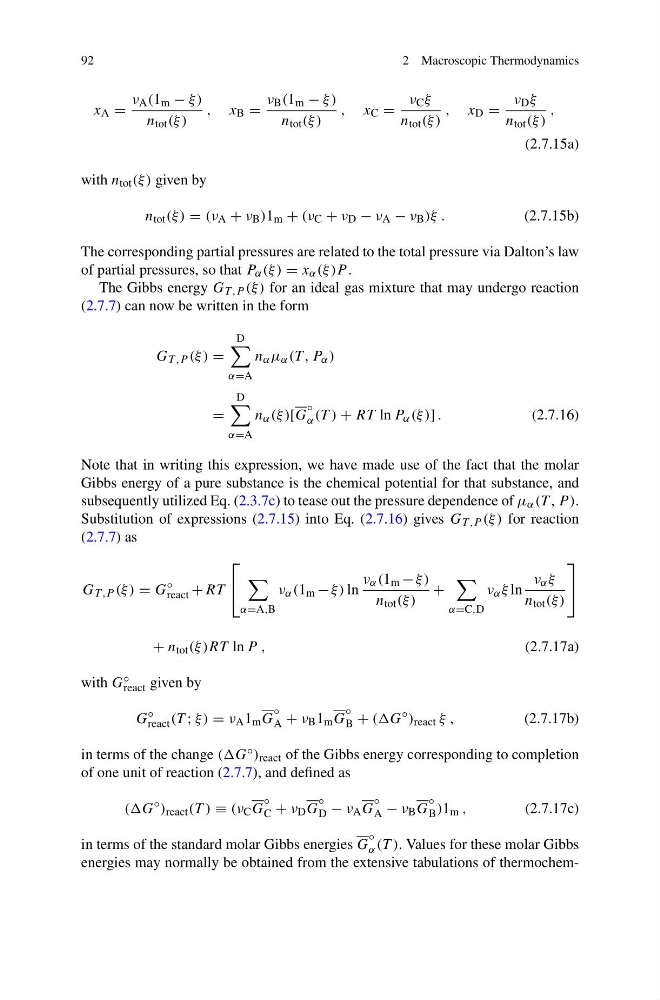
The Gibbs energy G T ,P (ξ ) for an ideal gas mixture that may undergo reaction
(2.7.7) can now be written in the form
G T ,P (ξ ) =
D
α=A
n α μ α (T , P α )
=
D
α=A
n α (ξ )[G
◦
α (T ) + RT ln P α (ξ )] .
(2.7.16)
Note that in writing this expression, we have made use of the fact that the molar
Gibbs energy of a pure substance is the chemical potential for that substance, and
subsequently utilized Eq. (2.3.7c) to tease out the pressure dependence of μ α (T , P ).
Substitution of expressions (2.7.15) into Eq. (2.7.16) gives G T ,P (ξ ) for reaction
(2.7.7) as
G T ,P (ξ ) = G
◦
react + RT
⎡
⎣
α=A,B
ν α (1 m − ξ) ln
ν α (1 m − ξ)
n tot (ξ )
+
α=C,D
ν α ξ ln
ν α ξ
n tot (ξ )
⎤
⎦
+ n tot (ξ )RT ln P ,
(2.7.17a)
with G ◦
react given by
G
◦
react (T ; ξ) = ν A 1 m G
◦
A + ν B 1 m G
◦
B + ((G
◦ ) react ξ ,
(2.7.17b)
in terms of the change ((G ◦ ) react of the Gibbs energy corresponding to completion
of one unit of reaction (2.7.7), and defined as
((G
◦ ) react (T ) ≡ (ν C G
◦
C + ν D G
◦
D − ν A G
◦
A − ν B G
◦
B )1 m ,
(2.7.17c)
in terms of the standard molar Gibbs energies G
◦
α (T ). Values for these molar Gibbs
energies may normally be obtained from the extensive tabulations of thermochem-
2 Macroscopic Thermodynamics
x A =
ν A (1 m − ξ)
n tot (ξ )
, x B =
ν B (1 m − ξ)
n tot (ξ )
, x C =
ν C ξ
n tot (ξ )
, x D =
ν D ξ
n tot (ξ )
,
(2.7.15a)
with n tot (ξ ) given by
n tot (ξ ) = (ν A + ν B )1 m + (ν C + ν D − ν A − ν B )ξ .
(2.7.15b)
The corresponding partial pressures are related to the total pressure via Dalton’s law
of partial pressures, so that P α (ξ ) = x α (ξ )P .
The Gibbs energy G T ,P (ξ ) for an ideal gas mixture that may undergo reaction
(2.7.7) can now be written in the form
G T ,P (ξ ) =
D
α=A
n α μ α (T , P α )
=
D
α=A
n α (ξ )[G
◦
α (T ) + RT ln P α (ξ )] .
(2.7.16)
Note that in writing this expression, we have made use of the fact that the molar
Gibbs energy of a pure substance is the chemical potential for that substance, and
subsequently utilized Eq. (2.3.7c) to tease out the pressure dependence of μ α (T , P ).
Substitution of expressions (2.7.15) into Eq. (2.7.16) gives G T ,P (ξ ) for reaction
(2.7.7) as
G T ,P (ξ ) = G
◦
react + RT
⎡
⎣
α=A,B
ν α (1 m − ξ) ln
ν α (1 m − ξ)
n tot (ξ )
+
α=C,D
ν α ξ ln
ν α ξ
n tot (ξ )
⎤
⎦
+ n tot (ξ )RT ln P ,
(2.7.17a)
with G ◦
react given by
G
◦
react (T ; ξ) = ν A 1 m G
◦
A + ν B 1 m G
◦
B + ((G
◦ ) react ξ ,
(2.7.17b)
in terms of the change ((G ◦ ) react of the Gibbs energy corresponding to completion
of one unit of reaction (2.7.7), and defined as
((G
◦ ) react (T ) ≡ (ν C G
◦
C + ν D G
◦
D − ν A G
◦
A − ν B G
◦
B )1 m ,
(2.7.17c)
in terms of the standard molar Gibbs energies G
◦
α (T ). Values for these molar Gibbs
energies may normally be obtained from the extensive tabulations of thermochem-