

84
3 Theoretical Study of Rh-Catalyzed …
+
N
H
Ac
O
N 2
R
2 O 2 C
R
1
CH 3 CN, 25 C
2 mol % [Cp*RhCl 2 ] 2
1 eq. CsOAc
75 - 97 % yield
R
1
NH
O
t BuO 2 C
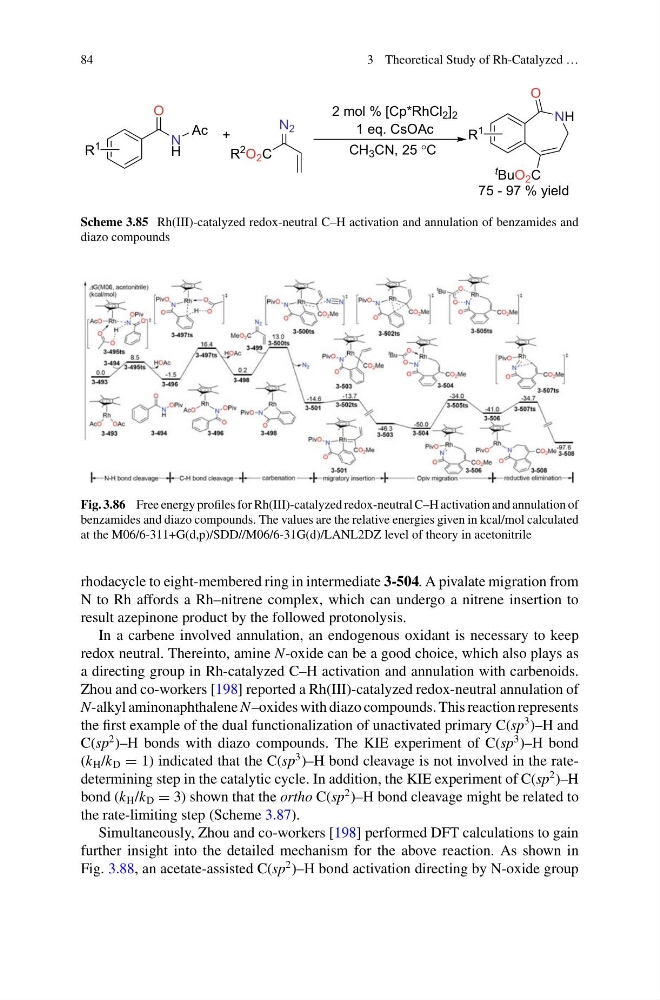
Scheme 3.85 Rh(III)-catalyzed redox-neutral C–H activation and annulation of benzamides and
diazo compounds
Fig. 3.86 Free energy profiles for Rh(III)-catalyzed redox-neutral C–H activation and annulation of
benzamides and diazo compounds. The values are the relative energies given in kcal/mol calculated
at the M06/6-311+G(d,p)/SDD//M06/6-31G(d)/LANL2DZ level of theory in acetonitrile
rhodacycle to eight-membered ring in intermediate 3-504. A pivalate migration from
N to Rh affords a Rh–nitrene complex, which can undergo a nitrene insertion to
result azepinone product by the followed protonolysis.
In a carbene involved annulation, an endogenous oxidant is necessary to keep
redox neutral. Thereinto, amine N-oxide can be a good choice, which also plays as
a directing group in Rh-catalyzed C–H activation and annulation with carbenoids.
Zhou and co-workers [198] reported a Rh(III)-catalyzed redox-neutral annulation of
N-alkyl aminonaphthalene N–oxides with diazo compounds. This reaction represents
the first example of the dual functionalization of unactivated primary C(sp
3 )–H and
C(sp
2 )–H bonds with diazo compounds. The KIE experiment of C(sp
3 )–H bond
(k H /k D = 1) indicated that the C(sp
3 )–H bond cleavage is not involved in the ratedetermining step in the catalytic cycle. In addition, the KIE experiment of C(sp
2 )–H
bond (k H /k D = 3) shown that the ortho C(sp
2 )–H bond cleavage might be related to
the rate-limiting step (Scheme 3.87).
Simultaneously, Zhou and co-workers [198] performed DFT calculations to gain
further insight into the detailed mechanism for the above reaction. As shown in
Fig. 3.88, an acetate-assisted C(sp
2 )–H bond activation directing by N-oxide group
3 Theoretical Study of Rh-Catalyzed …
+
N
H
Ac
O
N 2
R
2 O 2 C
R
1
CH 3 CN, 25 C
2 mol % [Cp*RhCl 2 ] 2
1 eq. CsOAc
75 - 97 % yield
R
1
NH
O
t BuO 2 C
Scheme 3.85 Rh(III)-catalyzed redox-neutral C–H activation and annulation of benzamides and
diazo compounds
Fig. 3.86 Free energy profiles for Rh(III)-catalyzed redox-neutral C–H activation and annulation of
benzamides and diazo compounds. The values are the relative energies given in kcal/mol calculated
at the M06/6-311+G(d,p)/SDD//M06/6-31G(d)/LANL2DZ level of theory in acetonitrile
rhodacycle to eight-membered ring in intermediate 3-504. A pivalate migration from
N to Rh affords a Rh–nitrene complex, which can undergo a nitrene insertion to
result azepinone product by the followed protonolysis.
In a carbene involved annulation, an endogenous oxidant is necessary to keep
redox neutral. Thereinto, amine N-oxide can be a good choice, which also plays as
a directing group in Rh-catalyzed C–H activation and annulation with carbenoids.
Zhou and co-workers [198] reported a Rh(III)-catalyzed redox-neutral annulation of
N-alkyl aminonaphthalene N–oxides with diazo compounds. This reaction represents
the first example of the dual functionalization of unactivated primary C(sp
3 )–H and
C(sp
2 )–H bonds with diazo compounds. The KIE experiment of C(sp
3 )–H bond
(k H /k D = 1) indicated that the C(sp
3 )–H bond cleavage is not involved in the ratedetermining step in the catalytic cycle. In addition, the KIE experiment of C(sp
2 )–H
bond (k H /k D = 3) shown that the ortho C(sp
2 )–H bond cleavage might be related to
the rate-limiting step (Scheme 3.87).
Simultaneously, Zhou and co-workers [198] performed DFT calculations to gain
further insight into the detailed mechanism for the above reaction. As shown in
Fig. 3.88, an acetate-assisted C(sp
2 )–H bond activation directing by N-oxide group