

3.7 Rh-Mediated Carbene Transfer
83
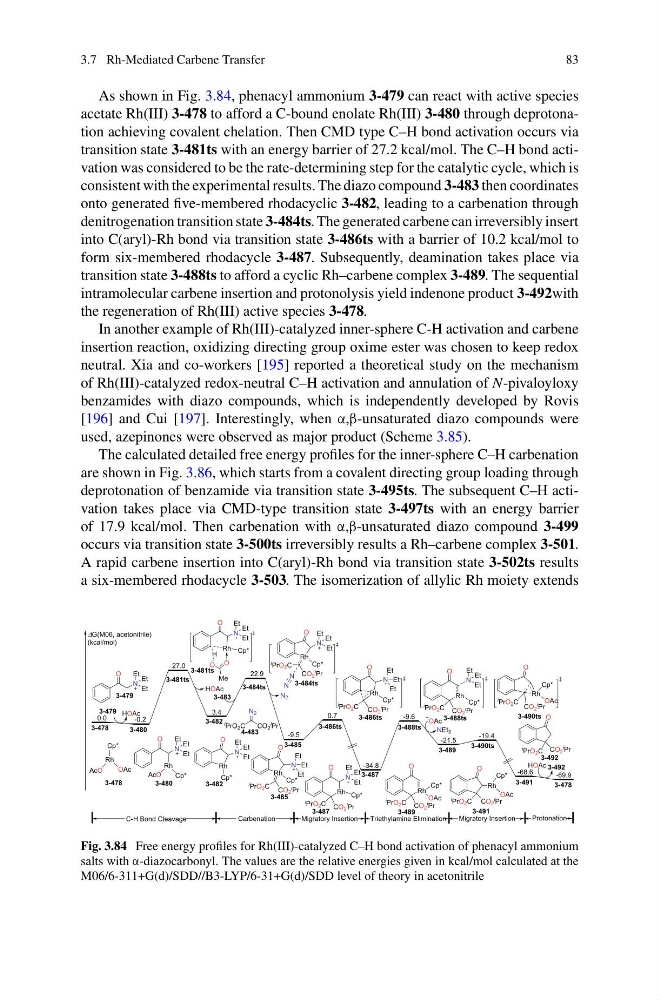
As shown in Fig. 3.84, phenacyl ammonium 3-479 can react with active species
acetate Rh(III) 3-478 to afford a C-bound enolate Rh(III) 3-480 through deprotonation achieving covalent chelation. Then CMD type C–H bond activation occurs via
transition state 3-481ts with an energy barrier of 27.2 kcal/mol. The C–H bond activation was considered to be the rate-determining step for the catalytic cycle, which is
consistent with the experimental results. The diazo compound 3-483 then coordinates
onto generated five-membered rhodacyclic 3-482, leading to a carbenation through
denitrogenation transition state 3-484ts. The generated carbene can irreversibly insert
into C(aryl)-Rh bond via transition state 3-486ts with a barrier of 10.2 kcal/mol to
form six-membered rhodacycle 3-487. Subsequently, deamination takes place via
transition state 3-488ts to afford a cyclic Rh–carbene complex 3-489. The sequential
intramolecular carbene insertion and protonolysis yield indenone product 3-492with
the regeneration of Rh(III) active species 3-478.
In another example of Rh(III)-catalyzed inner-sphere C-H activation and carbene
insertion reaction, oxidizing directing group oxime ester was chosen to keep redox
neutral. Xia and co-workers [195] reported a theoretical study on the mechanism
of Rh(III)-catalyzed redox-neutral C–H activation and annulation of N-pivaloyloxy
benzamides with diazo compounds, which is independently developed by Rovis
[196] and Cui [197]. Interestingly, when α,β-unsaturated diazo compounds were
used, azepinones were observed as major product (Scheme 3.85).
The calculated detailed free energy profiles for the inner-sphere C–H carbenation
are shown in Fig. 3.86, which starts from a covalent directing group loading through
deprotonation of benzamide via transition state 3-495ts. The subsequent C–H activation takes place via CMD-type transition state 3-497ts with an energy barrier
of 17.9 kcal/mol. Then carbenation with α,β-unsaturated diazo compound 3-499
occurs via transition state 3-500ts irreversibly results a Rh–carbene complex 3-501.
A rapid carbene insertion into C(aryl)-Rh bond via transition state 3-502ts results
a six-membered rhodacycle 3-503. The isomerization of allylic Rh moiety extends
3-478
0.0
(kcal/mol)
3-480
-0.2
3-481ts
27.0
3-482
3.4
Migratory Insertion
-9.5
3-487
-34.8
3-484ts
22.9
3-485
C-H Bond Cleavage
3-486ts
0.7
G(M06, acetonitrile)
HOAc
Triethylamine Elimination
3-488ts
-9.6
3-489
-21.5
3-479
3-490ts
-19.4
3-491
-68.6
3-478
-69.9
HOAc
HOAc 3-492
Carbenation
Protonation
N2
O
N Et
Et Et
O
N Et
Et Et
Rh
Cp*
AcO
O
N Et
Et Et
Rh
Cp*
Rh
Cp*
AcO
OAc
3-478
3-479
3-480
O
N Et
Et Et
Rh Cp*
O
H
O
Me
3-481ts
3-482
Rh
Cp*
i PrO2C
CO2
i Pr
N
N
O
N Et
Et Et
3-484ts
Rh
O
N
Et
Et
Et
Cp*
CO2
i Pr
i PrO2C
3-485
Rh
O
N
Et
Et
Et
Cp*
CO2
i
Pr
i PrO2C
O
Rh
i PrO2C CO2
i Pr
Cp*
OAc
O
N Et
Et Et
Rh
i PrO2C CO2
i Pr
Cp*
i PrO2C
CO2
i Pr
N2
3-483
4-483
3-486ts
3-488ts
3-490ts O
i PrO2C CO2
i Pr
O
N Et
Et Et
Rh
i PrO2C CO2
i Pr
Cp*
O
Rh
i PrO2C CO2
i Pr
Cp*
OAc
O
i PrO2C CO2
i Pr
Rh
Cp*
OAc
3-487
3-489
3-491
3-492
NEt3
OAc
Migratory Insertion
Fig. 3.84 Free energy profiles for Rh(III)-catalyzed C–H bond activation of phenacyl ammonium
salts with α-diazocarbonyl. The values are the relative energies given in kcal/mol calculated at the
M06/6-311+G(d)/SDD//B3-LYP/6-31+G(d)/SDD level of theory in acetonitrile
83
As shown in Fig. 3.84, phenacyl ammonium 3-479 can react with active species
acetate Rh(III) 3-478 to afford a C-bound enolate Rh(III) 3-480 through deprotonation achieving covalent chelation. Then CMD type C–H bond activation occurs via
transition state 3-481ts with an energy barrier of 27.2 kcal/mol. The C–H bond activation was considered to be the rate-determining step for the catalytic cycle, which is
consistent with the experimental results. The diazo compound 3-483 then coordinates
onto generated five-membered rhodacyclic 3-482, leading to a carbenation through
denitrogenation transition state 3-484ts. The generated carbene can irreversibly insert
into C(aryl)-Rh bond via transition state 3-486ts with a barrier of 10.2 kcal/mol to
form six-membered rhodacycle 3-487. Subsequently, deamination takes place via
transition state 3-488ts to afford a cyclic Rh–carbene complex 3-489. The sequential
intramolecular carbene insertion and protonolysis yield indenone product 3-492with
the regeneration of Rh(III) active species 3-478.
In another example of Rh(III)-catalyzed inner-sphere C-H activation and carbene
insertion reaction, oxidizing directing group oxime ester was chosen to keep redox
neutral. Xia and co-workers [195] reported a theoretical study on the mechanism
of Rh(III)-catalyzed redox-neutral C–H activation and annulation of N-pivaloyloxy
benzamides with diazo compounds, which is independently developed by Rovis
[196] and Cui [197]. Interestingly, when α,β-unsaturated diazo compounds were
used, azepinones were observed as major product (Scheme 3.85).
The calculated detailed free energy profiles for the inner-sphere C–H carbenation
are shown in Fig. 3.86, which starts from a covalent directing group loading through
deprotonation of benzamide via transition state 3-495ts. The subsequent C–H activation takes place via CMD-type transition state 3-497ts with an energy barrier
of 17.9 kcal/mol. Then carbenation with α,β-unsaturated diazo compound 3-499
occurs via transition state 3-500ts irreversibly results a Rh–carbene complex 3-501.
A rapid carbene insertion into C(aryl)-Rh bond via transition state 3-502ts results
a six-membered rhodacycle 3-503. The isomerization of allylic Rh moiety extends
3-478
0.0
(kcal/mol)
3-480
-0.2
3-481ts
27.0
3-482
3.4
Migratory Insertion
-9.5
3-487
-34.8
3-484ts
22.9
3-485
C-H Bond Cleavage
3-486ts
0.7
G(M06, acetonitrile)
HOAc
Triethylamine Elimination
3-488ts
-9.6
3-489
-21.5
3-479
3-490ts
-19.4
3-491
-68.6
3-478
-69.9
HOAc
HOAc 3-492
Carbenation
Protonation
N2
O
N Et
Et Et
O
N Et
Et Et
Rh
Cp*
AcO
O
N Et
Et Et
Rh
Cp*
Rh
Cp*
AcO
OAc
3-478
3-479
3-480
O
N Et
Et Et
Rh Cp*
O
H
O
Me
3-481ts
3-482
Rh
Cp*
i PrO2C
CO2
i Pr
N
N
O
N Et
Et Et
3-484ts
Rh
O
N
Et
Et
Et
Cp*
CO2
i Pr
i PrO2C
3-485
Rh
O
N
Et
Et
Et
Cp*
CO2
i
Pr
i PrO2C
O
Rh
i PrO2C CO2
i Pr
Cp*
OAc
O
N Et
Et Et
Rh
i PrO2C CO2
i Pr
Cp*
i PrO2C
CO2
i Pr
N2
3-483
4-483
3-486ts
3-488ts
3-490ts O
i PrO2C CO2
i Pr
O
N Et
Et Et
Rh
i PrO2C CO2
i Pr
Cp*
O
Rh
i PrO2C CO2
i Pr
Cp*
OAc
O
i PrO2C CO2
i Pr
Rh
Cp*
OAc
3-487
3-489
3-491
3-492
NEt3
OAc
Migratory Insertion
Fig. 3.84 Free energy profiles for Rh(III)-catalyzed C–H bond activation of phenacyl ammonium
salts with α-diazocarbonyl. The values are the relative energies given in kcal/mol calculated at the
M06/6-311+G(d)/SDD//B3-LYP/6-31+G(d)/SDD level of theory in acetonitrile