

82
3 Theoretical Study of Rh-Catalyzed …
3-470
0.0
(kcal/mol)
3-473
-9.7
3-474ts
0.6
3-475
-12.3
Nucleophilic Attack
E(M06,toluene)
3-472ts
6.0
3-471
O
O
H
O
Rh Rh
O
O
H
O
H
O
O
H
C
Ph
3-470
Proton Shift
3-477
-30.1
N
3-471
3-472ts
O
OMe
O
O
H
O
Rh Rh
O
O
H
O
H
O
O
H
C
Ph
O
OMe
N
H
3-473
O
O
H
O
Rh Rh
O
O
H
O
H
O
O
H
C
Ph
O
OMe
N
H
O
O
H
O
Rh Rh
O
O
H
O
H
O
O
H
C
Ph
O
OMe
N
H
3-474ts
O
O
H
O
Rh Rh
O
O
H
O
H
O
O
H
C
Ph
OH
OMe
N
3-475
O
O
H
O
Rh Rh
O
O
H
O
H
O
O
H
3-476
CH
N
Ph
O
MeO
3-477
3-476
Catalyst
Regeneration
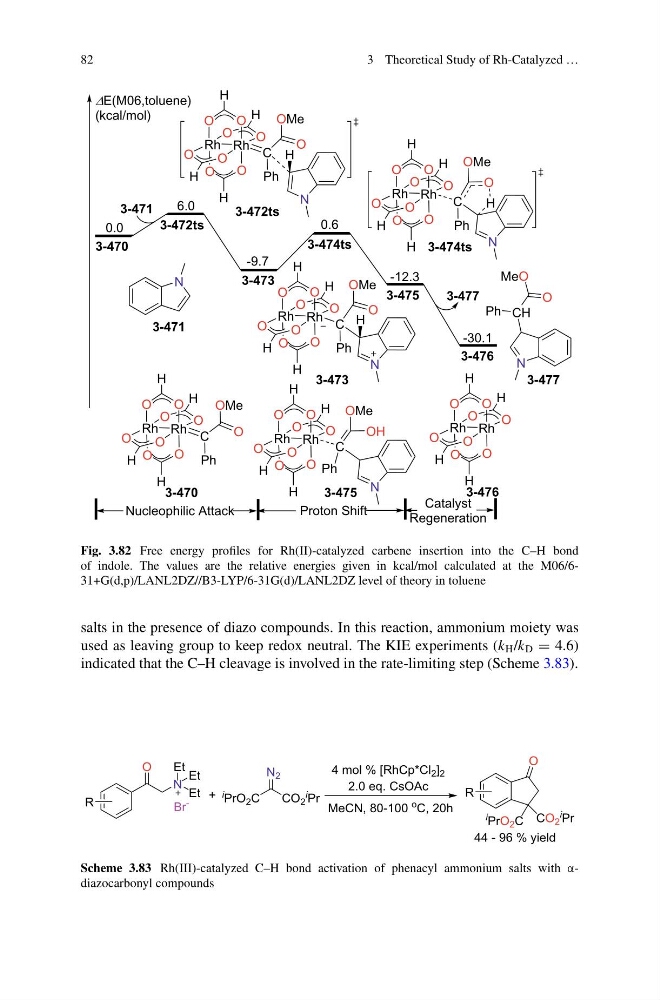
Fig. 3.82 Free energy profiles for Rh(II)-catalyzed carbene insertion into the C–H bond
of indole. The values are the relative energies given in kcal/mol calculated at the M06/631+G(d,p)/LANL2DZ//B3-LYP/6-31G(d)/LANL2DZ level of theory in toluene
salts in the presence of diazo compounds. In this reaction, ammonium moiety was
used as leaving group to keep redox neutral. The KIE experiments (k H /k D = 4.6)
indicated that the C–H cleavage is involved in the rate-limiting step (Scheme 3.83).
O
N
i PrO 2 C
CO 2
i Pr
N 2
MeCN, 80-100
o C, 20h
O
i
PrO 2 C CO 2
i Pr
Br
-
Et
Et Et
4 mol % [RhCp*Cl 2 ] 2
2.0 eq. CsOAc
R
+
R
44 - 96 % yield
Scheme 3.83 Rh(III)-catalyzed C–H bond activation of phenacyl ammonium salts with αdiazocarbonyl compounds
3 Theoretical Study of Rh-Catalyzed …
3-470
0.0
(kcal/mol)
3-473
-9.7
3-474ts
0.6
3-475
-12.3
Nucleophilic Attack
E(M06,toluene)
3-472ts
6.0
3-471
O
O
H
O
Rh Rh
O
O
H
O
H
O
O
H
C
Ph
3-470
Proton Shift
3-477
-30.1
N
3-471
3-472ts
O
OMe
O
O
H
O
Rh Rh
O
O
H
O
H
O
O
H
C
Ph
O
OMe
N
H
3-473
O
O
H
O
Rh Rh
O
O
H
O
H
O
O
H
C
Ph
O
OMe
N
H
O
O
H
O
Rh Rh
O
O
H
O
H
O
O
H
C
Ph
O
OMe
N
H
3-474ts
O
O
H
O
Rh Rh
O
O
H
O
H
O
O
H
C
Ph
OH
OMe
N
3-475
O
O
H
O
Rh Rh
O
O
H
O
H
O
O
H
3-476
CH
N
Ph
O
MeO
3-477
3-476
Catalyst
Regeneration
Fig. 3.82 Free energy profiles for Rh(II)-catalyzed carbene insertion into the C–H bond
of indole. The values are the relative energies given in kcal/mol calculated at the M06/631+G(d,p)/LANL2DZ//B3-LYP/6-31G(d)/LANL2DZ level of theory in toluene
salts in the presence of diazo compounds. In this reaction, ammonium moiety was
used as leaving group to keep redox neutral. The KIE experiments (k H /k D = 4.6)
indicated that the C–H cleavage is involved in the rate-limiting step (Scheme 3.83).
O
N
i PrO 2 C
CO 2
i Pr
N 2
MeCN, 80-100
o C, 20h
O
i
PrO 2 C CO 2
i Pr
Br
-
Et
Et Et
4 mol % [RhCp*Cl 2 ] 2
2.0 eq. CsOAc
R
+
R
44 - 96 % yield
Scheme 3.83 Rh(III)-catalyzed C–H bond activation of phenacyl ammonium salts with αdiazocarbonyl compounds