

3.7 Rh-Mediated Carbene Transfer
81
O
O
H
O
3-457
0.0
(kcal/mol)
3-460ts
-3.3
3-461
-3.1
Carbenation
-5.2
3-467
-5.4
3-468ts
3-457
-60.6
E(B3-LYP)
3-459
-19.9
3-458
Carbene Insertion
3-463
-3.3
2.6
3-464ts
3-457
-62.2
Rh Rh
O
O
H
O
H
O
O
H
3-457
N 2
H
H
O
O
H
O
Rh Rh
O
O
H
O
H
O
O
H
3-459
C
N
H
H
N
O
O
H
O
Rh Rh
O
O
H
O
H
O
O
H
3-460ts
C
N
H
H
N
N 2
O
O
H
O
Rh Rh
O
O
H
O
H
O
O
H
C
H
H
3-461
3-462
CH 3
H
3-462
3-466
3-465
CH(CH 3 ) 2
H
O
O
H
O
Rh Rh
O
O
H
O
H
O
O
H
C
H
H
3-463
CH 3
H
O
O
H
O
Rh Rh
O
O
H
O
H
O
O
H
C
H
H
CH 3
H
3-464ts
CH 3
H 3 C
3-465
CH(CH 3 ) 2
H 3 C
3-469
O
O
H
O
Rh Rh
O
O
H
O
H
O
O
H
C
H
H
3-467
CH(CH 3 ) 2
H
O
O
H
O
Rh Rh
O
O
H
O
H
O
O
H
C
H
H
CH(CH 3 ) 2
H
3-468ts
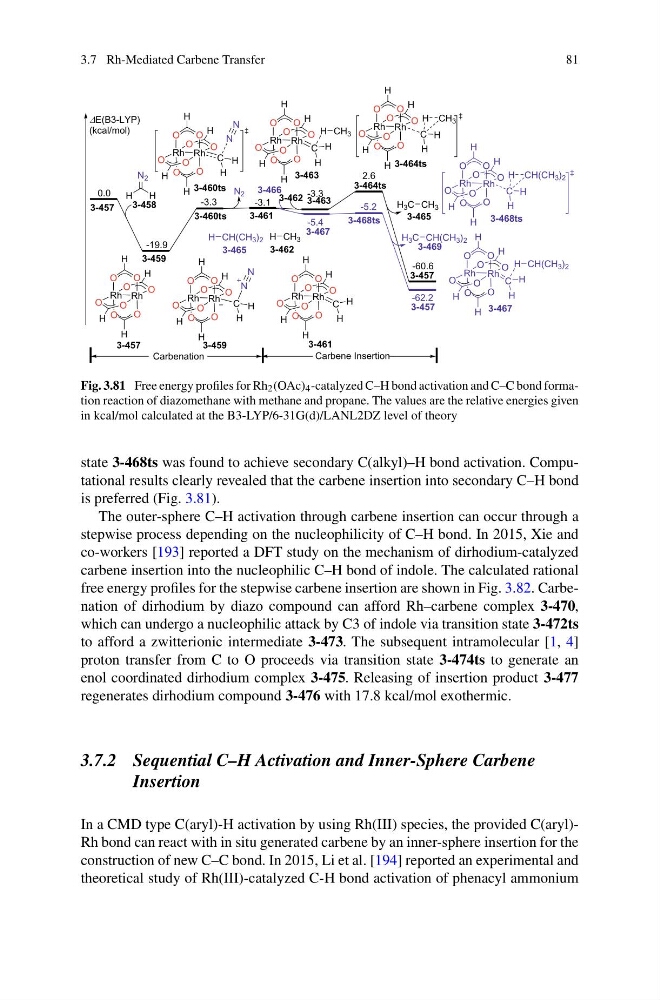
Fig. 3.81 Free energy profiles for Rh 2 (OAc) 4 -catalyzed C–H bond activation and C–C bond formation reaction of diazomethane with methane and propane. The values are the relative energies given
in kcal/mol calculated at the B3-LYP/6-31G(d)/LANL2DZ level of theory
state 3-468ts was found to achieve secondary C(alkyl)–H bond activation. Computational results clearly revealed that the carbene insertion into secondary C–H bond
is preferred (Fig. 3.81).
The outer-sphere C–H activation through carbene insertion can occur through a
stepwise process depending on the nucleophilicity of C–H bond. In 2015, Xie and
co-workers [193] reported a DFT study on the mechanism of dirhodium-catalyzed
carbene insertion into the nucleophilic C–H bond of indole. The calculated rational
free energy profiles for the stepwise carbene insertion are shown in Fig. 3.82. Carbenation of dirhodium by diazo compound can afford Rh–carbene complex 3-470,
which can undergo a nucleophilic attack by C3 of indole via transition state 3-472ts
to afford a zwitterionic intermediate 3-473. The subsequent intramolecular [1, 4]
proton transfer from C to O proceeds via transition state 3-474ts to generate an
enol coordinated dirhodium complex 3-475. Releasing of insertion product 3-477
regenerates dirhodium compound 3-476 with 17.8 kcal/mol exothermic.
3.7.2 Sequential C–H Activation and Inner-Sphere Carbene
Insertion
In a CMD type C(aryl)-H activation by using Rh(III) species, the provided C(aryl)Rh bond can react with in situ generated carbene by an inner-sphere insertion for the
construction of new C–C bond. In 2015, Li et al. [194] reported an experimental and
theoretical study of Rh(III)-catalyzed C-H bond activation of phenacyl ammonium
81
O
O
H
O
3-457
0.0
(kcal/mol)
3-460ts
-3.3
3-461
-3.1
Carbenation
-5.2
3-467
-5.4
3-468ts
3-457
-60.6
E(B3-LYP)
3-459
-19.9
3-458
Carbene Insertion
3-463
-3.3
2.6
3-464ts
3-457
-62.2
Rh Rh
O
O
H
O
H
O
O
H
3-457
N 2
H
H
O
O
H
O
Rh Rh
O
O
H
O
H
O
O
H
3-459
C
N
H
H
N
O
O
H
O
Rh Rh
O
O
H
O
H
O
O
H
3-460ts
C
N
H
H
N
N 2
O
O
H
O
Rh Rh
O
O
H
O
H
O
O
H
C
H
H
3-461
3-462
CH 3
H
3-462
3-466
3-465
CH(CH 3 ) 2
H
O
O
H
O
Rh Rh
O
O
H
O
H
O
O
H
C
H
H
3-463
CH 3
H
O
O
H
O
Rh Rh
O
O
H
O
H
O
O
H
C
H
H
CH 3
H
3-464ts
CH 3
H 3 C
3-465
CH(CH 3 ) 2
H 3 C
3-469
O
O
H
O
Rh Rh
O
O
H
O
H
O
O
H
C
H
H
3-467
CH(CH 3 ) 2
H
O
O
H
O
Rh Rh
O
O
H
O
H
O
O
H
C
H
H
CH(CH 3 ) 2
H
3-468ts
Fig. 3.81 Free energy profiles for Rh 2 (OAc) 4 -catalyzed C–H bond activation and C–C bond formation reaction of diazomethane with methane and propane. The values are the relative energies given
in kcal/mol calculated at the B3-LYP/6-31G(d)/LANL2DZ level of theory
state 3-468ts was found to achieve secondary C(alkyl)–H bond activation. Computational results clearly revealed that the carbene insertion into secondary C–H bond
is preferred (Fig. 3.81).
The outer-sphere C–H activation through carbene insertion can occur through a
stepwise process depending on the nucleophilicity of C–H bond. In 2015, Xie and
co-workers [193] reported a DFT study on the mechanism of dirhodium-catalyzed
carbene insertion into the nucleophilic C–H bond of indole. The calculated rational
free energy profiles for the stepwise carbene insertion are shown in Fig. 3.82. Carbenation of dirhodium by diazo compound can afford Rh–carbene complex 3-470,
which can undergo a nucleophilic attack by C3 of indole via transition state 3-472ts
to afford a zwitterionic intermediate 3-473. The subsequent intramolecular [1, 4]
proton transfer from C to O proceeds via transition state 3-474ts to generate an
enol coordinated dirhodium complex 3-475. Releasing of insertion product 3-477
regenerates dirhodium compound 3-476 with 17.8 kcal/mol exothermic.
3.7.2 Sequential C–H Activation and Inner-Sphere Carbene
Insertion
In a CMD type C(aryl)-H activation by using Rh(III) species, the provided C(aryl)Rh bond can react with in situ generated carbene by an inner-sphere insertion for the
construction of new C–C bond. In 2015, Li et al. [194] reported an experimental and
theoretical study of Rh(III)-catalyzed C-H bond activation of phenacyl ammonium