

80
3 Theoretical Study of Rh-Catalyzed …
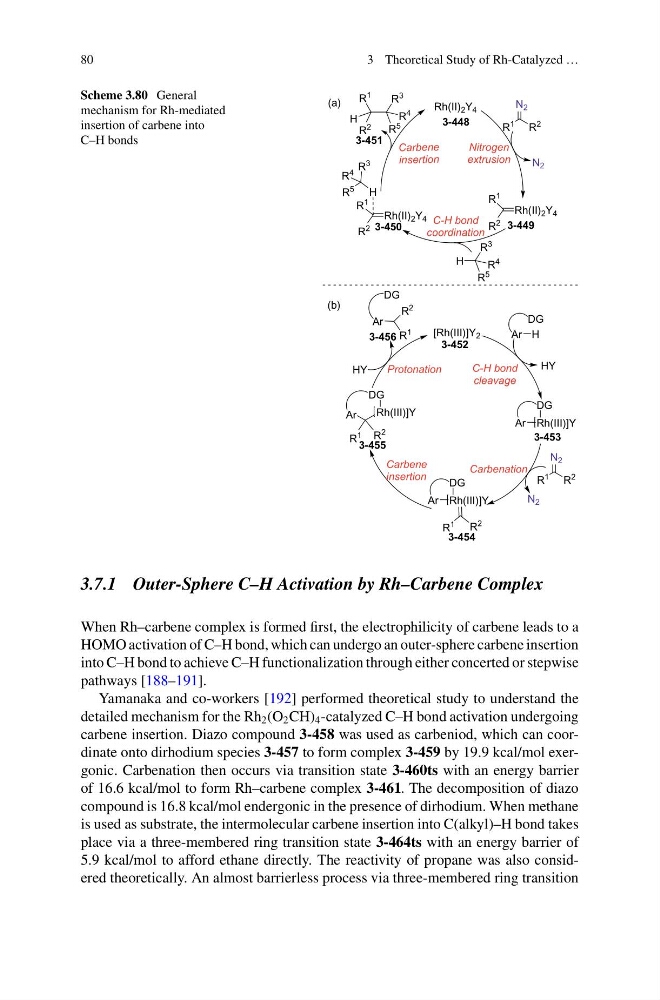
Scheme 3.80 General
mechanism for Rh-mediated
insertion of carbene into
C–H bonds
Carbene
insertion
Rh(II) 2 Y 4
3-448
Nitrogen
extrusion
N 2
R
2
R
1
N 2
Rh(II) 2 Y 4
R
2
R
1
3-449
H
R
3
R
5
R
4
R
4
R
5
R
3
H
Rh(II) 2 Y 4
R
2
R
1
C-H bond
coordination
R
3
R
5
R
4
R
2
R
1
H
(a)
(b)
Ar
DG
Rh(III)]Y
3-453
3-450
3-451
N 2
R
2
R
1
N 2
Carbenation
Ar
DG
Rh(III)]Y
R
2
R
1
3-454
[Rh(III)]Y 2
Ar H
DG
HY
Protonation
3-452
Carbene
insertion
C-H bond
cleavage
Ar
Rh(III)]Y
R
2
R
1
DG
3-455
HY
Ar
R
2
R
1
DG
3-456
3.7.1 Outer-Sphere C–H Activation by Rh–Carbene Complex
When Rh–carbene complex is formed first, the electrophilicity of carbene leads to a
HOMO activation of C–H bond, which can undergo an outer-sphere carbene insertion
into C–H bond to achieve C–H functionalization through either concerted or stepwise
pathways [188–191].
Yamanaka and co-workers [192] performed theoretical study to understand the
detailed mechanism for the Rh 2 (O 2 CH) 4 -catalyzed C–H bond activation undergoing
carbene insertion. Diazo compound 3-458 was used as carbeniod, which can coordinate onto dirhodium species 3-457 to form complex 3-459 by 19.9 kcal/mol exergonic. Carbenation then occurs via transition state 3-460ts with an energy barrier
of 16.6 kcal/mol to form Rh–carbene complex 3-461. The decomposition of diazo
compound is 16.8 kcal/mol endergonic in the presence of dirhodium. When methane
is used as substrate, the intermolecular carbene insertion into C(alkyl)–H bond takes
place via a three-membered ring transition state 3-464ts with an energy barrier of
5.9 kcal/mol to afford ethane directly. The reactivity of propane was also considered theoretically. An almost barrierless process via three-membered ring transition
3 Theoretical Study of Rh-Catalyzed …
Scheme 3.80 General
mechanism for Rh-mediated
insertion of carbene into
C–H bonds
Carbene
insertion
Rh(II) 2 Y 4
3-448
Nitrogen
extrusion
N 2
R
2
R
1
N 2
Rh(II) 2 Y 4
R
2
R
1
3-449
H
R
3
R
5
R
4
R
4
R
5
R
3
H
Rh(II) 2 Y 4
R
2
R
1
C-H bond
coordination
R
3
R
5
R
4
R
2
R
1
H
(a)
(b)
Ar
DG
Rh(III)]Y
3-453
3-450
3-451
N 2
R
2
R
1
N 2
Carbenation
Ar
DG
Rh(III)]Y
R
2
R
1
3-454
[Rh(III)]Y 2
Ar H
DG
HY
Protonation
3-452
Carbene
insertion
C-H bond
cleavage
Ar
Rh(III)]Y
R
2
R
1
DG
3-455
HY
Ar
R
2
R
1
DG
3-456
3.7.1 Outer-Sphere C–H Activation by Rh–Carbene Complex
When Rh–carbene complex is formed first, the electrophilicity of carbene leads to a
HOMO activation of C–H bond, which can undergo an outer-sphere carbene insertion
into C–H bond to achieve C–H functionalization through either concerted or stepwise
pathways [188–191].
Yamanaka and co-workers [192] performed theoretical study to understand the
detailed mechanism for the Rh 2 (O 2 CH) 4 -catalyzed C–H bond activation undergoing
carbene insertion. Diazo compound 3-458 was used as carbeniod, which can coordinate onto dirhodium species 3-457 to form complex 3-459 by 19.9 kcal/mol exergonic. Carbenation then occurs via transition state 3-460ts with an energy barrier
of 16.6 kcal/mol to form Rh–carbene complex 3-461. The decomposition of diazo
compound is 16.8 kcal/mol endergonic in the presence of dirhodium. When methane
is used as substrate, the intermolecular carbene insertion into C(alkyl)–H bond takes
place via a three-membered ring transition state 3-464ts with an energy barrier of
5.9 kcal/mol to afford ethane directly. The reactivity of propane was also considered theoretically. An almost barrierless process via three-membered ring transition