

3.6 Rh-Catalyzed C–H Bond Annulation
79
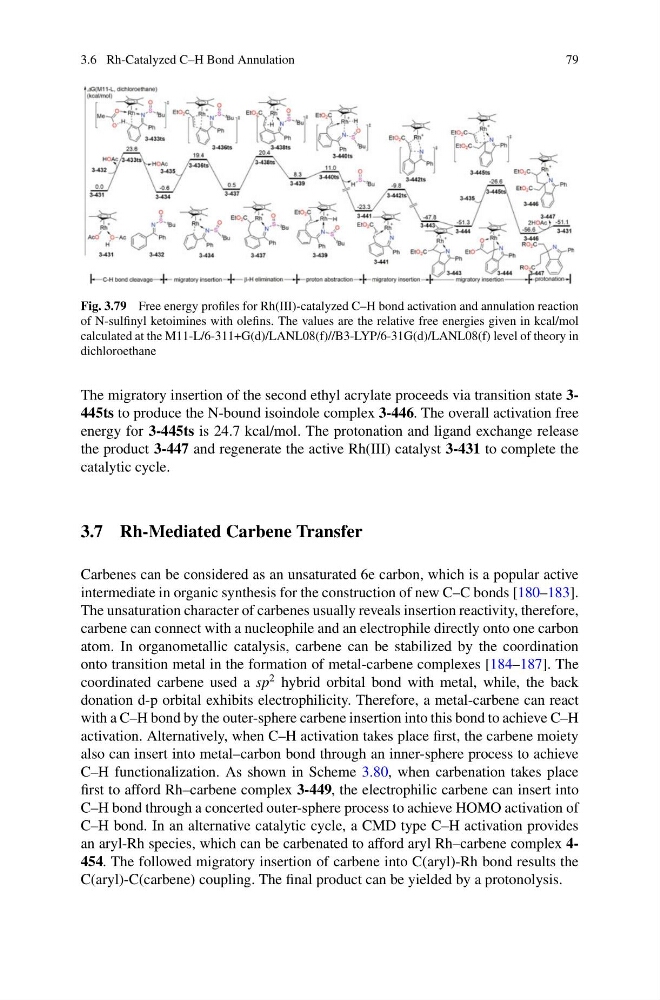
Fig. 3.79 Free energy profiles for Rh(III)-catalyzed C–H bond activation and annulation reaction
of N-sulfinyl ketoimines with olefins. The values are the relative free energies given in kcal/mol
calculated at the M11-L/6-311+G(d)/LANL08(f)//B3-LYP/6-31G(d)/LANL08(f) level of theory in
dichloroethane
The migratory insertion of the second ethyl acrylate proceeds via transition state 3445ts to produce the N-bound isoindole complex 3-446. The overall activation free
energy for 3-445ts is 24.7 kcal/mol. The protonation and ligand exchange release
the product 3-447 and regenerate the active Rh(III) catalyst 3-431 to complete the
catalytic cycle.
3.7 Rh-Mediated Carbene Transfer
Carbenes can be considered as an unsaturated 6e carbon, which is a popular active
intermediate in organic synthesis for the construction of new C–C bonds [180–183].
The unsaturation character of carbenes usually reveals insertion reactivity, therefore,
carbene can connect with a nucleophile and an electrophile directly onto one carbon
atom. In organometallic catalysis, carbene can be stabilized by the coordination
onto transition metal in the formation of metal-carbene complexes [184–187]. The
coordinated carbene used a sp
2 hybrid orbital bond with metal, while, the back
donation d-p orbital exhibits electrophilicity. Therefore, a metal-carbene can react
with a C–H bond by the outer-sphere carbene insertion into this bond to achieve C–H
activation. Alternatively, when C–H activation takes place first, the carbene moiety
also can insert into metal–carbon bond through an inner-sphere process to achieve
C–H functionalization. As shown in Scheme 3.80, when carbenation takes place
first to afford Rh–carbene complex 3-449, the electrophilic carbene can insert into
C–H bond through a concerted outer-sphere process to achieve HOMO activation of
C–H bond. In an alternative catalytic cycle, a CMD type C–H activation provides
an aryl-Rh species, which can be carbenated to afford aryl Rh–carbene complex 4454. The followed migratory insertion of carbene into C(aryl)-Rh bond results the
C(aryl)-C(carbene) coupling. The final product can be yielded by a protonolysis.
79
Fig. 3.79 Free energy profiles for Rh(III)-catalyzed C–H bond activation and annulation reaction
of N-sulfinyl ketoimines with olefins. The values are the relative free energies given in kcal/mol
calculated at the M11-L/6-311+G(d)/LANL08(f)//B3-LYP/6-31G(d)/LANL08(f) level of theory in
dichloroethane
The migratory insertion of the second ethyl acrylate proceeds via transition state 3445ts to produce the N-bound isoindole complex 3-446. The overall activation free
energy for 3-445ts is 24.7 kcal/mol. The protonation and ligand exchange release
the product 3-447 and regenerate the active Rh(III) catalyst 3-431 to complete the
catalytic cycle.
3.7 Rh-Mediated Carbene Transfer
Carbenes can be considered as an unsaturated 6e carbon, which is a popular active
intermediate in organic synthesis for the construction of new C–C bonds [180–183].
The unsaturation character of carbenes usually reveals insertion reactivity, therefore,
carbene can connect with a nucleophile and an electrophile directly onto one carbon
atom. In organometallic catalysis, carbene can be stabilized by the coordination
onto transition metal in the formation of metal-carbene complexes [184–187]. The
coordinated carbene used a sp
2 hybrid orbital bond with metal, while, the back
donation d-p orbital exhibits electrophilicity. Therefore, a metal-carbene can react
with a C–H bond by the outer-sphere carbene insertion into this bond to achieve C–H
activation. Alternatively, when C–H activation takes place first, the carbene moiety
also can insert into metal–carbon bond through an inner-sphere process to achieve
C–H functionalization. As shown in Scheme 3.80, when carbenation takes place
first to afford Rh–carbene complex 3-449, the electrophilic carbene can insert into
C–H bond through a concerted outer-sphere process to achieve HOMO activation of
C–H bond. In an alternative catalytic cycle, a CMD type C–H activation provides
an aryl-Rh species, which can be carbenated to afford aryl Rh–carbene complex 4454. The followed migratory insertion of carbene into C(aryl)-Rh bond results the
C(aryl)-C(carbene) coupling. The final product can be yielded by a protonolysis.