

78
3 Theoretical Study of Rh-Catalyzed …
3-417
0.0
(kcal/mol)
3-419ts
2.9
3-420
7.1
3-421ts
25.9
migratory insertion
3-424
-3.9
3-422
8.8
N-H bond cleavage
3-423ts
29.2
G(M06-D3, dichloroethane)
HOAc
reductive elimination
3-425
-9.4
10.1
3-418
oxidation addition
3-427
-7.3
3-429
-53.4
3-417
-69.3
HOAc
2HOAc
3-430
C-H bond cleavage
protonation
Ph
Ph
Rh
AcO
OAc
3-417
3-426ts
3-428ts
11.8
H
N
NHAc
3-418
3-419ts
Rh
OAc
HN
N
Ac
3-420
3-421ts
3-422
3-423ts
Rh
HN
N
Ac
Ph
Ph
3-424
3-425
3-426ts
3-427
3-428ts
Rh
N
H
O
Me
N
Ph
Ph
3-429
H
N
Ph
Ph
3-430
Rh
Ph
Ph
HN
N
Ac
Rh
HN
N
Ac
Rh OAc
HN
N
Ac
O
Me
O
H
Rh
HN
N
Ac
O
Me
O
H
Rh
N
H
O
Me
N
Ph
Ph
Rh
N
H
O
Me
N
Ph
Ph
Rh
N
N
Ph
Ph
H
O
Me
Rh
N
N
Ph
Ph
O
Me
H
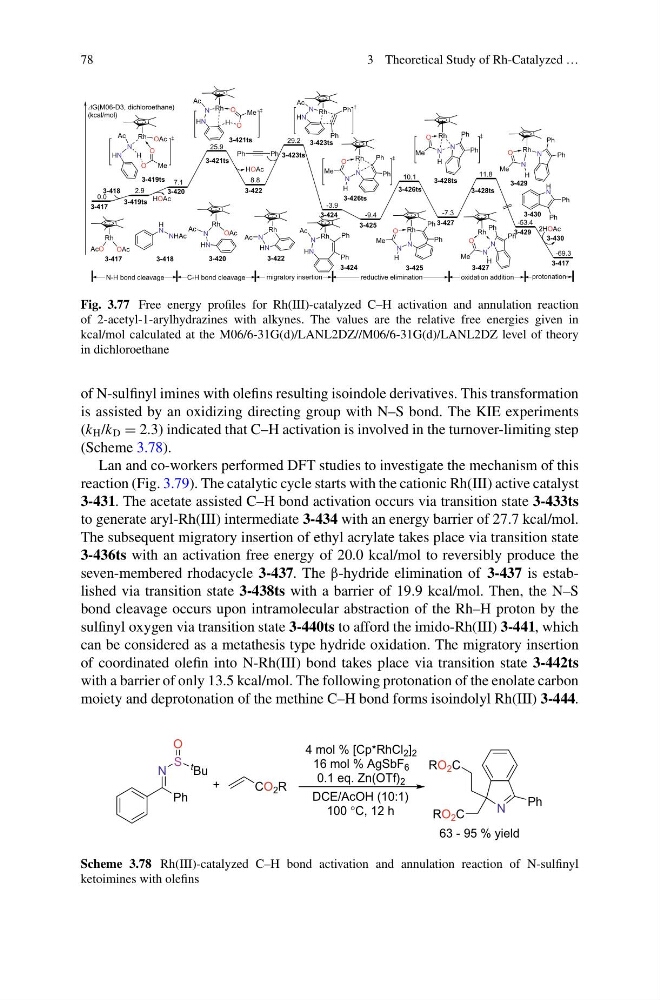
Fig. 3.77 Free energy profiles for Rh(III)-catalyzed C–H activation and annulation reaction
of 2-acetyl-1-arylhydrazines with alkynes. The values are the relative free energies given in
kcal/mol calculated at the M06/6-31G(d)/LANL2DZ//M06/6-31G(d)/LANL2DZ level of theory
in dichloroethane
of N-sulfinyl imines with olefins resulting isoindole derivatives. This transformation
is assisted by an oxidizing directing group with N–S bond. The KIE experiments
(k H /k D = 2.3) indicated that C–H activation is involved in the turnover-limiting step
(Scheme 3.78).
Lan and co-workers performed DFT studies to investigate the mechanism of this
reaction (Fig. 3.79). The catalytic cycle starts with the cationic Rh(III) active catalyst
3-431. The acetate assisted C–H bond activation occurs via transition state 3-433ts
to generate aryl-Rh(III) intermediate 3-434 with an energy barrier of 27.7 kcal/mol.
The subsequent migratory insertion of ethyl acrylate takes place via transition state
3-436ts with an activation free energy of 20.0 kcal/mol to reversibly produce the
seven-membered rhodacycle 3-437. The β-hydride elimination of 3-437 is established via transition state 3-438ts with a barrier of 19.9 kcal/mol. Then, the N–S
bond cleavage occurs upon intramolecular abstraction of the Rh–H proton by the
sulfinyl oxygen via transition state 3-440ts to afford the imido-Rh(III) 3-441, which
can be considered as a metathesis type hydride oxidation. The migratory insertion
of coordinated olefin into N-Rh(III) bond takes place via transition state 3-442ts
with a barrier of only 13.5 kcal/mol. The following protonation of the enolate carbon
moiety and deprotonation of the methine C–H bond forms isoindolyl Rh(III) 3-444.
4 mol % [Cp*RhCl 2 ] 2
16 mol % AgSbF 6
0.1 eq. Zn(OTf) 2
DCE/AcOH (10:1)
100 C, 12 h
63 - 95 % yield
+
Ph
N
S
O
t Bu
CO 2 R
N
Ph
RO 2 C
RO 2 C
Scheme 3.78 Rh(III)-catalyzed C–H bond activation and annulation reaction of N-sulfinyl
ketoimines with olefins
3 Theoretical Study of Rh-Catalyzed …
3-417
0.0
(kcal/mol)
3-419ts
2.9
3-420
7.1
3-421ts
25.9
migratory insertion
3-424
-3.9
3-422
8.8
N-H bond cleavage
3-423ts
29.2
G(M06-D3, dichloroethane)
HOAc
reductive elimination
3-425
-9.4
10.1
3-418
oxidation addition
3-427
-7.3
3-429
-53.4
3-417
-69.3
HOAc
2HOAc
3-430
C-H bond cleavage
protonation
Ph
Ph
Rh
AcO
OAc
3-417
3-426ts
3-428ts
11.8
H
N
NHAc
3-418
3-419ts
Rh
OAc
HN
N
Ac
3-420
3-421ts
3-422
3-423ts
Rh
HN
N
Ac
Ph
Ph
3-424
3-425
3-426ts
3-427
3-428ts
Rh
N
H
O
Me
N
Ph
Ph
3-429
H
N
Ph
Ph
3-430
Rh
Ph
Ph
HN
N
Ac
Rh
HN
N
Ac
Rh OAc
HN
N
Ac
O
Me
O
H
Rh
HN
N
Ac
O
Me
O
H
Rh
N
H
O
Me
N
Ph
Ph
Rh
N
H
O
Me
N
Ph
Ph
Rh
N
N
Ph
Ph
H
O
Me
Rh
N
N
Ph
Ph
O
Me
H
Fig. 3.77 Free energy profiles for Rh(III)-catalyzed C–H activation and annulation reaction
of 2-acetyl-1-arylhydrazines with alkynes. The values are the relative free energies given in
kcal/mol calculated at the M06/6-31G(d)/LANL2DZ//M06/6-31G(d)/LANL2DZ level of theory
in dichloroethane
of N-sulfinyl imines with olefins resulting isoindole derivatives. This transformation
is assisted by an oxidizing directing group with N–S bond. The KIE experiments
(k H /k D = 2.3) indicated that C–H activation is involved in the turnover-limiting step
(Scheme 3.78).
Lan and co-workers performed DFT studies to investigate the mechanism of this
reaction (Fig. 3.79). The catalytic cycle starts with the cationic Rh(III) active catalyst
3-431. The acetate assisted C–H bond activation occurs via transition state 3-433ts
to generate aryl-Rh(III) intermediate 3-434 with an energy barrier of 27.7 kcal/mol.
The subsequent migratory insertion of ethyl acrylate takes place via transition state
3-436ts with an activation free energy of 20.0 kcal/mol to reversibly produce the
seven-membered rhodacycle 3-437. The β-hydride elimination of 3-437 is established via transition state 3-438ts with a barrier of 19.9 kcal/mol. Then, the N–S
bond cleavage occurs upon intramolecular abstraction of the Rh–H proton by the
sulfinyl oxygen via transition state 3-440ts to afford the imido-Rh(III) 3-441, which
can be considered as a metathesis type hydride oxidation. The migratory insertion
of coordinated olefin into N-Rh(III) bond takes place via transition state 3-442ts
with a barrier of only 13.5 kcal/mol. The following protonation of the enolate carbon
moiety and deprotonation of the methine C–H bond forms isoindolyl Rh(III) 3-444.
4 mol % [Cp*RhCl 2 ] 2
16 mol % AgSbF 6
0.1 eq. Zn(OTf) 2
DCE/AcOH (10:1)
100 C, 12 h
63 - 95 % yield
+
Ph
N
S
O
t Bu
CO 2 R
N
Ph
RO 2 C
RO 2 C
Scheme 3.78 Rh(III)-catalyzed C–H bond activation and annulation reaction of N-sulfinyl
ketoimines with olefins