

3.6 Rh-Catalyzed C–H Bond Annulation
77
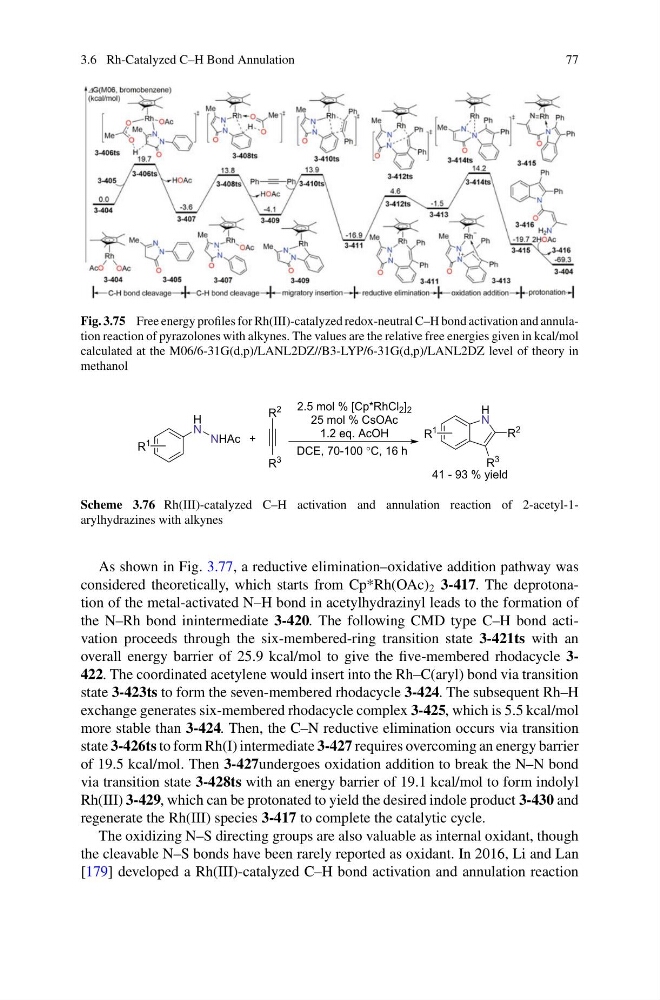
Fig. 3.75 Free energy profiles for Rh(III)-catalyzed redox-neutral C–H bond activation and annulation reaction of pyrazolones with alkynes. The values are the relative free energies given in kcal/mol
calculated at the M06/6-31G(d,p)/LANL2DZ//B3-LYP/6-31G(d,p)/LANL2DZ level of theory in
methanol
2.5 mol % [Cp*RhCl 2 ] 2
25 mol % CsOAc
1.2 eq. AcOH
DCE, 70-100 C, 16 h
41 - 93 % yield
+
R
2
R
3
H
N
NHAc
R
1
R
1
H
N
R
2
R
3
Scheme 3.76 Rh(III)-catalyzed C–H activation and annulation reaction of 2-acetyl-1arylhydrazines with alkynes
As shown in Fig. 3.77, a reductive elimination–oxidative addition pathway was
considered theoretically, which starts from Cp*Rh(OAc) 2 3-417. The deprotonation of the metal-activated N–H bond in acetylhydrazinyl leads to the formation of
the N–Rh bond inintermediate 3-420. The following CMD type C–H bond activation proceeds through the six-membered-ring transition state 3-421ts with an
overall energy barrier of 25.9 kcal/mol to give the five-membered rhodacycle 3422. The coordinated acetylene would insert into the Rh–C(aryl) bond via transition
state 3-423ts to form the seven-membered rhodacycle 3-424. The subsequent Rh–H
exchange generates six-membered rhodacycle complex 3-425, which is 5.5 kcal/mol
more stable than 3-424. Then, the C–N reductive elimination occurs via transition
state 3-426ts to form Rh(I) intermediate 3-427 requires overcoming an energy barrier
of 19.5 kcal/mol. Then 3-427undergoes oxidation addition to break the N–N bond
via transition state 3-428ts with an energy barrier of 19.1 kcal/mol to form indolyl
Rh(III) 3-429, which can be protonated to yield the desired indole product 3-430 and
regenerate the Rh(III) species 3-417 to complete the catalytic cycle.
The oxidizing N–S directing groups are also valuable as internal oxidant, though
the cleavable N–S bonds have been rarely reported as oxidant. In 2016, Li and Lan
[179] developed a Rh(III)-catalyzed C–H bond activation and annulation reaction
77
Fig. 3.75 Free energy profiles for Rh(III)-catalyzed redox-neutral C–H bond activation and annulation reaction of pyrazolones with alkynes. The values are the relative free energies given in kcal/mol
calculated at the M06/6-31G(d,p)/LANL2DZ//B3-LYP/6-31G(d,p)/LANL2DZ level of theory in
methanol
2.5 mol % [Cp*RhCl 2 ] 2
25 mol % CsOAc
1.2 eq. AcOH
DCE, 70-100 C, 16 h
41 - 93 % yield
+
R
2
R
3
H
N
NHAc
R
1
R
1
H
N
R
2
R
3
Scheme 3.76 Rh(III)-catalyzed C–H activation and annulation reaction of 2-acetyl-1arylhydrazines with alkynes
As shown in Fig. 3.77, a reductive elimination–oxidative addition pathway was
considered theoretically, which starts from Cp*Rh(OAc) 2 3-417. The deprotonation of the metal-activated N–H bond in acetylhydrazinyl leads to the formation of
the N–Rh bond inintermediate 3-420. The following CMD type C–H bond activation proceeds through the six-membered-ring transition state 3-421ts with an
overall energy barrier of 25.9 kcal/mol to give the five-membered rhodacycle 3422. The coordinated acetylene would insert into the Rh–C(aryl) bond via transition
state 3-423ts to form the seven-membered rhodacycle 3-424. The subsequent Rh–H
exchange generates six-membered rhodacycle complex 3-425, which is 5.5 kcal/mol
more stable than 3-424. Then, the C–N reductive elimination occurs via transition
state 3-426ts to form Rh(I) intermediate 3-427 requires overcoming an energy barrier
of 19.5 kcal/mol. Then 3-427undergoes oxidation addition to break the N–N bond
via transition state 3-428ts with an energy barrier of 19.1 kcal/mol to form indolyl
Rh(III) 3-429, which can be protonated to yield the desired indole product 3-430 and
regenerate the Rh(III) species 3-417 to complete the catalytic cycle.
The oxidizing N–S directing groups are also valuable as internal oxidant, though
the cleavable N–S bonds have been rarely reported as oxidant. In 2016, Li and Lan
[179] developed a Rh(III)-catalyzed C–H bond activation and annulation reaction