

References
85
2.5 mol % [Cp*RhCl 2 ] 2
50 mol % CsOAc
0.5 eq. AcOH
DCE, 60 C, 6 h
50 - 85 % yield
+
R
1
N
O
R
2
R
2
N 2
R
3 O 2 C
CO 2 R
3
R
1
N
R
2
R
2
CO 2 R
3
CO 2 R
3
Scheme 3.87 Rh(III)-catalyzed redox-neutral annulation of 1-naphthylamine N-oxides with diazo
compounds
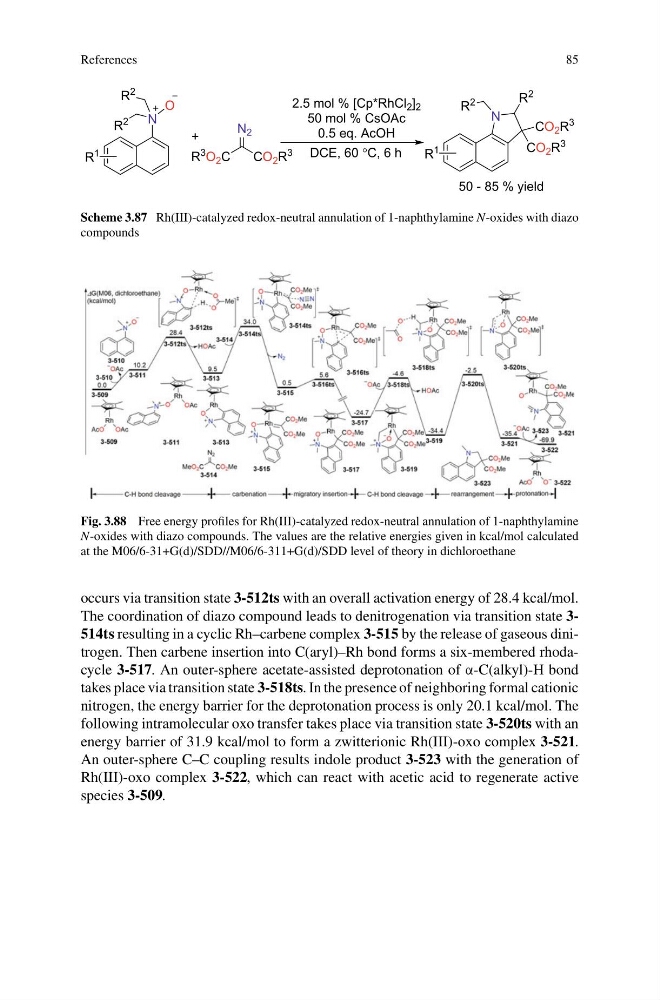
Fig. 3.88 Free energy profiles for Rh(III)-catalyzed redox-neutral annulation of 1-naphthylamine
N-oxides with diazo compounds. The values are the relative energies given in kcal/mol calculated
at the M06/6-31+G(d)/SDD//M06/6-311+G(d)/SDD level of theory in dichloroethane
occurs via transition state 3-512ts with an overall activation energy of 28.4 kcal/mol.
The coordination of diazo compound leads to denitrogenation via transition state 3514ts resulting in a cyclic Rh–carbene complex 3-515 by the release of gaseous dinitrogen. Then carbene insertion into C(aryl)–Rh bond forms a six-membered rhodacycle 3-517. An outer-sphere acetate-assisted deprotonation of α-C(alkyl)-H bond
takes place via transition state 3-518ts. In the presence of neighboring formal cationic
nitrogen, the energy barrier for the deprotonation process is only 20.1 kcal/mol. The
following intramolecular oxo transfer takes place via transition state 3-520ts with an
energy barrier of 31.9 kcal/mol to form a zwitterionic Rh(III)-oxo complex 3-521.
An outer-sphere C–C coupling results indole product 3-523 with the generation of
Rh(III)-oxo complex 3-522, which can react with acetic acid to regenerate active
species 3-509.
85
2.5 mol % [Cp*RhCl 2 ] 2
50 mol % CsOAc
0.5 eq. AcOH
DCE, 60 C, 6 h
50 - 85 % yield
+
R
1
N
O
R
2
R
2
N 2
R
3 O 2 C
CO 2 R
3
R
1
N
R
2
R
2
CO 2 R
3
CO 2 R
3
Scheme 3.87 Rh(III)-catalyzed redox-neutral annulation of 1-naphthylamine N-oxides with diazo
compounds
Fig. 3.88 Free energy profiles for Rh(III)-catalyzed redox-neutral annulation of 1-naphthylamine
N-oxides with diazo compounds. The values are the relative energies given in kcal/mol calculated
at the M06/6-31+G(d)/SDD//M06/6-311+G(d)/SDD level of theory in dichloroethane
occurs via transition state 3-512ts with an overall activation energy of 28.4 kcal/mol.
The coordination of diazo compound leads to denitrogenation via transition state 3514ts resulting in a cyclic Rh–carbene complex 3-515 by the release of gaseous dinitrogen. Then carbene insertion into C(aryl)–Rh bond forms a six-membered rhodacycle 3-517. An outer-sphere acetate-assisted deprotonation of α-C(alkyl)-H bond
takes place via transition state 3-518ts. In the presence of neighboring formal cationic
nitrogen, the energy barrier for the deprotonation process is only 20.1 kcal/mol. The
following intramolecular oxo transfer takes place via transition state 3-520ts with an
energy barrier of 31.9 kcal/mol to form a zwitterionic Rh(III)-oxo complex 3-521.
An outer-sphere C–C coupling results indole product 3-523 with the generation of
Rh(III)-oxo complex 3-522, which can react with acetic acid to regenerate active
species 3-509.