

74
3 Theoretical Study of Rh-Catalyzed …
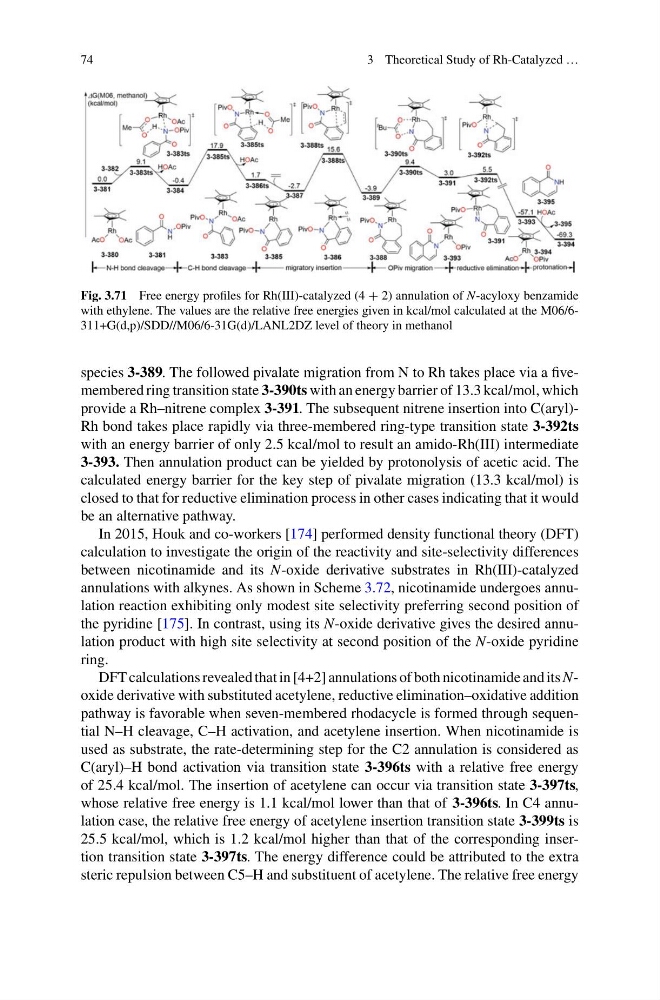
Fig. 3.71 Free energy profiles for Rh(III)-catalyzed (4 + 2) annulation of N-acyloxy benzamide
with ethylene. The values are the relative free energies given in kcal/mol calculated at the M06/6311+G(d,p)/SDD//M06/6-31G(d)/LANL2DZ level of theory in methanol
species 3-389. The followed pivalate migration from N to Rh takes place via a fivemembered ring transition state 3-390ts with an energy barrier of 13.3 kcal/mol, which
provide a Rh–nitrene complex 3-391. The subsequent nitrene insertion into C(aryl)Rh bond takes place rapidly via three-membered ring-type transition state 3-392ts
with an energy barrier of only 2.5 kcal/mol to result an amido-Rh(III) intermediate
3-393. Then annulation product can be yielded by protonolysis of acetic acid. The
calculated energy barrier for the key step of pivalate migration (13.3 kcal/mol) is
closed to that for reductive elimination process in other cases indicating that it would
be an alternative pathway.
In 2015, Houk and co-workers [174] performed density functional theory (DFT)
calculation to investigate the origin of the reactivity and site-selectivity differences
between nicotinamide and its N-oxide derivative substrates in Rh(III)-catalyzed
annulations with alkynes. As shown in Scheme 3.72, nicotinamide undergoes annulation reaction exhibiting only modest site selectivity preferring second position of
the pyridine [175]. In contrast, using its N-oxide derivative gives the desired annulation product with high site selectivity at second position of the N-oxide pyridine
ring.
DFT calculations revealed that in [4+2] annulations of both nicotinamide and its Noxide derivative with substituted acetylene, reductive elimination–oxidative addition
pathway is favorable when seven-membered rhodacycle is formed through sequential N–H cleavage, C–H activation, and acetylene insertion. When nicotinamide is
used as substrate, the rate-determining step for the C2 annulation is considered as
C(aryl)–H bond activation via transition state 3-396ts with a relative free energy
of 25.4 kcal/mol. The insertion of acetylene can occur via transition state 3-397ts,
whose relative free energy is 1.1 kcal/mol lower than that of 3-396ts. In C4 annulation case, the relative free energy of acetylene insertion transition state 3-399ts is
25.5 kcal/mol, which is 1.2 kcal/mol higher than that of the corresponding insertion transition state 3-397ts. The energy difference could be attributed to the extra
steric repulsion between C5–H and substituent of acetylene. The relative free energy
3 Theoretical Study of Rh-Catalyzed …
Fig. 3.71 Free energy profiles for Rh(III)-catalyzed (4 + 2) annulation of N-acyloxy benzamide
with ethylene. The values are the relative free energies given in kcal/mol calculated at the M06/6311+G(d,p)/SDD//M06/6-31G(d)/LANL2DZ level of theory in methanol
species 3-389. The followed pivalate migration from N to Rh takes place via a fivemembered ring transition state 3-390ts with an energy barrier of 13.3 kcal/mol, which
provide a Rh–nitrene complex 3-391. The subsequent nitrene insertion into C(aryl)Rh bond takes place rapidly via three-membered ring-type transition state 3-392ts
with an energy barrier of only 2.5 kcal/mol to result an amido-Rh(III) intermediate
3-393. Then annulation product can be yielded by protonolysis of acetic acid. The
calculated energy barrier for the key step of pivalate migration (13.3 kcal/mol) is
closed to that for reductive elimination process in other cases indicating that it would
be an alternative pathway.
In 2015, Houk and co-workers [174] performed density functional theory (DFT)
calculation to investigate the origin of the reactivity and site-selectivity differences
between nicotinamide and its N-oxide derivative substrates in Rh(III)-catalyzed
annulations with alkynes. As shown in Scheme 3.72, nicotinamide undergoes annulation reaction exhibiting only modest site selectivity preferring second position of
the pyridine [175]. In contrast, using its N-oxide derivative gives the desired annulation product with high site selectivity at second position of the N-oxide pyridine
ring.
DFT calculations revealed that in [4+2] annulations of both nicotinamide and its Noxide derivative with substituted acetylene, reductive elimination–oxidative addition
pathway is favorable when seven-membered rhodacycle is formed through sequential N–H cleavage, C–H activation, and acetylene insertion. When nicotinamide is
used as substrate, the rate-determining step for the C2 annulation is considered as
C(aryl)–H bond activation via transition state 3-396ts with a relative free energy
of 25.4 kcal/mol. The insertion of acetylene can occur via transition state 3-397ts,
whose relative free energy is 1.1 kcal/mol lower than that of 3-396ts. In C4 annulation case, the relative free energy of acetylene insertion transition state 3-399ts is
25.5 kcal/mol, which is 1.2 kcal/mol higher than that of the corresponding insertion transition state 3-397ts. The energy difference could be attributed to the extra
steric repulsion between C5–H and substituent of acetylene. The relative free energy