

3.6 Rh-Catalyzed C–H Bond Annulation
73
2.5 mol % [Cp*RhCl 2 ] 2
2 eq. CsOAc
MeOH, 60 C, 16 h
52 - 98 % yield
+
N
H
O
OPiv
R
1
R
2
R
3
R
1
NH
O
R
2
R
3
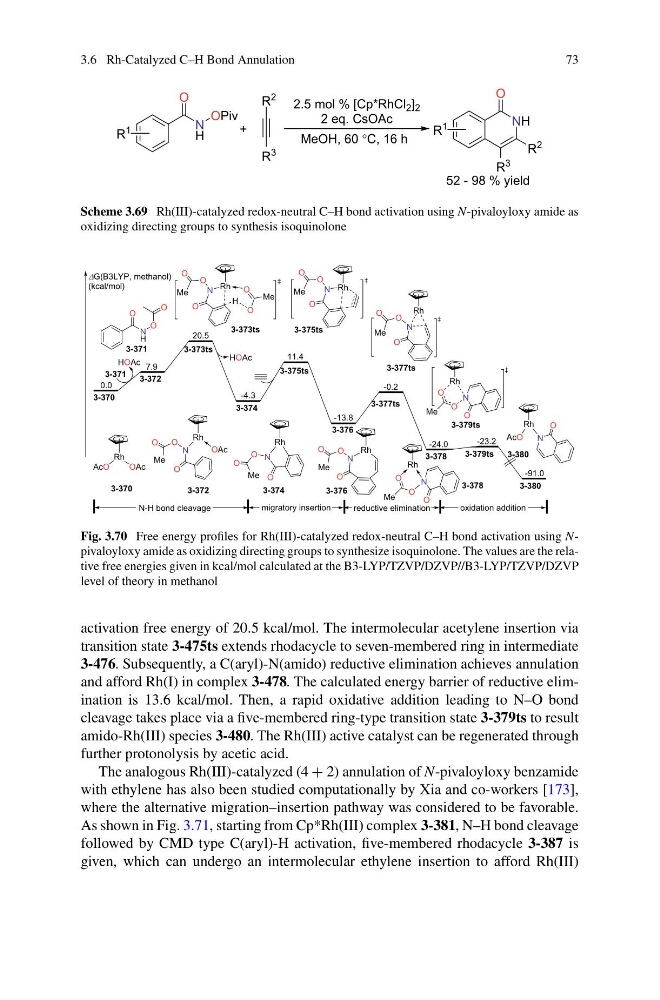
Scheme 3.69 Rh(III)-catalyzed redox-neutral C–H bond activation using N-pivaloyloxy amide as
oxidizing directing groups to synthesis isoquinolone
3-370
0.0
(kcal/mol)
3-373ts
20.5
3-374
-4.3
migratory insertion
-13.8
3-378
-24.0
3-375ts
11.4
3-376
N-H bond cleavage
3-377ts
-0.2
G(B3LYP, methanol)
HOAc
reductive elimination
3-372
7.9
3-379ts
-23.2
3-380
-91.0
3-370
HOAc
3-371
N
H
O
O
O
3-371
3-372
3-373ts
3-374
3-375ts
3-376
3-377ts
3-378
3-379ts
3-380
oxidation addition
Rh
AcO
OAc
N
O
O
Me
O
Rh O
Me
O
H
N
O
O
Me
O
Rh
OAc
N
O
O
Me
O
Rh
N
O
O
Me
O
Rh
N
O
O
Me
O
Rh
N
O
O
Me
O
Rh
N
O
O
Me
O
Rh
N
O
O
Me
O
Rh
N
O
AcO
Rh
Fig. 3.70 Free energy profiles for Rh(III)-catalyzed redox-neutral C–H bond activation using Npivaloyloxy amide as oxidizing directing groups to synthesize isoquinolone. The values are the relative free energies given in kcal/mol calculated at the B3-LYP/TZVP/DZVP//B3-LYP/TZVP/DZVP
level of theory in methanol
activation free energy of 20.5 kcal/mol. The intermolecular acetylene insertion via
transition state 3-475ts extends rhodacycle to seven-membered ring in intermediate
3-476. Subsequently, a C(aryl)-N(amido) reductive elimination achieves annulation
and afford Rh(I) in complex 3-478. The calculated energy barrier of reductive elimination is 13.6 kcal/mol. Then, a rapid oxidative addition leading to N–O bond
cleavage takes place via a five-membered ring-type transition state 3-379ts to result
amido-Rh(III) species 3-480. The Rh(III) active catalyst can be regenerated through
further protonolysis by acetic acid.
The analogous Rh(III)-catalyzed (4 + 2) annulation of N-pivaloyloxy benzamide
with ethylene has also been studied computationally by Xia and co-workers [173],
where the alternative migration–insertion pathway was considered to be favorable.
As shown in Fig. 3.71, starting from Cp*Rh(III) complex 3-381, N–H bond cleavage
followed by CMD type C(aryl)-H activation, five-membered rhodacycle 3-387 is
given, which can undergo an intermolecular ethylene insertion to afford Rh(III)
73
2.5 mol % [Cp*RhCl 2 ] 2
2 eq. CsOAc
MeOH, 60 C, 16 h
52 - 98 % yield
+
N
H
O
OPiv
R
1
R
2
R
3
R
1
NH
O
R
2
R
3
Scheme 3.69 Rh(III)-catalyzed redox-neutral C–H bond activation using N-pivaloyloxy amide as
oxidizing directing groups to synthesis isoquinolone
3-370
0.0
(kcal/mol)
3-373ts
20.5
3-374
-4.3
migratory insertion
-13.8
3-378
-24.0
3-375ts
11.4
3-376
N-H bond cleavage
3-377ts
-0.2
G(B3LYP, methanol)
HOAc
reductive elimination
3-372
7.9
3-379ts
-23.2
3-380
-91.0
3-370
HOAc
3-371
N
H
O
O
O
3-371
3-372
3-373ts
3-374
3-375ts
3-376
3-377ts
3-378
3-379ts
3-380
oxidation addition
Rh
AcO
OAc
N
O
O
Me
O
Rh O
Me
O
H
N
O
O
Me
O
Rh
OAc
N
O
O
Me
O
Rh
N
O
O
Me
O
Rh
N
O
O
Me
O
Rh
N
O
O
Me
O
Rh
N
O
O
Me
O
Rh
N
O
O
Me
O
Rh
N
O
AcO
Rh
Fig. 3.70 Free energy profiles for Rh(III)-catalyzed redox-neutral C–H bond activation using Npivaloyloxy amide as oxidizing directing groups to synthesize isoquinolone. The values are the relative free energies given in kcal/mol calculated at the B3-LYP/TZVP/DZVP//B3-LYP/TZVP/DZVP
level of theory in methanol
activation free energy of 20.5 kcal/mol. The intermolecular acetylene insertion via
transition state 3-475ts extends rhodacycle to seven-membered ring in intermediate
3-476. Subsequently, a C(aryl)-N(amido) reductive elimination achieves annulation
and afford Rh(I) in complex 3-478. The calculated energy barrier of reductive elimination is 13.6 kcal/mol. Then, a rapid oxidative addition leading to N–O bond
cleavage takes place via a five-membered ring-type transition state 3-379ts to result
amido-Rh(III) species 3-480. The Rh(III) active catalyst can be regenerated through
further protonolysis by acetic acid.
The analogous Rh(III)-catalyzed (4 + 2) annulation of N-pivaloyloxy benzamide
with ethylene has also been studied computationally by Xia and co-workers [173],
where the alternative migration–insertion pathway was considered to be favorable.
As shown in Fig. 3.71, starting from Cp*Rh(III) complex 3-381, N–H bond cleavage
followed by CMD type C(aryl)-H activation, five-membered rhodacycle 3-387 is
given, which can undergo an intermolecular ethylene insertion to afford Rh(III)